





- BRNN
- BRI News
- BRNN News
- Database
Official Documents Polices and Regulations
Inter-government Documents International Cooperation BRI Countries
Business Guide Economic Data BRI Data
Trade
Investment Projects Latest projects
Cases - Content Pool

Photo shows the Beijing library under the night sky. (Photo/Fan Jiashan)
"Mr. Lu Xun, could you recommend one of your classic works?"
"If I were to suggest one, perhaps Call to Arms would be a good starting point…"
This conversation took place at the Metaverse Experience Hall of the Beijing Library. Supported by artificial intelligence (AI) and other emerging technologies, the hall offers visitors a novel approach to immersive reading and knowledge-based social engagement.
As one of three institutions under the Capital Library of China, the Beijing Library has introduced an AI-powered digital human modeled after renowned Chinese writer Lu Xun. Historically, Lu Xun played a role in establishing the predecessor of the Capital Library of China. Today, his digital incarnation symbolizes the library's digital transformation.
"We developed the digital Lu Xun using AI technologies to provide guided tours, recommend books, and introduce local cuisine and cultural sites," explained Fei Jun, professor with the School of Design, the Central Academy of Fine Arts, and creative director of the Metaverse Experience Hall. His team conducted in-depth research on Lu Xun's life and works to create a realistic and multidimensional digital persona.
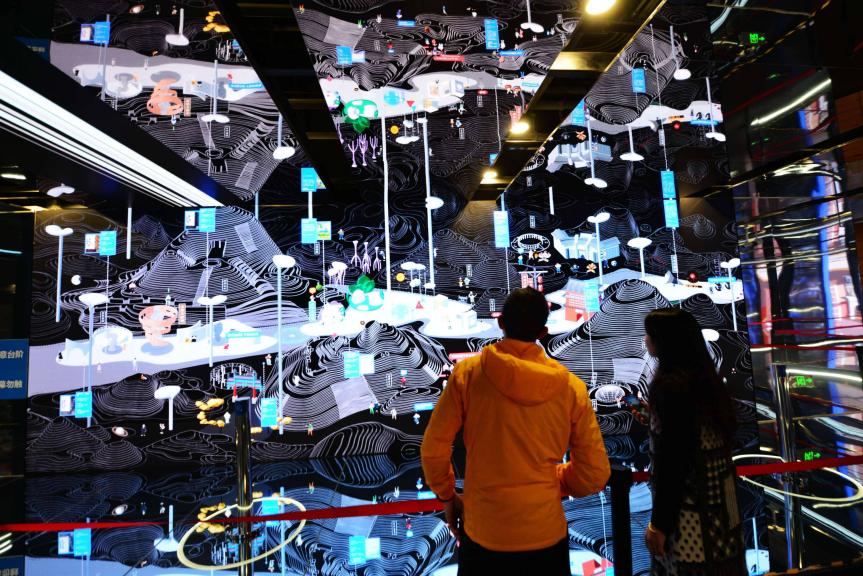
Readers visit the Metaverse Experience Hall of the Beijing Library. (Photo/Fan Jiashan)
In addition to the digital Lu Xun, Fei's team created two other digital characters, "Tutu" and "2122," each with distinct personalities: one childlike and the other futuristic. These avatars, driven by large language models, engage visitors in conversations about literature and everyday life. Since the library opened at the end of 2023, these AI characters have participated in more than 1.7 million voice interactions.
Seven-year-old reader Wang Jiayi eagerly asked "2122" questions such as, "Why did dinosaurs go extinct?" and "Why do maple leaves turn red in autumn?" Her mother commented, "The digital humans are engaging and informative. They genuinely spark children's interest in learning."
Entering the library feels akin to stepping into a digital universe.
Visitors can scan a QR code to verify their identity, customize their attire, and quickly generate digital avatars within the Metaverse. These avatars can navigate virtual spaces such as the Children's Library, Ancient Books Collection, Art Literature Library, and Intangible Cultural Heritage Library, exploring venue information and upcoming events.
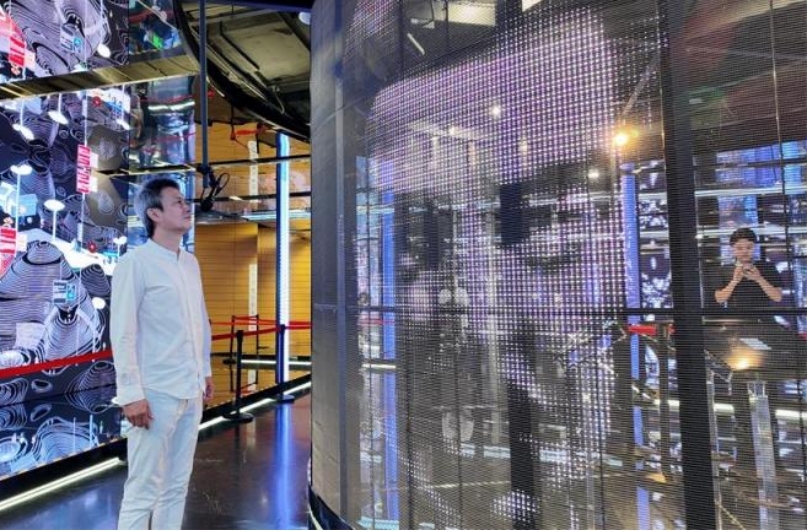
A reader interacts with the digital Lu Xun at the Metaverse Experience Hall of the Beijing Library. (Photo from Beijing Youth Daily)
Readers also interact with one another via their digital avatars, sharing reading lists, exchanging book reviews, and bridging online and offline reading experiences.
Looking ahead, the library plans to introduce additional immersive features, including personalized virtual study rooms. "Our goal is to offer a multisensory experience -- visual, auditory, and even tactile -- so users feel as if they've entered a parallel world for immersive reading," Fei said. His team is also developing an online version of the metaverse library, enabling remote access to its digital environment and vast knowledge collections.
"Beyond traditional print books, we want to create a technology-enhanced environment that sparks curiosity and encourages readers to explore knowledge in innovative ways," said Li Nianzu, deputy director of the Capital Library of China.

Tel:86-10-65363107, 86-10-65368220, 86-10-65363106
 Scan the QR Code
 Follow Us