





- BRNN
- BRI News
- BRNN News
- Database
Official Documents Polices and Regulations
Inter-government Documents International Cooperation BRI Countries
Business Guide Economic Data BRI Data
Trade
Investment Projects Latest projects
Cases - Content Pool
In 2025, China's sports event economy is brimming with energy. Sports events have become a major force driving domestic demand and consumption upgrading.
The recently concluded 15th National Games, held in the Greater Bay Area, which consists of south China's Guangdong Province and the Hong Kong and Macao SARs, delivered a consumption boost that reached far beyond the realm of sports.
Anchored by the event, a broad consumption ecosystem emerged, extending into tourism, dining, accommodation, transportation, retail, and other sectors. By Nov. 16, market development for the 15th National Games had generated 1.84 billion yuan (about $260 million) in revenue, spanning sponsorships, donations, ticket sales, and licensed merchandise.
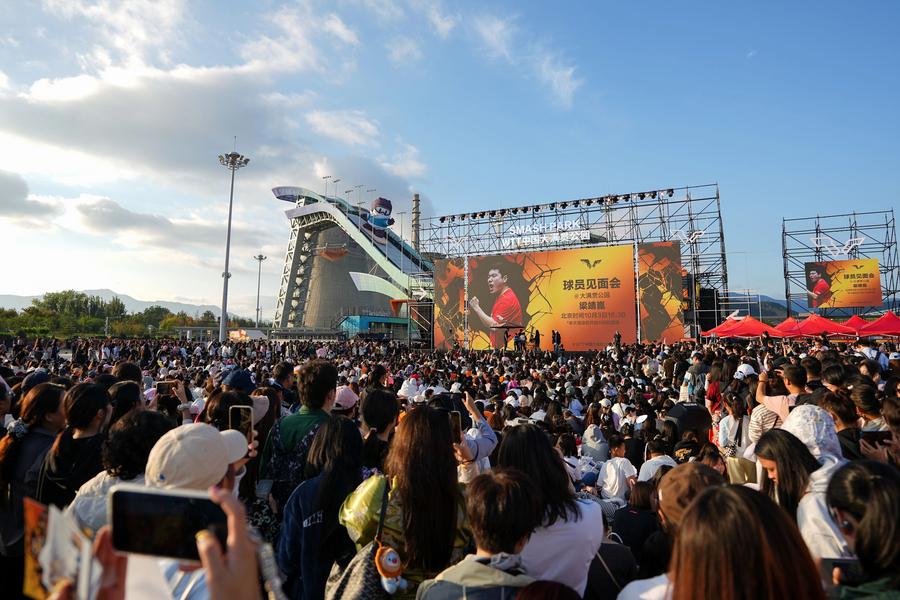
Fans participate in a player meet-and-greet event at the 2025 WTT China Smash on Oct. 3, 2025. (Xinhua/Ju Huanzong)
During this year's National Day and Mid-Autumn Festival holiday, Shanghai hosted six major international competitions, including the 2025 Rolex Shanghai Masters and the 2025 World Rowing Championships. Together, they attracted more than 800,000 visits, with overseas visitors making up 15 percent.
Beijing hosted the 2025 China Open tennis tournament and the 2025 World Table Tennis (WTT) China Smash. Attendance data shows that the National Tennis Center welcomed 360,000 visits during the 2025 China Open tennis tournament, the highest in its history. Tickets sales during the event reached 88 million yuan, up 10 percent year on year. Licensed merchandise sales exceeded 12.5 million yuan.
Behind the impressive numbers lies the steady improvement of China's sports infrastructure and a significant upgrade in event operations. According to a survey, as of Dec. 31, 2024, China had 4.84 million sports venues with a combined area of 4.23 billion square meters.
It's not just major national and international sporting events that are booming though. Community sporting events rooted in local culture are flourishing.
The continued popularity of the "Village Super League" and the "Village BA" in southwest China's Guizhou Province shows the multiplier effect that emerges when sports merge with local culture. On the sidelines, performances featuring intangible cultural heritage and ethnic dances transform the games into cultural celebrations. The "Village Super League" has boosted the visibility of intangible cultural heritage items like the Grand Song of the Dong ethnic group, while also bringing local specialties to new markets.
In east China's Jiangsu Province, the Su Super League, an amateur football competition, drew more than 60,000 spectators for a single match and generated over 38 billion yuan in consumption across multiple scenarios. Data shows that in the first half of this year, 511 major events across seven regions, including Hebei and Fujian provinces, generated over 16 billion yuan in sports-related consumption.
The rapid rise of China's sports event economy is supported by forward-looking national planning and strong policy backing.
During the 14th Five-Year Plan period (2021-2025), the General Administration of Sport and other government departments have introduced a series of measures to ensure the healthy development of the sector. According to Gao Zhidan, director of the General Administration of Sport, China's sports industry has recorded an average annual growth rate of more than 10 percent over the past five years, becoming a new bright spot in the national economy.

Tel:86-10-65363107, 86-10-65368220, 86-10-65363106
 Scan the QR Code
 Follow Us