





- BRNN
- BRI News
- BRNN News
- Database
Official Documents Polices and Regulations
Inter-government Documents International Cooperation BRI Countries
Business Guide Economic Data BRI Data
Trade
Investment Projects Latest projects
Cases - Content Pool
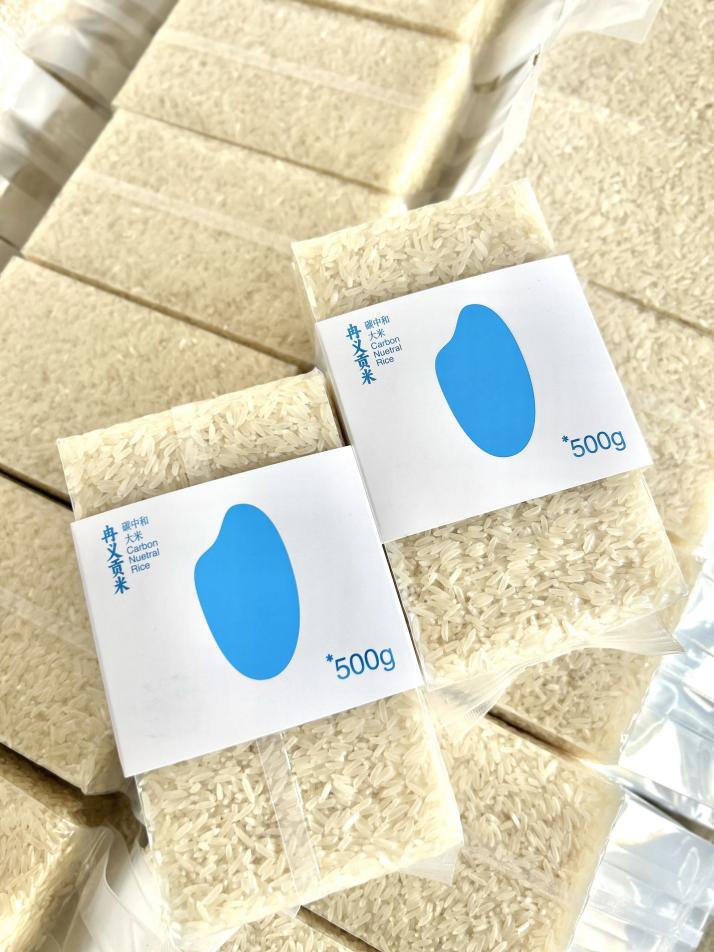
Photo shows the carbon-neutral "Ranyi rice." (Photo provided by the National Carbon Market)
In the serene fields of Qionglai, southwest China's Sichuan province, a young farmer's meticulous record-keeping is doing more than tracking harvests, but meticulously documenting the carbon footprint of every grain. What began as a personal experiment in low-carbon farming has now turned into the production of certified "carbon-neutral rice," offering a promising insight into the future of sustainable agriculture.
Huang Xin, a university-educated "new farmer" from Qionglai, recently observed with pride as boxes of "Ranyi rice" were prepared for delivery. Back in September, following a successful harvest, Huang organized a blind tasting at the fields, where a variety of rice samples were presented to a panel of local villagers and agricultural experts. The "Ranyi rice," distinguished by its delicate texture and low carbon emissions, emerged as the unanimous favorite.
However, this rice represents more than just superior taste. This year, "Ranyi rice" underwent rigorous carbon footprint assessment and received certification as a carbon-neutral product from the Sichuan United Environmental Exchange, officially earning the distinction of "carbon-neutral rice."
Why is it important for rice to be carbon-neutral?
For Huang, a local of Qionglai who returned to farming after completing his university studies, the project was about introducing innovation into traditional agriculture. As the green, low-carbon movement gained momentum, he saw an opportunity to produce rice in a sustainable manner, benefiting both the environment and China's broader "dual carbon" goals.
Initially, Huang faced skepticism. When he presented his idea to Zhang Kaiguo, general manager of Sichuan-based Guotan Tech, Zhang expressed doubt. "Achieving carbon neutrality for an agricultural product is no simple task," Zhang remarked.
The primary challenge, Zhang explained, lies in the complexity of carbon footprint accounting, which involves measuring the total greenhouse gas emissions and removals over a product's entire life cycle. "In industrial operations, the calculation process is relatively straightforward, thanks to mature production data systems. However, agriculture is often non-standardized, relying heavily on personal experience. Accurate accounting requires detailed records of every farming activity and its associated emissions," Zhang explained, acknowledging that such meticulous record-keeping is beyond the capabilities of many farmers.
Undeterred, Huang decided to persist. "I already kept records of agricultural inputs for economic purposes. Now I simply added a 'low-carbon account,'" he explained, resolving to meet Zhang's high standards.
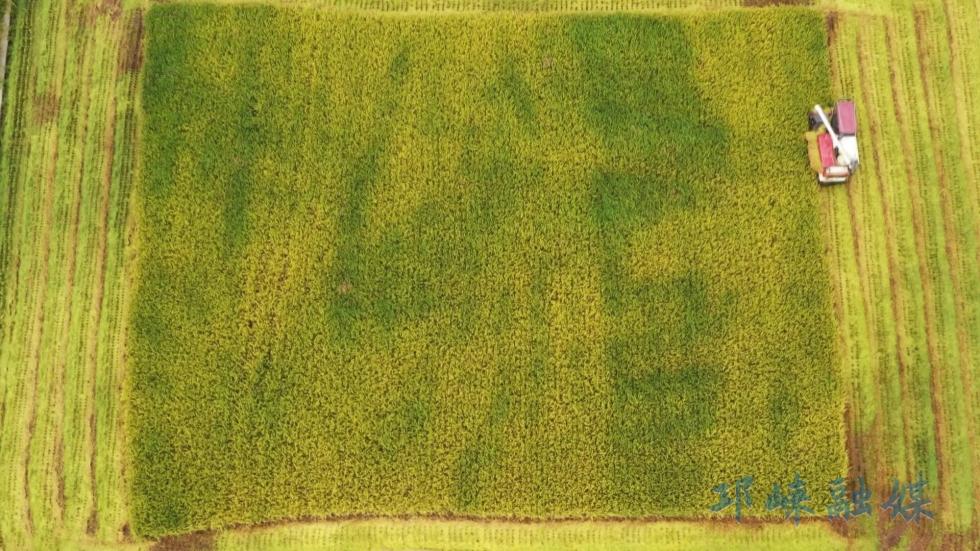
Photo shows a paddy field of the farm of Huang Xin in Qionglai, southwest China's Sichuan province. (Photo from the Qionglai media center)
The process was demanding: tracking began with the transportation of seeds and extended across more than 10 stages, including planting, field management, harvesting, and processing. In total, over 15 types of detailed data were required just for plot mapping alone. "Every detail had to be documented: fertilizer use per unit area, fuel consumption for machinery, and more," Huang recalled. Each activity was meticulously logged with the oversight of relevant staff and third-party certifiers.
In spring this year, Huang cultivated 200 mu (approximately 13 hectares) of nationally certified premium rice, reviving the local "Ranyi rice" variety. As the seedlings matured, his "low-carbon ledger" became thicker.
Reducing emissions for sustainable rice cultivation
While record-keeping was vital, the question remained: how could carbon-neutral rice be effectively grown? The solution lay in reducing emissions.
"Chemical fertilizers and pesticides contribute significantly to greenhouse gas emissions," Huang noted. To mitigate this, he adopted a hybrid approach, using bio-organic fertilizer alongside organic-inorganic compound fertilizers. "Bio-organic fertilizer can replace some chemical fertilizers, reducing both indirect emissions from production and transport, as well as methane emissions from rice paddies," explained Huang.
In certain field corners, he placed paper bags containing trichogramma wasp eggs, a natural predator of the rice stem borer. "Using insects for pest control proved even more effective than expected," he said.
By harvest time, carbon footprint assessments of the 200 mu of rice paddy revealed that the full life-cycle carbon emissions of "Ranyi rice" totaled 946.54 grams of CO2 equivalent per kilogram, nearly 50 percent lower than conventionally grown rice. Huang selected 20 tons of rice for carbon offsetting through the Sichuan United Environmental Exchange's platform, securing its carbon-neutral certification. The journey of this single grain of rice to carbon neutrality has successfully reached its destination.
"With this certification, the rice now carries a green 'ID card,'" Huang said. He designed special packaging for "Ranyi rice," which includes a QR code that provides consumers with full transparency regarding the product's carbon footprint.
This year, the transition to carbon-neutral rice has brought tangible benefits to Huang's farm: soil fertility has improved, and the quality of the produce has been enhanced. In Qionglai, several near-zero-carbon zones and carbon-neutral agricultural products are emerging, as the region embraces the green, low-carbon philosophy, injecting new vitality into its agricultural development.

Tel:86-10-65363107, 86-10-65368220, 86-10-65363106
 Scan the QR Code
 Follow Us