





- BRNN
- BRI News
- BRNN News
- Database
Official Documents Polices and Regulations
Inter-government Documents International Cooperation BRI Countries
Business Guide Economic Data BRI Data
Trade
Investment Projects Latest projects
Cases - Content Pool
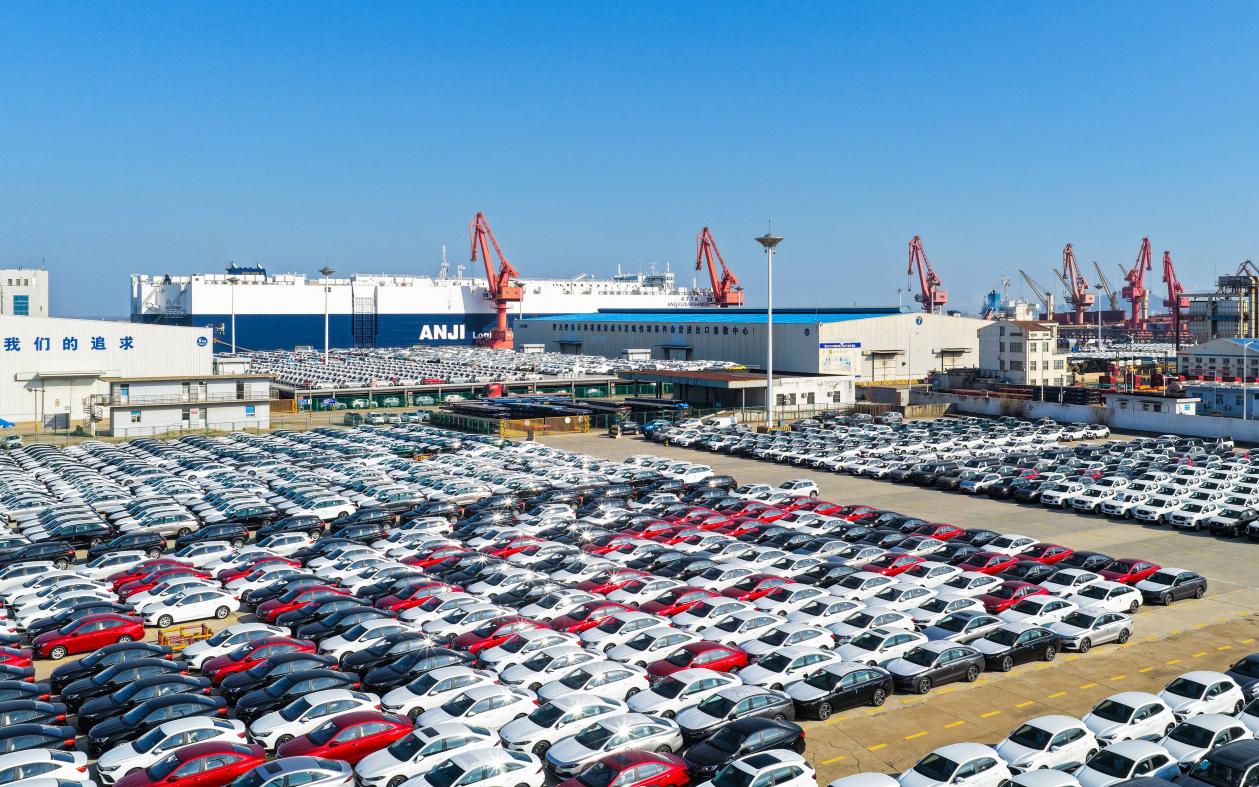
Chinese automobiles are ready to be shipped overseas in Lianyungang, east China's Jiangsu province, Dec. 17, 2025. (Photo/Wang Jianmin)
Stepping into a plant operated by Chinese automaker BYD in Shenshan Special Cooperation Zone, Shenzhen, south China's Guangdong province, visitors are greeted by a striking sight: a "steel forest" of nearly 1,000 industrial robots moving in precise synchronization.
Powered by a self-developed digital infrastructure and an AI-enabled visual system, the facility achieves stamping precision of 1.8 microns and 100 percent automation in welding.
The outcome is impressive: a new vehicle rolls off the line every 51 seconds.
This facility exemplifies the speed and technological sophistication underpinning China's automotive sector. A potent combination of efficient smart manufacturing, a robust domestic supply chain, rapid technological advancements, and the steady introduction of competitive new models -- supported by favorable policies -- has consistently driven domestic demand and sustained sales growth.
The statistics confirm this momentum: China's automobile production and sales each exceeded 30 million units for the third consecutive year, securing the country's position as the global leader for an unprecedented 17th straight year.
This robust performance highlights the resilience of the Chinese economy and its ongoing shift towards higher-quality, innovation-driven growth, even amidst significant external pressures and domestic challenges.
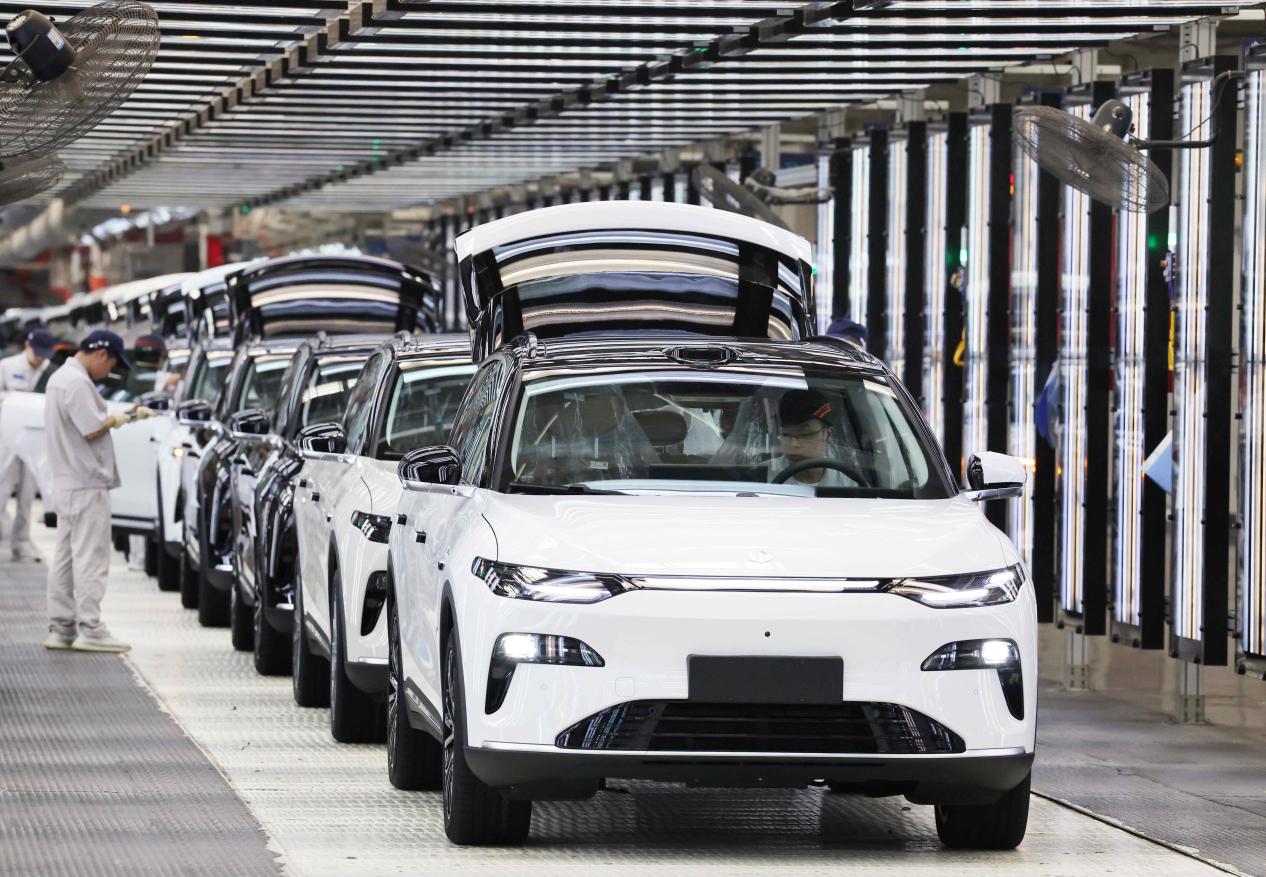
New energy vehicles are assembled in a workshop of a factory of Chinese automaker Leapmotor in Jinhua, east China's Zhejiang province. (Photo/Xu Congjun)
The push for innovation extends to extreme conditions. On the morning of Dec. 23, 2025, as temperatures dropped to minus 28 degrees Celsius in Mohe, northeast China's Heilongjiang province. Zhang Luchao, a system control engineer at a research institute of Chinese automaker Geely, set out on a 10-kilometer city driving test.
Starting a Geely Galaxy Starship 7 left overnight, he evaluated its AI-powered energy management system. According to Zhang, the system learns from user behavior and determines whether to warm up the battery pack based on factors such as departure time, indoor and outdoor temperatures, weather conditions, and remaining charge--cutting thermal management energy use by up to 30 percent.
In 2025, the average driving range of pure electric passenger vehicles in China approached 500 kilometers. Meanwhile, key technologies -- including 800-volt high-voltage silicon carbide platforms and fast-charging systems capable of delivering an 80 percent charge in 15 minutes -- have entered large-scale application.
Solid-state batteries have moved into small-batch trial production, targeting mass production by 2027. Innovation across multiple energy pathways -- electric, hybrid, hydrogen, and synthetic fuels -- advanced concurrently. China's "super hybrid" technology, integrating various power modes, gained widespread domestic adoption and began exporting to international automakers.
As electrification advances, concerns over charging and range are steadily easing, a trend that keeps advancing the replacement of traditional fuel vehicles with new energy vehicles (NEVs). In 2025, China produced 16.626 million and sold 16.49 million NEVs, up 29 percent and 28.2 percent year on year, respectively. NEVs accounted for 47.9 percent of total new car sales.
Exports are also gaining momentum. China exported 2.615 million NEVs in 2025, doubling from the previous year. Passenger vehicle exports doubled from a year ago to 2.532 million units, while commercial vehicle exports reached 83,000 units, up 86.8 percent year on year.
At the same time, autonomous driving is moving rapidly from testing to large-scale deployment, emerging as one of the earliest commercial applications of embodied intelligence. More than 60 percent of new passenger vehicles sold in China now come equipped with Level-2 advanced driver assistance systems.
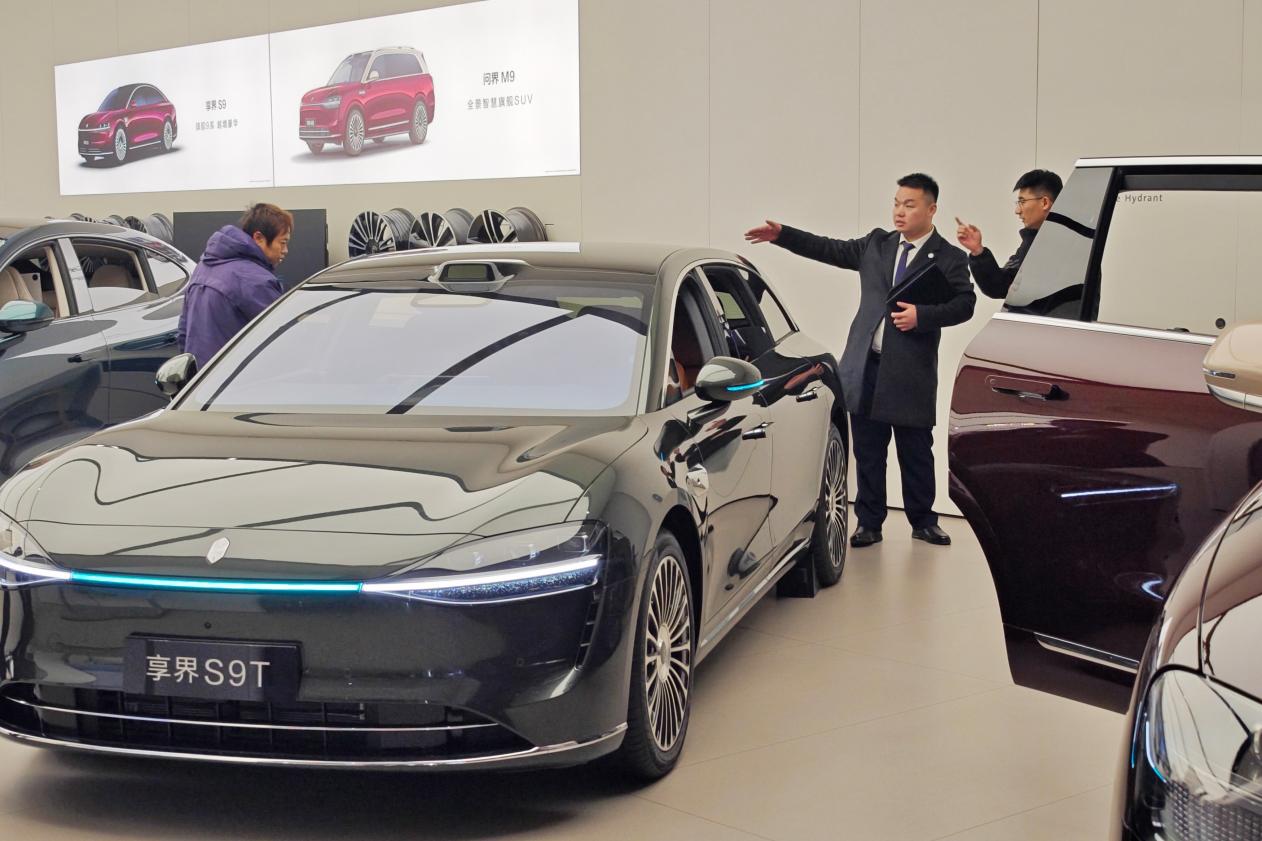
New energy vehicles developed by the Harmony Intelligent Mobility Alliance are exhibited in a mall in Jinan, east China's Shandong province. (Photo/Tang Ke)
On Dec. 15, 2025, two models developed by Chinese automakers Changan and BAIC received China's first permits for Level-3 autonomous driving, making the two companies the first in the country authorized to test Level-3 conditionally autonomous vehicles on public roads.
Regulatory measures have also helped stabilize the market. Since last year, authorities have moved to curb excessive price competition, tighten product consistency inspections, and step up enforcement against unfair practices.
These efforts are gradually addressing issues such as disorderly price wars and declining profitability. From January to November 2025, profits in the auto sector rose by 7.5 percent year on year, 3.1 percentage points higher than the January-October figure.
As the industry shifts away from resource-intensive, low-price competition toward innovation and value upgrading, mainstream automakers are ramping up efforts to deliver high-quality offerings.
In 2025, a range of flagship models embodying the core technological strengths of major brands gained strong market traction. Among them, the Maextro S800 under the Harmony Intelligent Mobility Alliance captured around 50 percent of sales in the million-yuan ($145,262) luxury car segment. Meanwhile, the AITO M9, M8, and M7 topped the sales charts in the 500,000-yuan, 400,000-yuan, and 300,000-yuan SUV segments, respectively. The Voyah Dream continued to lead monthly sales in the high-end MPV category, with its average selling price exceeding 400,000 yuan.
Across these segments, domestic premium new energy vehicle brands--exemplified by AITO, Li Auto, Zeekr, Voyah, and Xiaomi -- recorded combined sales growth of over 40 percent year on year in 2025.
According to Chen Shihua, deputy secretary-general of the China Association of Automobile Manufacturers, the sector is expected to maintain steady performance in 2026, supported by the smooth continuation of policies promoting large-scale equipment upgrades and consumer goods trade-ins, as China's accelerates its shift toward high-quality development.

Tel:86-10-65363107, 86-10-65368220, 86-10-65363106
 Scan the QR Code
 Follow Us