





- BRNN
- BRI News
- BRNN News
- Database
Official Documents Polices and Regulations
Inter-government Documents International Cooperation BRI Countries
Business Guide Economic Data BRI Data
Trade
Investment Projects Latest projects
Cases - Content Pool
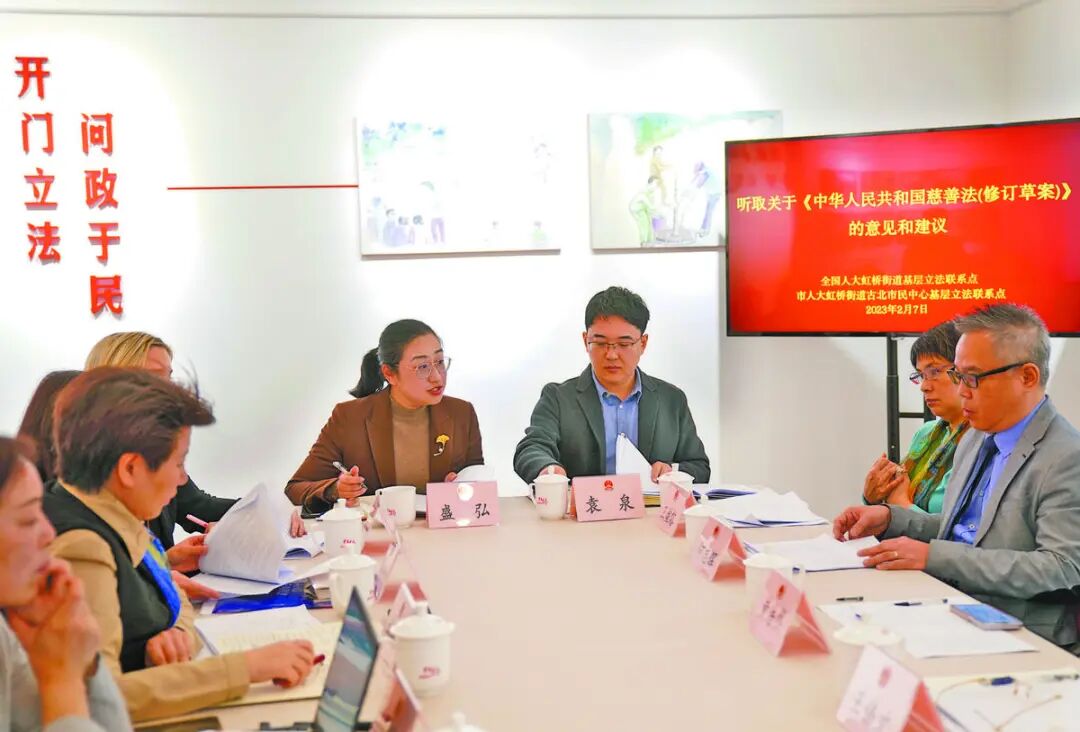
Citizens join a legislative consultation meeting at the Gubei civic center in Hongqiao subdistrict, Changning district, Shanghai. (Photo/Liu Ying)
Shanghai recently hosted a legislative consultation meeting on the draft law on promoting ethnic unity and progress at the Gubei civic center in Changning district's Hongqiao subdistrict.
The meeting fostered an engaged discussion, with attendees -- including deputies to the National People's Congress (NPC), academics, legal professionals, and members of non- Communist Party of China political parties -- offering a wealth of valuable insights.
For Sheng Hong, an NPC deputy and Party branch secretary in the local Ronghua No. 4 Residents' Community, this marked her 11th such consultation meeting within a year.
"Over the past year," Sheng noted, "the scope of these legislative consultations have covered critical areas like ecological and environmental protection, urban governance, and public well-being. Participants contribute diverse perspectives and specific revision suggestions based on their professional expertise. This process effectively integrates grassroots voices and professional insights, ensuring draft laws are more grounded in reality."
Sheng reflected on the evolution of public participation. Initially, residents visited grassroots legislative outreach offices primarily to understand how laws are made. Gradually, she observed, they evolved from passive recipients of legislative information into active advocates for legal awareness. Today, a robust network for gathering public opinion has taken shape, with participation expanding significantly.
A notable moment came in July 2025, Sheng recalled, when the State Council issued guidelines on gradually implementing free preschool education. Residents who had previously contributed to consultations on the draft preschool education law felt a profound sense of accomplishment. "They recognized that ideas debated at our grassroots offices were being reflected in national policy," Sheng explained.
She emphasized the shifting public expectations: "The focus is no longer just on whether laws exist, but on their effectiveness, practicality, and ability to solve real-world problems." During the legislative process of the preschool education law, factors such as demographic changes in school-age populations and household financial capacity were fully considered.
The resulting legislation aims to encourage increased government investment to reduce family burdens while simultaneously strengthening kindergarten teaching staff and improving facilities. "Beyond ensuring access," Sheng stated, "the law actively addresses the public's demand for high-quality early education, enhancing its relevance and timeliness."
Promoting "public well-being" with "public voices," a steady stream of practical, experience-based legislative suggestions is being conveyed from grassroots legislative outreach offices to the Great Hall of the People for legal adoption.
To date, the Legislative Affairs Commission of the NPC Standing Committee has set up 60 local legislative outreach offices nationwide. Additionally, provincial and city-level legislatures operate a network of over 7,800 such offices. In 2025 alone, opinions and suggestions were solicited from these offices on 26 draft laws, yielding more than 34,000 submissions, many of which have been adopted in legislation.
"Matters of the people should be discussed by the people themselves," Sheng said. "As an NPC deputy from the primary level, I will continue to stay close to the people, listen to their voices, pool their wisdom, and bring more of their views to the Great Hall of the People, contributing to the practice of whole-process people's democracy at the grassroots level and to improving the quality of legislation."
Tel:86-10-65363107, 86-10-65368220, 86-10-65363106
 Scan the QR Code
 Follow Us