





- BRNN
- BRI News
- BRNN News
- Database
Official Documents Polices and Regulations
Inter-government Documents International Cooperation BRI Countries
Business Guide Economic Data BRI Data
Trade
Investment Projects Latest projects
Cases - Content Pool
The question of how to understand China remains a recurring topic for the international community. Chinese President Xi Jinping has frequently invoked the parable of the blind men and the elephant to underscore the necessity of viewing China comprehensively and objectively.
Amidst the current international landscape, there is a growing desire in engaging with China's opportunities. Establishing a comprehensive and accurate understanding of China is fundamental to building robust cooperation.
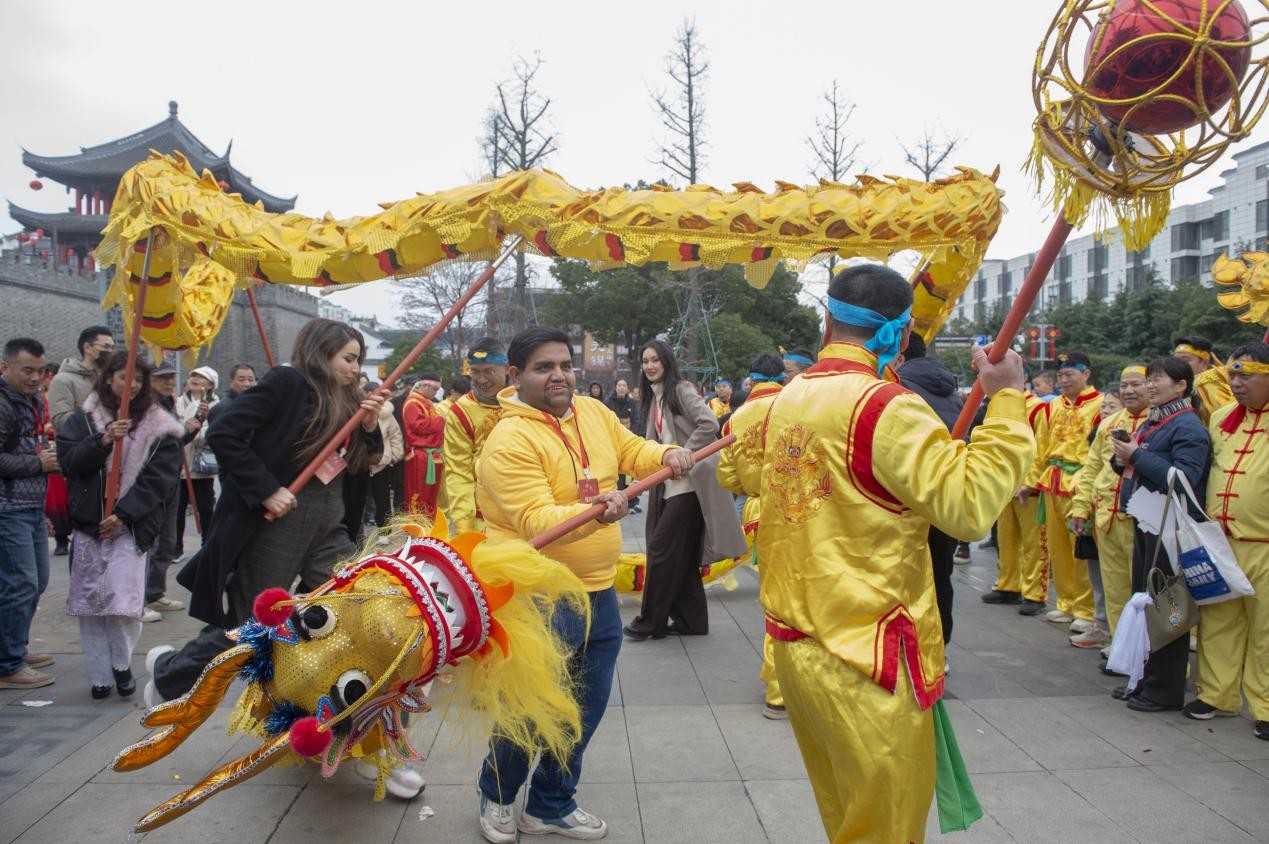
Foreigners experience dragon dance in Wuxi, east China's Jiangsu province. (Photo/Pan Zhengguang)
Home to over 1.4 billion people, China is undergoing the largest modernization process in human history. Given its extensive history, vast territory, rich culture, rapid development, and profound transformation, however, any partial observation, like that of the blind men touching an elephant, cannot grasp the whole picture. Such limited perspectives can exacerbate cognitive biases and impede meaningful exchange and mutual learning.
A truly comprehensive understanding of China requires situating it within both historical and contemporary contexts. Ignoring China's history and culture, the spiritual world of its people, or the profound changes occurring in modern China renders a complete understanding impossible.
China's journey from a nation plagued by poverty and weakness to the world's second-largest economy, and from struggling to meet basic needs to establishing a moderately prosperous society in all respects, is no accident. This "China miracle" has been achieved through steadfast adherence to a modernization path tailored to its unique national conditions.
Genuine insight into China can only be gained through historical and developmental perspectives, which open the door to deeper mutual engagement. Since the start of this year, a succession of foreign leaders has visited China. Through face-to-face exchanges, they have worked to enhance understanding and mutual trust, joining China in seeking new avenues for cooperation in an ever-shifting global landscape.
As China's interactions with other countries continue to deepen, more and more foreigners are choosing to experience firsthand the depth of Chinese civilization and the dynamism of Chinese modernization.

Foreign children experience paper cutting, an intangible cultural heritage item, in Nanxinan village, Huangshan, east China's Anhui province. (Photo/Shi Yalei)
Recently, a trend has emerged among overseas internet users to "become Chinese," with many sharing videos that highlight aspects of Chinese lifestyles or incorporating Chinese elements into their daily lives. This more grounded and participatory approach reflects a shift from distant observation to active cultural engagement.
Some international media outlets noted that this trend signals a change in mindset -- from viewing China from afar to embracing a more immersive understanding. As one online comment put it, the idea of "becoming Chinese" reflects a shared aspiration for a better life.
Recent surveys by multiple international polling institutions also show that more people around the world are taking a greater interest in China, holding more favorable views, and expressing stronger identification with it.
President Xi has always encouraged foreigners to visit more places in China, and his invitation mirrors China's openness and confidence.

Foreigners pick navel oranges in an orchard in Anyuan county, Ganzhou, east China's Jiangxi province. (Photo/Zhu Haipeng)
In 2025, China expanded its unilateral visa-free policy to 48 countries, while the number of ports eligible for the 240-hour visa-free transit policy increased to 65. Last year, China recorded 82.035 million cross-border trips by foreign nationals, up 26.4 percent year on year, with more than 70 percent benefiting from visa-free entry.
A time-honored China casts a spell on its visitors, while a modern China draws gasps of "That's so cool!" from friends around the world. As understanding deepens, a comprehensive, authentic, and multi-faceted picture of China is crystallizing -- along with a broader recognition of its many dimensions.
Today, China is advancing with determination on a new journey toward Chinese modernization. Only through a full and accurate understanding of China can one appreciate why the country continues to represent certainty, opportunity and the future.
The recommendations for formulating the 15th Five-Year Plan outline a blueprint for China's economic and social development over the next five years, while also offering the world a "list of opportunities."
With confidence in opening up and a sincere commitment to sharing development opportunities, China will continue to work with all countries to write a new chapter of harmony in diversity and shared prosperity.

Tel:86-10-65363107, 86-10-65368220, 86-10-65363106
 Scan the QR Code
 Follow Us