





- BRNN
- BRI News
- BRNN News
- Database
Official Documents Polices and Regulations
Inter-government Documents International Cooperation BRI Countries
Business Guide Economic Data BRI Data
Trade
Investment Projects Latest projects
Cases - Content Pool

A worker manufactures running shoes in a workshop of a shoemaking enterprise in Shangqiu, central China's Henan province. (Photo/Xu Zeyuan)
Chinese running shoes are gaining global prominence as international influencers showcase their performance and affordability across social media platforms.
This trend is amplified by China's advanced cross-border e-commerce and logistics infrastructure, which delivers unprecedented convenience to overseas consumers through three key advantages: rapid delivery, diversified purchasing channels, and continuously enhanced shopping experiences.
Cross-border e-commerce has emerged as a pivotal driver of China's international competitiveness, with 2025 trade volume reaching 2.75 trillion yuan (some $400 billion). As a critical business-to-business service, cross-border logistics enables Chinese companies to reduce overseas delivery times and operational costs while improving consumer satisfaction -- creating essential support for global brand expansion.
Last year's Chinese government work report called for promoting the development of cross-border e-commerce, improving international delivery and logistics systems, and strengthening overseas warehouse construction.
At the national conference on the service sector held in April this year, authorities emphasized the need to pursue both capacity expansion and quality improvement while balancing development with regulation to promote high-quality and efficient growth of the service industry.
Against this backdrop, how can cross-border logistics build on current momentum and achieve higher-quality development?
One key direction is faster transportation.
China's State Council recently issued guidelines on promoting the expansion and upgrading of the service sector, explicitly calling for the vigorous development of international maritime and air transport services.
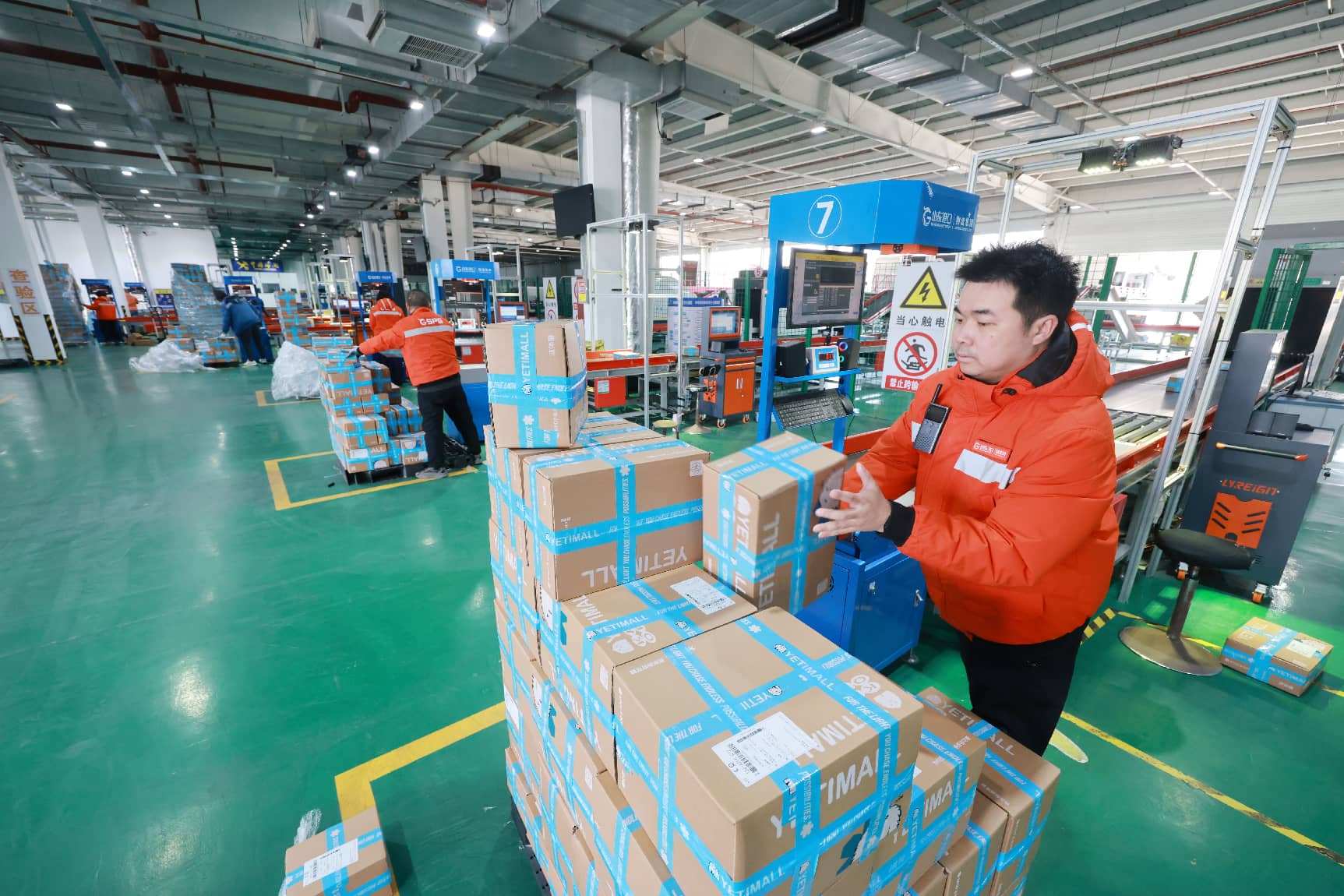
Cross-border e-commerce parcels are sorted in a logistics park managed by Shandong Port Land-Sea International Logistics Group Co., Ltd. in Weihai, east China's Shandong province. (Photo/Zhu Chunxiao)
Data show that in the first quarter, China's international cargo and mail transportation volume exceeded 1.1 million tons, up 17.6 percent year on year. Demand has been particularly strong for high-value-added goods such as cross-border e-commerce products, high-end manufacturing equipment and biopharmaceutical products.
Meanwhile, customs clearance efficiency keeps improving. A "9610" cross-border e-commerce direct mail export model is unlocking greater potential, allowing more small and medium-sized sellers to get fast clearance for small-sized and high-frequency parcels.
Another focus is improving overseas storage and distribution capabilities.
Guidelines jointly issued by six departments, including China's Ministry of Commerce, call for stronger support for overseas warehouses and the improvement of intelligent overseas logistics platforms.
To date, Chinese companies have established more than 2,500 overseas warehouses worldwide, covering a total area exceeding 30 million square meters. The United States and Europe alone account for more than 70 percent of the total.
Returns are also becoming more convenient.
Since April 1, China's General Administration of Customs has rolled out a nationwide cross-regional return system for cross-border e-commerce retail exports. Under the new policy, goods returned from overseas no longer have to re-enter China through the original customs office from which they were exported. Instead, companies can choose any customs port nationwide to handle return procedures. The move is expected to help address longstanding industry challenges surrounding costly, time-consuming and difficult return processing.
This growth creates significant talent demand. China's cross-border e-commerce sector faced a shortage of 4 million professionals in 2025, with data analysts in supply chain roles commanding premium salaries of 250,000-500,000 yuan annually. The global embrace of Chinese sportswear transcends product quality -- it demonstrates how "China Services" infrastructure upgrades provide competitive advantages in international markets, offering new testament to China's industrial evolution.

Tel:86-10-65363107, 86-10-65368220, 86-10-65363106
 Scan the QR Code
 Follow Us