





- BRNN
- BRI News
- BRNN News
- Database
Official Documents Polices and Regulations
Inter-government Documents International Cooperation BRI Countries
Business Guide Economic Data BRI Data
Trade
Investment Projects Latest projects
Cases - Content Pool
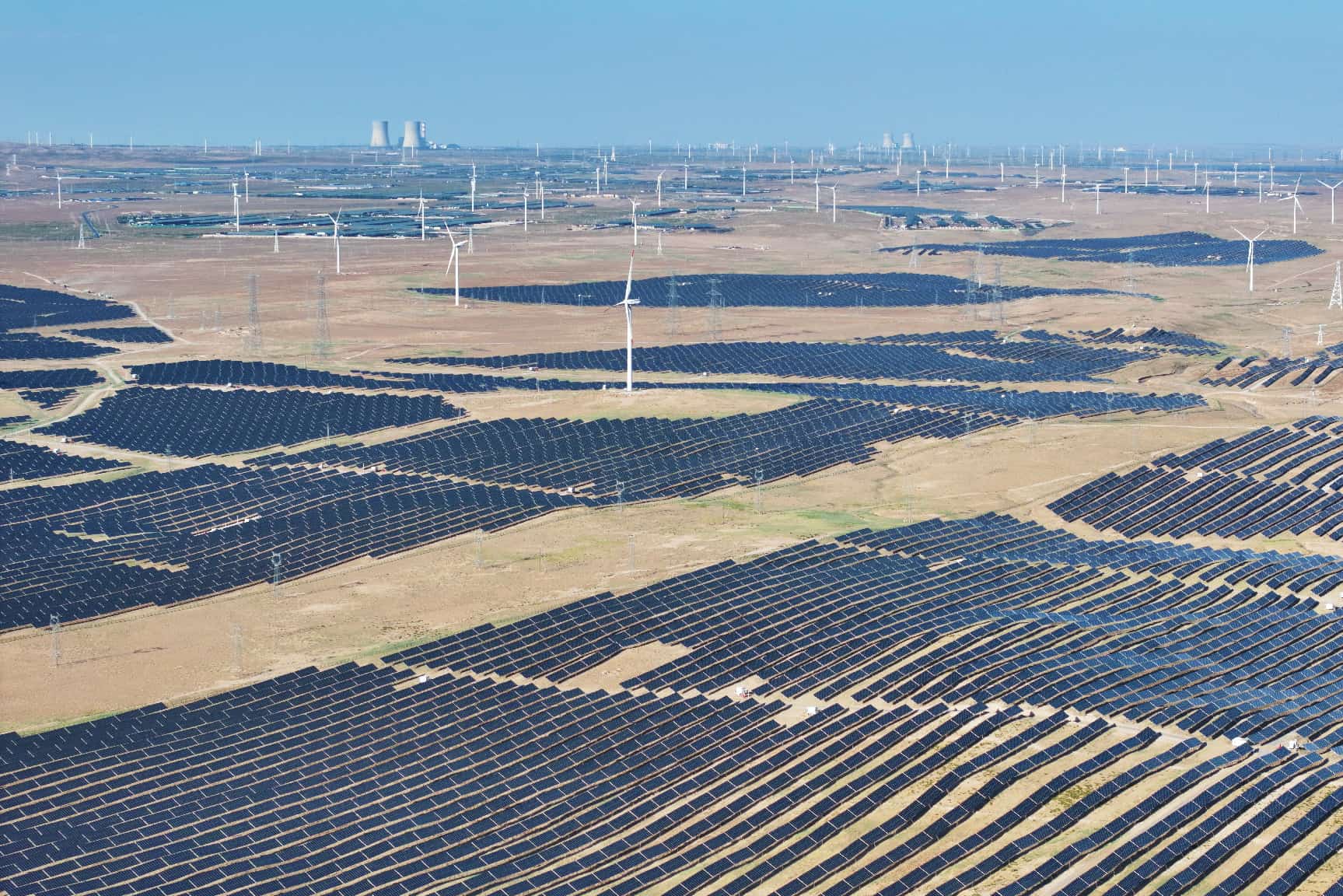
Photo shows a new energy base in Baitugang township, Lingwu, Yinchuan, northwest China's Ningxia Hui autonomous region. (Photo/Yuan Hongyan)
From emerging industries such as electronic information, embodied intelligence, and commercial spaceflight to the booming growth of cultural tourism, digital, green and health-related consumption, China's economy has continued to generate new momentum in the first half of 2026.
How has the economy performed during this period? Four key indicators provide a clear picture.
Installed Power Capacity Exceeds 4 Billion kW: A Marker of Stable Growth
By the end of May, China's total installed power generation capacity had reached 4.01 billion kilowatts, up 11 percent year on year, ranking first in the world.
It took China eight years to increase its installed capacity from 1 billion to 2 billion kilowatts, then four years and four months to reach 3 billion. The latest milestone -- from 3 billion to 4 billion kilowatts -- was achieved in just over two years.
The rapid expansion is underpinned by China's world-leading complete industrial system for new energy. From polysilicon, solar cells and inverters to complete wind turbines, blades and towers, China has built the most comprehensive new energy equipment industrial chain globally. Around 80 percent of photovoltaic modules and 60 percent of wind power equipment worldwide are produced in China.
In the first half of this year, the global energy market experienced significant volatility, yet China's energy system withstood external shocks, maintained a stable balance between supply and demand, and demonstrated strong resilience. Beyond energy, this stability has has been a consistent feature across the broader economy, from grain production and industrial output to employment. This steady foundation has enabled China's economy to move forward with confidence amid challenges.
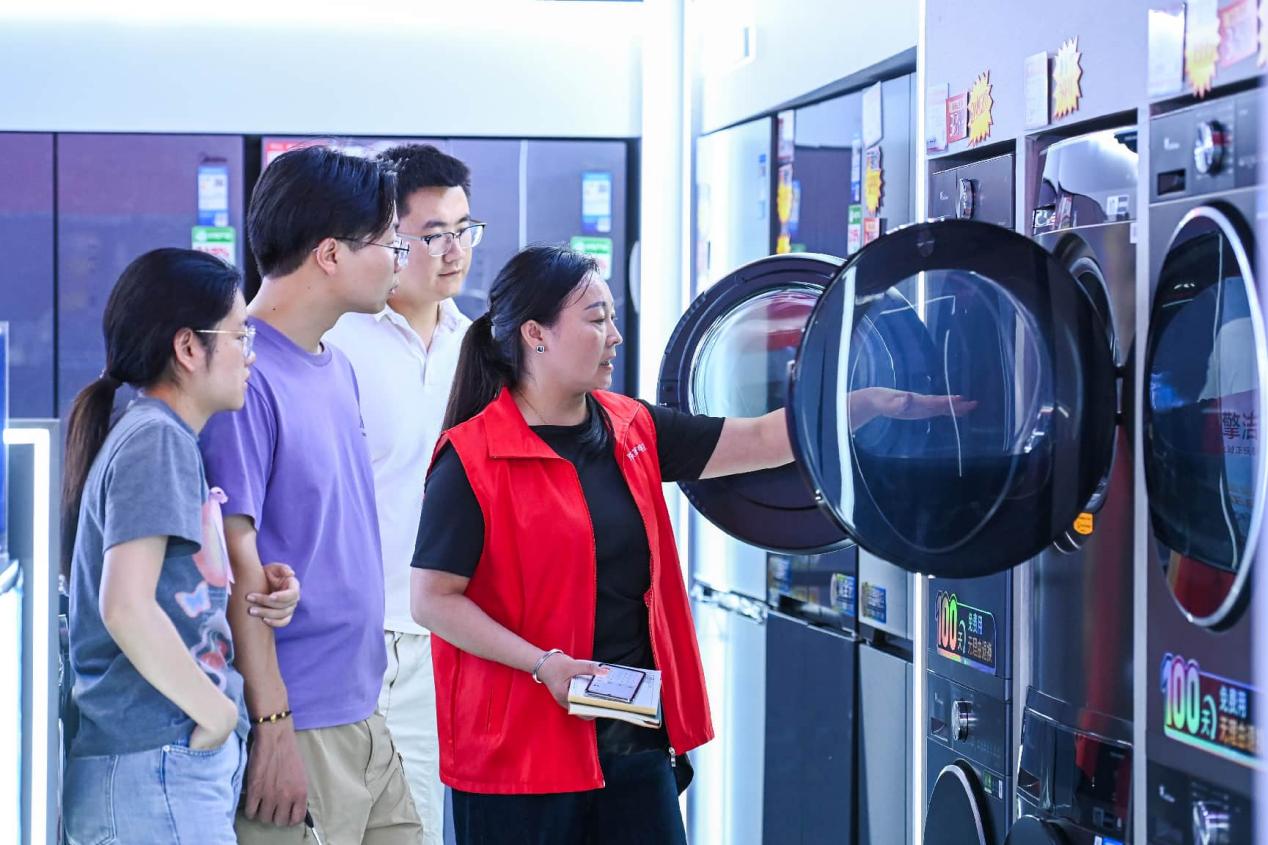
Customers shop for home appliances eligible for trade-in subsidies at a store in Yichun, east China's Jiangxi province. (Photo/Zhou Liang)
Hundreds of Trillions in Daily AI Token Calls: A Surge in New Industrial Momentum
A token is the smallest unit of information processed by large artificial intelligence (AI) models. Every question users ask and every piece of content generated by AI involves token processing.
In the first half of 2026, China's AI sector experienced explosive growth. By the end of May, China's average daily AI token usage had reached hundreds of trillions, ranking among the highest in the world.
At the beginning of 2024, China's average daily token usage stood at only 100 billion. By the end of 2025, that figure had surged to 100 trillion. Continued rapid growth in 2026 reflects the strong momentum of China's intelligent economy.
Huo Jinjie, president of International Data Corporation China, predicted that China's generative AI market could approach $100 billion by 2029, with a compound annual growth rate of about 68 percent between 2024 and 2029, making China one of the world's most dynamic AI application markets.
The accelerated transition from traditional to new growth drivers has become a defining feature of China's economic performance. From January to May, high-tech manufacturing contributed nearly 40 percent of industrial growth, while equipment manufacturing contributed nearly 60 percent. The shift toward higher-end, smarter, greener and more integrated development is yielding notable results.
Over 1 Trillion Yuan ($147 billion) in Trade-in Sales: A Vibrant Consumer Market
In Yixing, east China's Jiangsu province, consumer Guo Wei placed an order immediately after trying out a new smartphone at a retail store. His four-year-old phone was traded in for 400 yuan, and with an additional government subsidy of more than 400 yuan, the new phone originally priced at 2,800 yuan cost him less than 2,000 yuan. "The whole process was simple and smooth, completed within minutes," he said.
Since the beginning of 2026, government departments including the National Development and Reform Commission and the Ministry of Commerce have optimized policies on consumer goods trade-ins, while local governments have continued to unlock policy benefits. As of June 20, sales generated through consumer goods trade-in programs had exceeded 1 trillion yuan, benefiting 136 million people.
The trillion-yuan scale of consumer goods trade-ins vividly reflects the vitality of China's enormous consumer market.
Across China, emerging smart devices including smart watches and smart eyewear have gained widespread traction, with their sales volume surging multiple times year on year. The country handles over 550 million express parcels each day, facilitating the efficient flow of people, logistics, data and capital. Spending on travel, cultural performances and sporting events keeps heating up, and tickets for hit shows routinely sell out in seconds.
From goods consumption to services consumption, and from green consumption to smart consumption, new consumption scenarios are constantly emerging and market potential continues to be unleashed.
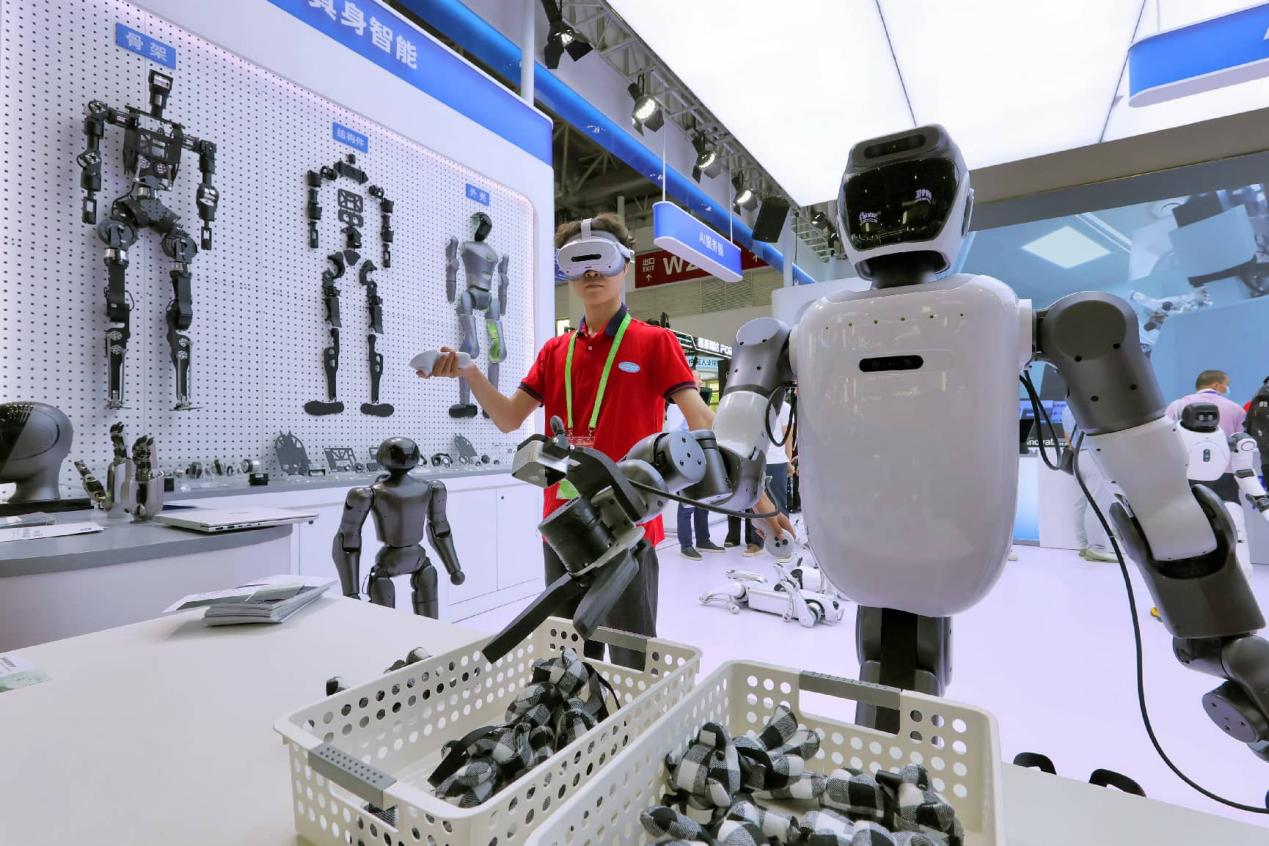
A staff member controls an AI-enabled teleoperation robot to grab objects at the 4th China International Supply Chain Expo, June 23. (Photo/Tang Ke)
China-Africa Trade Tops 1 Trillion Yuan for the First Time: Integrated Openness and Win-Win Cooperation
Shenzhen, south China's Guangdong province, trucks loaded with fresh South African fruit were heading to supermarkets and produce markets across the country. "With tariffs reduced from 10 percent to zero, the import cost of this shipment of apples has fallen by nearly 20,000 yuan," said Luo Shengcong, general manager of a Shenzhen-based international freight forwarding company.
This year marks the 70th anniversary of the establishment of diplomatic relations between China and African countries. Since May 1, China has fully implemented a zero-tariff policy for 53 African countries that it has diplomatic relations with. According to customs data, China's imports and exports with African countries totaled 1.14 trillion yuan in the first five months of this year, exceeding 1 trillion yuan for the first time in a comparable period and increasing 18.2 percent year on year.
China has extended zero-tariff treatment to 63 countries, signed 24 free trade agreements with 31 countries and regions, and expanded the number of pilot free trade zones to 23. It has also continued to host major platforms on a regular basis, including the China International Supply Chain Expo, the China International Import Expo and the "Export to China" series of events.
Throughout continuously opening up, China is sharing more development opportunities with the world. From January to May, China's total imports and exports of goods reached 20.68 trillion yuan, up 15.3 percent year on year. The country also saw 25,297 newly established foreign-invested enterprises, an increase of 5.3 percent.
Amid profound shifts in the global economic and trade landscape, China is continuing to provide the world with a stable and predictable force for openness and cooperation.

Tel:86-10-65363107, 86-10-65368220, 86-10-65363106
 Scan the QR Code
 Follow Us