





- BRNN
- BRI News
- BRNN News
- Database
Official Documents Polices and Regulations
Inter-government Documents International Cooperation BRI Countries
Business Guide Economic Data BRI Data
Trade
Investment Projects Latest projects
Cases - Content Pool
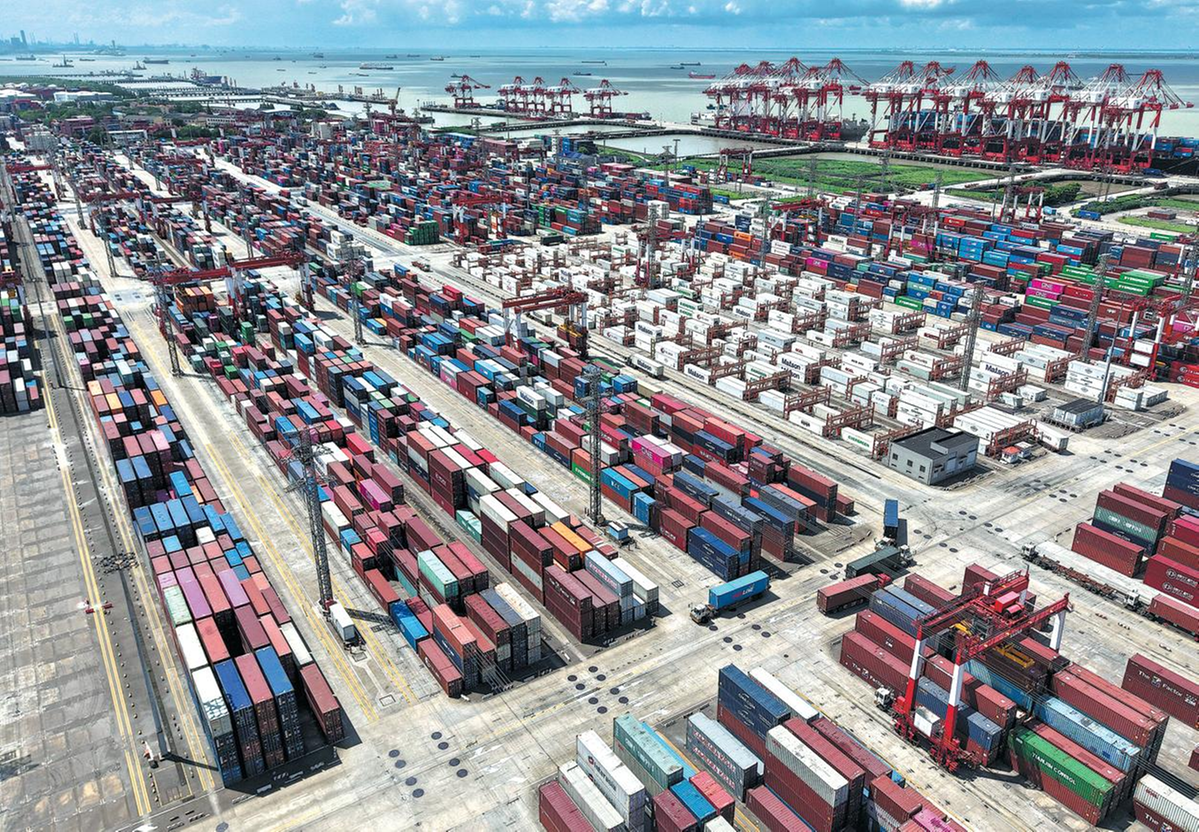
An aerial photo shows a bustling foreign trade container terminal with constant truck and vessel movements at Shanghai Port on July 14. LONG WEI/FOR CHINA DAILY
On the factory floor of Warsonco Intelligent Technology (Guangdong) Co in Dongguan, South China's Guangdong province, palletizing robots lifted cartons from conveyor belts and stacked them neatly onto pallets in late July, while engineers carried out routine performance checks before shipment.
Replacing labor-intensive manual handling, the palletizing robots can stack between eight and 12 cartons per minute. They can be programmed with up to 800 palletizing patterns and simultaneously handle two different product types, making them well suited for industries such as food processing, pharmaceuticals, consumer goods and printing.
The scene reflects a broader shift taking place across China's manufacturing sector, where artificial intelligence and automation are making industrial robots easier to deploy, operate and scale.
Xiao Fageng, the company's sales director, said as manufacturers worldwide face rising labor costs and growing demand for flexible production, Chinese robotics companies are increasingly developing AI-powered systems that lower technical barriers while expanding their presence in overseas markets.
Demand for the company's robots has been growing both in China and overseas. Its products are now sold in more than 50 countries and regions, and Warsonco expects total shipments to reach between 8,000 and 10,000 units this year, up about 60 percent from a year earlier, according to information released by Huangpu Customs in Guangdong.
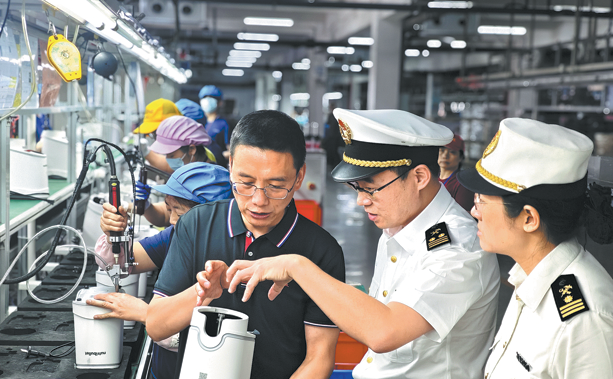
Customs officers from Ningbo Customs learn about the features and export demand for a new ice cream maker at a home appliance firm in Ningbo, Zhejiang province, on July 21. CHINA DAILY
Customs data showed China's industrial robot exports exceeded imports for the first time in 2025, making the country a net exporter of industrial robots. In the first half, China's industrial robot exports reached 6.29 billion yuan, up 18.6 percent year-on-year, with products shipped to 141 countries and regions.
Industrial robots are not the only high-end Chinese-made equipment riding the AI boom, as power infrastructure hardware has also seen surging global orders.
At a workshop of Jiangsu Yawei Transformer Co in Nantong, East China's Jiangsu province, workers were racing to complete large-capacity power transformers and dry-type distribution transformers destined for countries in the Middle East and Southeast Asia.
As power consumption per server rack at data centers has climbed from around 10 kilowatts to several hundred kWs — and in some cases even megawatt levels — reliable, high-capacity electricity supply has become critical. Once regarded as conventional grid equipment, transformers are becoming a cornerstone of AI infrastructure, said Li Luosheng, the company's manager for customs affairs.
"In the past, most of our exports were conventional transformer models," said Li. "Now, a growing proportion of our orders comes from AI data centers and overseas power grid upgrade projects, where customers place much higher demands on energy efficiency, reliability and delivery speed."
Jiangsu's exports of electrical equipment, including transformers, electrical control devices and wires and cables, reached 140.56 billion yuan in the first half of 2026, up 23.5 percent year-on-year, statistics from Nanjing Customs showed.
China's export mix has undergone a profound transformation over the past four decades. In the early years of reform and opening-up, labor-intensive products such as garments, furniture and household appliances helped Chinese manufacturers gain a foothold in global markets by leveraging competitive production costs.
With the country's industrial capabilities advancing, exports increasingly moved up the value chain, with higher-value and technology-intensive products taking a larger share.
Chen Bin, deputy director of the expert committee of the Beijing-based China Machinery Industry Federation, said the transformation has accelerated in recent years.
After electric vehicles, lithium batteries and photovoltaic products emerged as China's "new trio" of export growth drivers, a new wave of products — including industrial robots, commercial drones, 3D printers, artificial intelligence applications and innovative pharmaceuticals — is rapidly gaining global traction, said Chen.
Backed by a comprehensive industrial ecosystem, a deep engineering talent pool and sustained innovation, China's foreign trade is increasingly being driven by technological advancement rather than traditional cost advantages, he added.
The shift is already evident in China's latest trade figures. Alongside notable export growth in tech-intensive green products such as energy storage systems and electric-powered trucks, China's trade in hardware supporting computing power, including electronic components and computer parts, surged 56.6 percent year-on-year to 5.13 trillion yuan between January and June, data from the General Administration of Customs showed.
Wang Jun, the administration's vice-minister, said the country's AI-powered smart glasses, translation devices and robotic exoskeletons are among a growing range of intelligent products undergoing rapid innovation.
The rising contribution of these innovation-driven products has helped underpin China's broader trade growth. The country's foreign trade expanded 16.9 percent year-on-year to 25.47 trillion yuan in the first half, with imports growing faster than exports. Exports rose 13.4 percent, while imports climbed 22.1 percent, exceeding export growth by 8.7 percentage points, according to customs data.
Pushing back against the so-called "China Shock 2.0" narrative, which portrays China's development as a disruption to the global economy, Li Jiaying, an assistant researcher at Renmin University of China's Chongyang Institute for Financial Studies in Beijing, said China's export growth is increasingly driven by innovation rather than low-cost manufacturing.
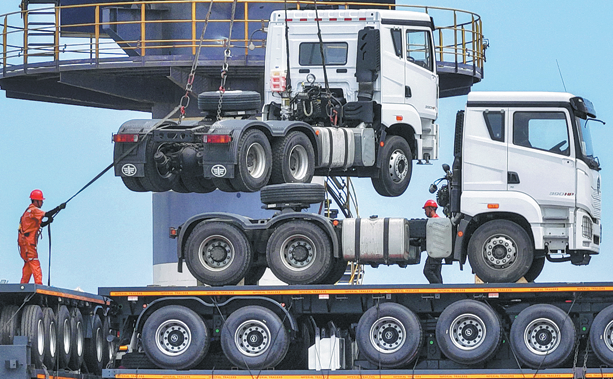
Workers load trucks for export onto ships at Yantai Port in Shandong province on July 15. TANG KE/FOR CHINA DAILY
The country's industrial upgrading has expanded global supply, improved production efficiency and created more choices for consumers and businesses worldwide.
"Rather than displacing other economies, China's technological progress strengthens global industrial and supply chains by delivering competitive products, accelerating innovation and supporting the worldwide green and digital transitions," she said.
Echoing that view, Ding Rijia, a professor of industrial economy at China University of Mining and Technology-Beijing, said that following Europe's energy shortage, demand for imported green equipment has risen sharply, while many developing economies are only beginning their energy transition, leaving substantial long-term demand unmet.
"China's export growth of technology-intensive and green products reflects its ability to respond to genuine global demand, with additional supply emerging because demand already exists," said Ding, adding the narrative that China's exports are driven by "overcapacity" and are undermining Western manufacturing is not supported by market realities.
That assessment is also reflected in the investment strategies of multinational companies operating in China. Stefan Floeck, ABB's division president of IEC Low Voltage Motors, said China will remain central to the Swedish-Swiss technology company's global motor business as the country's industrial upgrading and green transition continue to drive demand for more energy-efficient equipment.
"To capture these opportunities, we will continue investing in local research and development, manufacturing and supply chains to better serve Chinese customers while reinforcing China as an innovation hub and export base within the company's global network," said Floeck.
ABB's low-voltage motor business has invested more than 150 million yuan in recent years to upgrade its Shanghai manufacturing base, including research and development testing laboratories and production lines. Its domestic supply chain also supports exports from China to overseas markets.
Despite headwinds such as rising trade protectionism and persistent geopolitical uncertainties, China's exports are likely to remain resilient in the second half, said Wen Bin, chief economist at China Minsheng Bank. He attributed the outlook to the global AI investment cycle, the United States' relatively moderate tariff policy and measures to strengthen manufacturers' competitiveness.
Similar views were expressed by Lynn Song, chief economist for China at Dutch bank ING. "Exports have been one of China's primary growth engines in recent years, and this year's acceleration continues to beat expectations," he said.
"China's exports over the first half of the year already nearly match the levels seen through the first seven months of 2025, and the base case is for solid export growth to continue. Strong external demand remains one of the key pillars supporting China's industrial activity," said Song.
"It remains a key engine of growth for China and is likely to continue playing that role for the rest of the year," he said, while cautioning that potential new tariffs from the European Union and proposed US secondary sanctions related to Russian energy exports could pose risks to the country's export outlook.

Tel:86-10-65363107, 86-10-65368220, 86-10-65363106
 Scan the QR Code
 Follow Us