





- BRNN
- BRI News
- BRNN News
- Database
Official Documents Polices and Regulations
Inter-government Documents International Cooperation BRI Countries
Business Guide Economic Data BRI Data
Trade
Investment Projects Latest projects
Cases - Content Pool
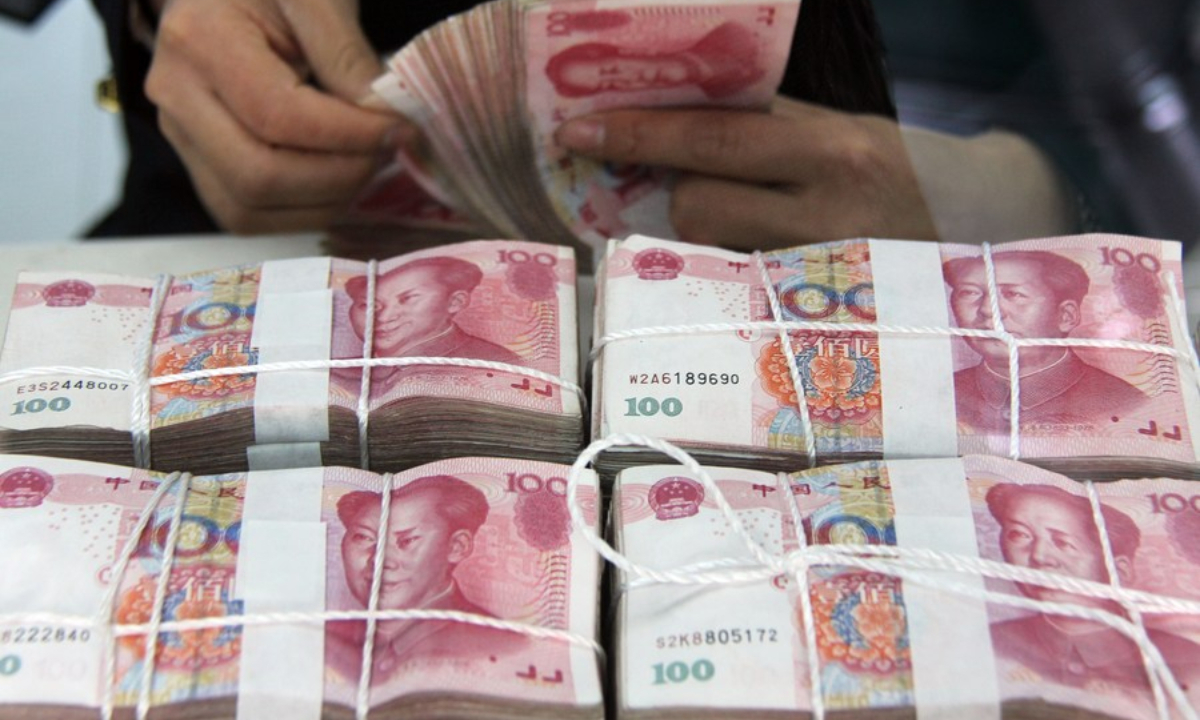
File photo shows a worker counts Chinese currency Renminbi banknotes at a bank in Tancheng County of Linyi City, East China's Shandong Province. Photo: Xinhua
Five-year China Government Bond (CGB) futures debuted on the Hong Kong Exchanges and Clearing Ltd (HKEX) on Monday, becoming the only CGB futures in the offshore market.
Analysts said that the move further enriches risk management tools for international investors, enhances the appeal of yuan-denominated assets, consolidates the role of the Hong Kong Special Administrative Region (HKSAR) as an offshore yuan hub, and strengthens the confidence of long-term investment in China.
The new 5-year CGB futures contracts have a size of 500,000 yuan ($74,051), and settled in cash rather than via physical delivery of bonds. The September futures on five-year Chinese sovereign notes opened at 106.685 yuan per contract, before rising to an intraday high of 107.730 yuan.
"In the long run, the debut of this important product will further enrich the usage scenarios of offshore yuan, reinforce Hong Kong's function as a global offshore yuan hub, and better enhance the effectiveness of financial services in supporting the real economy," Wu Qing, chairman of the China Securities Regulatory Commission (CSRC), said on Monday in Hong Kong during the launch ceremony of the futures.
Currently, together with the HKSAR government, the CSRC is making every effort to advance various preparatory works for the inclusion of yuan-denominated stock trading counters and real estate investment trusts (REITs) into the Stock Connect program," Wu said.
"We will support index companies from both regions in strengthening cooperation to launch more indices based on Chinese assets, promote industry institutions from both markets to roll out more exchange-traded fund (ETF) products," Wu said, adding that efforts will also be made to support the HKSAR in launching more futures varieties priced and settled in yuan.
As part of the efforts to broaden the investment scope for qualified foreign investors, the CSRC announced in April that qualified foreign investors have been allowed to participate in treasury bond futures trading starting from the same day, with trading activities limited to hedging purposes.
"The securities regulator has opened up access for qualified foreign investors, and coupled with the launch of the 5-year CGB futures by HKEX this time, the moves enrich interest rate risk management tools available to foreign institutional investors," Tian Lihui, dean of the Institute of Financial Development at Nankai University, told the Global Times on Monday.
As market mechanisms continue to improve and various business sections - spot bonds, repurchase agreements, swaps, and futures - are seamlessly integrated, it is expected to better attract foreign capital to invest in Chinese assets, Tian said.
The expansion in the number of qualified foreign institutional investors (QFIIs) is a tangible signal of foreign capital increasing its allocation to Chinese assets. According to data released by the CSRC in July, the number of QFIIs had reached 990 as of the end of June 2026. Among them, 60 institutions have been granted qualification approvals so far this year, setting a record high for the same period in previous years, domestic financial media outlet China Securities Journal reported on Monday.
China's capital market opening-up has entered a new stage of institutional opening-up, and the HKSAR's roles as a bridge will seamlessly connect the depth of the mainland market with global rules, Tian said.
Going forward, the HKSAR's role will be upgraded from a "capital channel" to an offshore yuan risk management hub: on one hand, it will refine the yuan product ecosystem through instruments such as government bond futures to attract long-term capital; on the other hand, by deepening regulatory coordination with the mainland, it will explore cross-boundary data sharing and mutual recognition of green finance standards, thereby consolidating its status as the global offshore yuan hub, the expert said.
On Monday, the CSRC and the Securities and Futures Commission of the HKSAR announced a series of new measures to deepen further the practical cooperation and coordinated development of the two markets, consolidating and enhancing the HKSAR's status as an international financial center.
"Under 'One Country, Two Systems,' Hong Kong enjoys the unique advantage of having strong support from the motherland while being closely connected to the world. As an important bridge in our country's financial system, Hong Kong will continue to leverage its role in 'bringing in and going global,' better integrating into and serving the overall development of our country," John Lee, chief executive of the HKSAR, said on Monday, according to HKSAR government website.
Hong Kong is proactively aligning with the National 15th Five Year Plan and is working at full speed to formulate the city's first five-year plan, fostering high quality market development by promoting yuan internationalization and cross-border capital flows, Lee said.

Tel:86-10-65363107, 86-10-65368220, 86-10-65363106
 Scan the QR Code
 Follow Us