





- BRNN
- BRI News
- BRNN News
- Database
Official Documents Polices and Regulations
Inter-government Documents International Cooperation BRI Countries
Business Guide Economic Data BRI Data
Trade
Investment Projects Latest projects
Cases - Content Pool
At noon, 55-year-old Wei Xianyang sits down at his workbench at the Academy of Painting and Calligraphy in Nanling county, Wuhu, east China's Anhui Province. The moment he starts working, he seems glued to his chair, his back slightly hunched and his eyes shining with concentration.
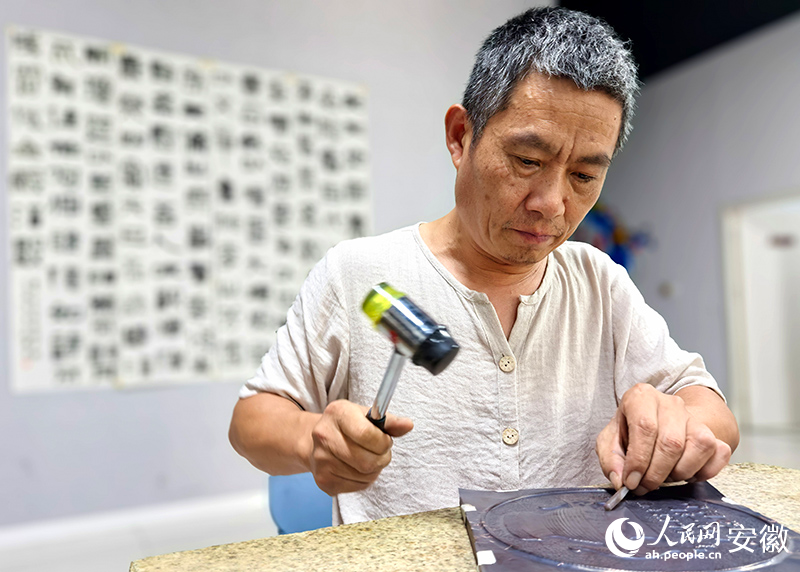
Wei Xianyang hammers copper foil at the Academy of Painting and Calligraphy in Nanling county, Wuhu, east China's Anhui Province. (People's Daily Online/Wang Ruihua)
The craft he practices is a hand-hammered copper relief technique, which is a fusion of woodblock printing and rubbing techniques. First, patterns are carved onto a board. Then, a piece of annealed copper foil is placed over the board and hammered repeatedly, gradually taking on every line and detail of the carved design.
"The copper foil must be kept between 0.1 and 0.12 millimeters thick. If it is too thin, it can tear easily; if it is too thick, it becomes difficult to shape," Wei said. The most crucial step is annealing, which involves heating the copper foil to around 350 degrees Celsius. If it is not heated enough, the copper will lack flexibility; if overheated, it will lose its strength.
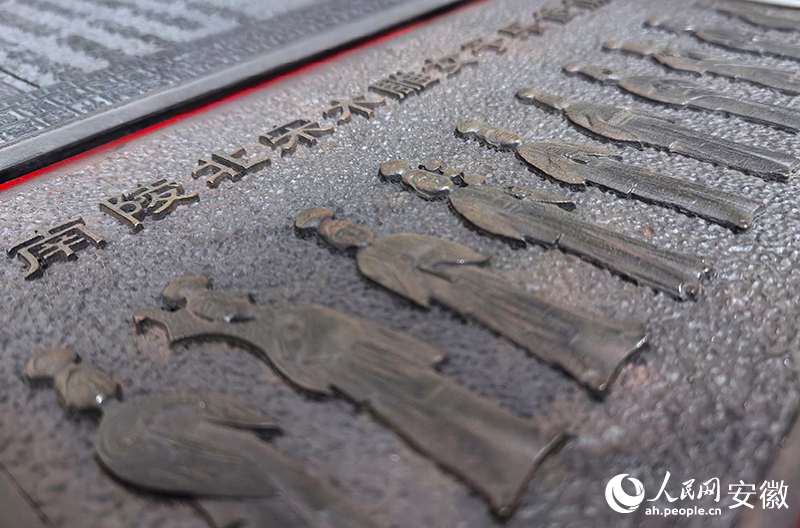
Photo shows a carving board featuring female musicians from a Northern Song Dynasty (960-1126) wooden sculpture in Nanling county, Wuhu, east China's Anhui Province. (People's Daily Online/Wang Ruihua)
Wei's craftsmanship was nurtured from an early age. Born in Nanling in 1972, he grew up watching his father, a renowned local artist specializing in iron calligraphy and iron painting, transform iron sheets into characters and copper sheets into artworks.
In the 1980s, Wei began learning the hand-hammered copper relief technique. After graduating from junior high school, Wei worked as an art teacher before opening an iron art workshop. Before opening the workshop, he held his first solo exhibition of iron calligraphy and paintings.
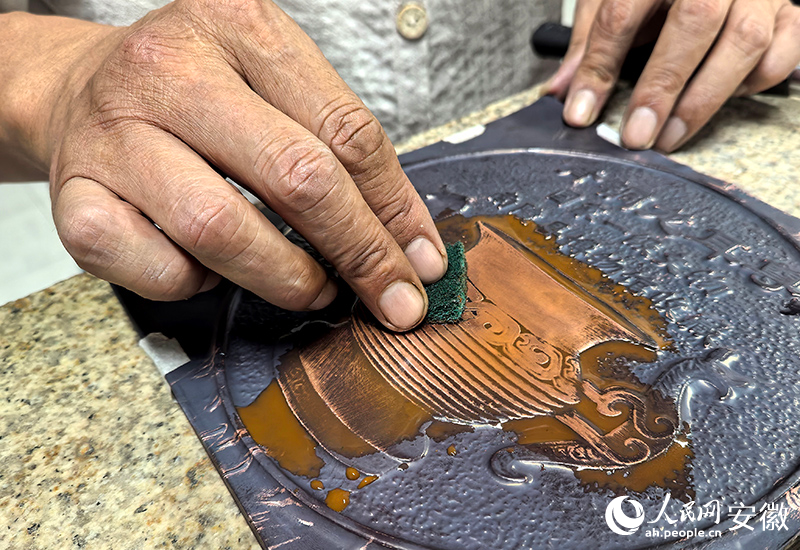
Wei Xianyang polishes a piece of artwork in Nanling county, Wuhu, east China's Anhui Province. (People's Daily Online/Wang Ruihua)
Over the years, Wei has trained more than 30 apprentices, but only a handful have stayed in the profession.
From around 1995 to 2000, Wei's business was at its peak. "We didn't even have finished pieces in stock because we couldn't make them fast enough," he recalled. At the time, people often displayed copper artworks at weddings, housewarmings and store openings as symbols of good fortune.
Today, the market has changed. Machine-made handicrafts are faster to produce and cheaper, while purely handmade works have become a niche interest. Yet Wei remains committed to his craft. "Only when people can afford it and enjoy using it can we talk about passing on the tradition," he said.
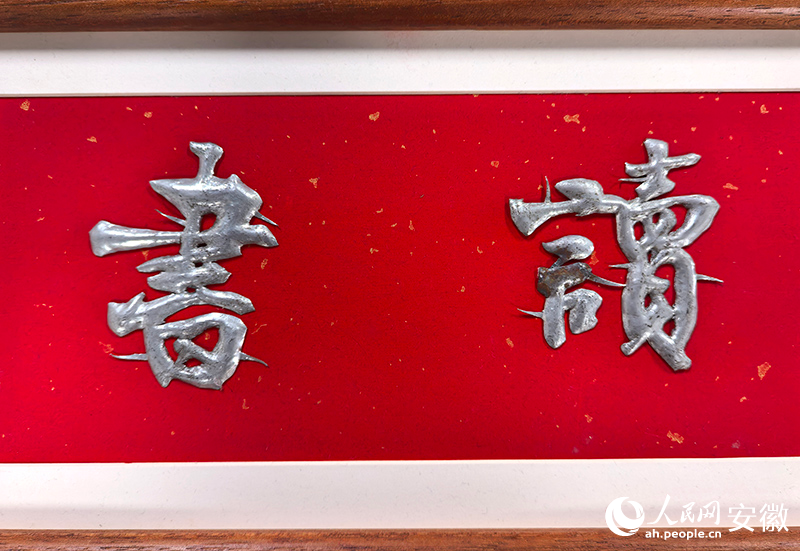
Photo shows an iron calligraphy work by Wei Xianyang. (People's Daily Online/Wang Ruihua)
"As long as my health allows, I'll keep hammering," Wei said.

Tel:86-10-65363107, 86-10-65368220, 86-10-65363106
 Scan the QR Code
 Follow Us