





- BRNN
- BRI News
- BRNN News
- Database
Official Documents Polices and Regulations
Inter-government Documents International Cooperation BRI Countries
Business Guide Economic Data BRI Data
Trade
Investment Projects Latest projects
Cases - Content Pool
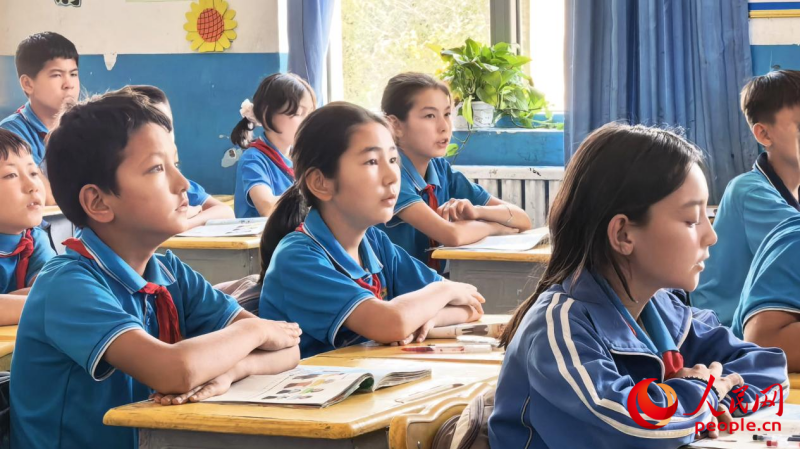
Adila Alim (second from left) attends an English class at Shuguang Elementary School in Qiatekale township, Gaochang district, Turpan, northwest China's Xinjiang Uygur Autonomous Region, June 16, 2026. (People's Daily Online/Nadila)
Adila Alim sat up straight in class at Shuguang Elementary School in Qiatekale township, Gaochang district, Turpan, northwest China's Xinjiang Uygur Autonomous Region, her eyes fixed on the blackboard. A little over a year ago, she could barely make out words on a page, with her face almost touching the book and her right eye able to detect only faint light.
Such turnarounds are not uncommon in Turpan, where medical aid workers from central China's Hunan Province, the birthplace of Mao Zedong, have transformed patients' lives and deepened ties between the two places. Locals call the aid workers, sent under China's paired-assistance program for Xinjiang, "Dr. Mao."
The name traces back to 2022, when a 94-year-old Uygur woman, after a heart stent procedure, thanked her doctors for coming from "Chairman Mao's hometown" to care for her. The nickname stuck.
A Hunan medical team providing free medical services in Shuguang village spotted Adila's condition on June 15, 2025. She had a severe corneal disease that required an urgent transplant. Officials quickly enrolled her in a charitable corneal transplant program with Aier Eye Hospital. She flew to Changsha, capital of Hunan Province, on June 29, underwent surgery on July 2, and is now back in class.
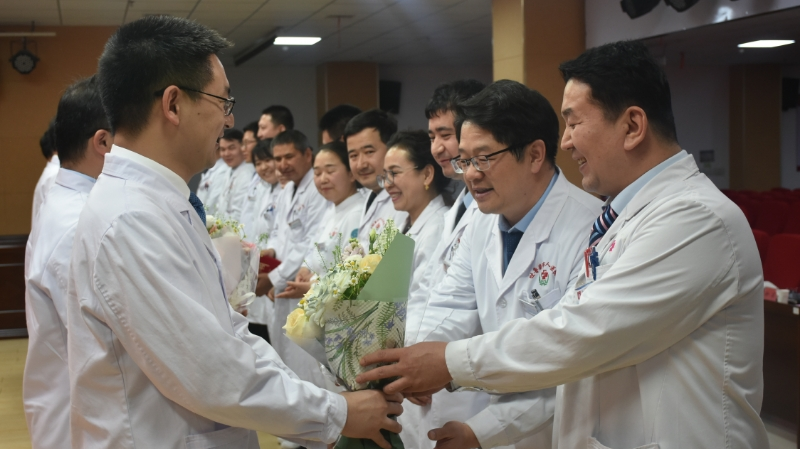
Trainees present flowers to their mentors at a ceremony at Turpan People's Hospital in Turpan, northwest China's Xinjiang Uygur Autonomous Region. The ceremony marks the launch of a team-based medical aid program run by central China's Hunan Province. (Photo courtesy of the Integrated Media Center of Turpan/Miliguli)
More than half a year later, at Turpan People's Hospital, cardiologist Zhang Yu, a medical worker providing aid in Xinjiang, led a team that cleared local resident Zhou Zhongguang's fully blocked artery and implanted three stents in under 90 minutes. "Without their timely rescue, I wouldn't have survived another five to 10 minutes," Zhou said.
Hunan's medical teams have introduced over 200 new techniques and programs, carried out community outreach covering more than 41,000 patient visits, and trained local doctors through a mentorship program.
"We're here to leave skills behind, not just perform surgeries," said Chen Guodong, head of Hunan's 10th medical aid group and the hospital's president.
With support from Hunan's aid teams, the hospital has established four national-level centers and four autonomous-region-level key specialties, including general surgery and gynecology.
Hunan has sent 477 medical experts in 10 groups to Turpan since 1998, building a medical team that continues to provide services for locals.

Tel:86-10-65363107, 86-10-65368220, 86-10-65363106
 Scan the QR Code
 Follow Us