





- BRNN
- BRI News
- BRNN News
- Database
Official Documents Polices and Regulations
Inter-government Documents International Cooperation BRI Countries
Business Guide Economic Data BRI Data
Trade
Investment Projects Latest projects
Cases - Content Pool
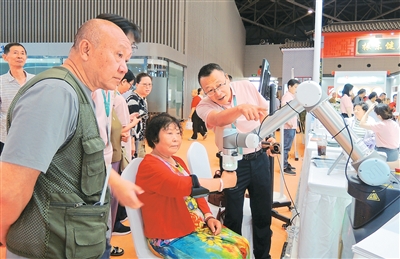
Visitors try out a single-joint exoskeleton robot at a silver economy cooperation and exchange event in Taiyuan, north China's Shanxi Province. (Photo/Fan Genlin)
China is stepping up efforts to expand the supply of products and services for its elderly population. A plan for expanding consumption during the 15th Five-Year Plan period (2026-2030) calls for greater development of urgently needed products, including elderly-friendly daily necessities, leisure and companion products, functional clothing, rehabilitation aids, care robots, multifunctional nursing beds and health monitoring devices.
By the end of 2025, China had 323.38 million people aged 60 and above, accounting for 23 percent of the country's population.
A search for "silver economy" and "elderly-friendly" products on e-commerce platforms brings up mobility aids, bathing aids, handrails, physiotherapy equipment, rehabilitation devices and emergency call buttons. Functional assistance is a key feature of these products and a basic need for many older consumers.
Data from the State Administration for Market Regulation shows that by the end of April 2025, China had 216,000 types of elderly-friendly products involving nearly 10,000 companies. Mobility aids, daily living aids, home safety products, nursing supplies, rehabilitation equipment and health-monitoring devices have all seen notable growth.
A report released by the China National Committee on Aging this year has found that functional food and clothing are the most sought-after categories, with more than 70 percent of respondents expressing demand for them. Home-based elderly-friendly renovations ranked second, followed by smart products and anti-aging products and technologies.
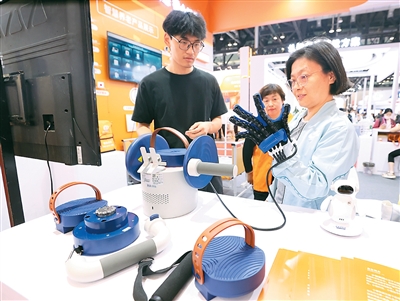
A visitor tries out a multi-functional rehabilitation training system at the 12th China International Senior Services Expo in Beijing. (Photo/Chen Xiaogen)
The traditional view that older people "save more and spend less" is also changing as increasingly well-educated and higher-income groups enter retirement.
A 2025 report on Shanghai's silver economy found that "new retirees" are becoming a major consumer group, with strong demand for cultural and tourism activities, health and wellness products, and smart devices. Spending on parents and preparations for later life are also on the rise.
In 2025, elderly-friendly home renovations were included in a government subsidy program for home improvements, driving sales of 7.21 million related products. More than 9,000 residential communities underwent elderly-friendly and accessibility upgrades.
"The consumption needs and preferences of people born in the 1950s and 1960s are becoming increasingly diverse as their incomes rise and their lifestyles are influenced by the internet, artificial intelligence and big data," said Yuan Xin, a professor at Nankai University.
Wang Qi, head of health and wellness marketing at the Wellness Smart Promotion Department of Panasonic's China & Northeast Asia arm, said sales of oxygen generators have surged over the past two years as demand for better health management has grown. The products are no longer used only by people with respiratory problems, but are also being chosen by older consumers seeking a more comfortable home environment and better quality of life.
Other popular products include smart beds that can adjust sleep settings and monitor health in real time, as well as electric wheelchairs, movable handrails and massage devices.
Businesses are responding to the growing demand. Value-added tax invoice data from China's State Taxation Administration show that in the first half of 2025, sales revenue from elderly-friendly fitness equipment, rehabilitation aids, and nutritional and health care food manufacturing grew 14.7 percent, 12.1 percent and 6.9 percent year on year, respectively.
Revenue from smart elderly-care technology services and smart and wearable equipment for older people grew even faster, by 33.7 percent and 32.6 percent, respectively. The number of businesses engaged in manufacturing silver-economy products rose 14.1 percent year on year during the same period.
The market is also expanding beyond "rehabilitation" and "assistance" as more older consumers seek beauty, fashion, technology and higher-quality lifestyles.
A survey by France-based cosmetics producer L'Oréal found that 91 percent of consumers believe age is just a number, while 77 percent are willing to try new things later in life. The survey said older consumers are using a wider range of skincare and makeup products and are increasingly willing to explore new beauty and lifestyle options.
Some cities are already exploring new applications. In Shanghai, millimeter-wave radar for contactless monitoring and fall-detection eye-protection lamps are being used in nursing homes. Anti-shake smart wristbands and lightweight exoskeleton robots have been included in rehabilitation-aid rental programs, while a semi-humanoid elderly-care robot is expected to enter the market in 2026.

Tel:86-10-65363107, 86-10-65368220, 86-10-65363106
 Scan the QR Code
 Follow Us