





- BRNN
- BRI News
- BRNN News
- Database
Official Documents Polices and Regulations
Inter-government Documents International Cooperation BRI Countries
Business Guide Economic Data BRI Data
Trade
Investment Projects Latest projects
Cases - Content Pool
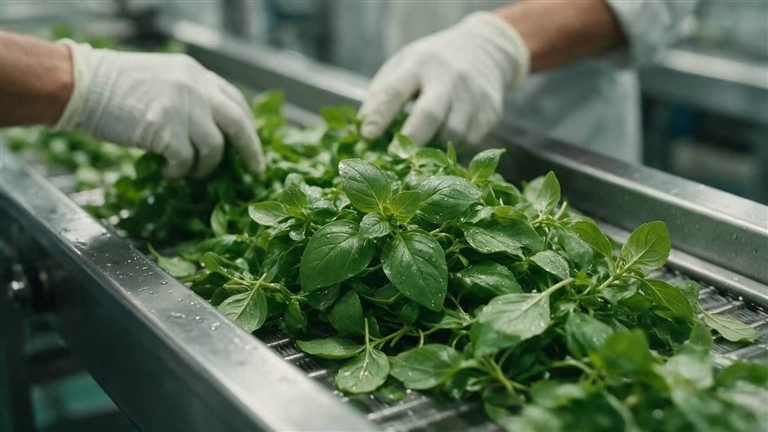
Photo shows a jingjie sauce production line in central China's Henan Province. (Photo courtesy of the interviewee)
If one flavor defines Henan's cuisine, it's jingjie, a mint-like herb known in English as Schizonepeta, whose sharp, cooling flavor is found in dishes across the province in central China.
Long valued in traditional Chinese medicine as well as home cooking, jingjie has moved beyond the dinner table to inspire new products, drinks and tourism experiences — a shift from a humble local herb to what is now sometimes called a "flavor economy."
In Kaifeng, which was the ancient capital of the Northern Song Dynasty (960—1127), restaurants serve jingjie in dozens of forms: cold jingjie with sauce, pancakes with jingjie, egg soup with jingjie, noodles with jingjie, and soup dumplings with jingjie.
The herb's culinary roots run deep — in the Northern Song Dynasty, cold jingjie with sauce was a signature dish served to travelers, scholars and merchants visiting the capital, giving rise to a local expression: "to have eaten a big plate of jingjie," meaning someone is worldly and experienced.
Jingjie's history as a medicinal herb dates back more than 2,000 years. It was first recorded under an earlier name in a medical text during the Eastern Han Dynasty (25-220) and was later mentioned in texts from the Tang (618-907), Song (960-1279) and Ming (1368-1644) dynasties for its cooling, detoxifying properties.
It grows easily across the Huanghuai region, including Henan, Shandong, Hebei, Shanxi and Anhui provinces, and needs little care to thrive.
For Henan natives living elsewhere, a bundle of fresh jingjie is a taste of home.
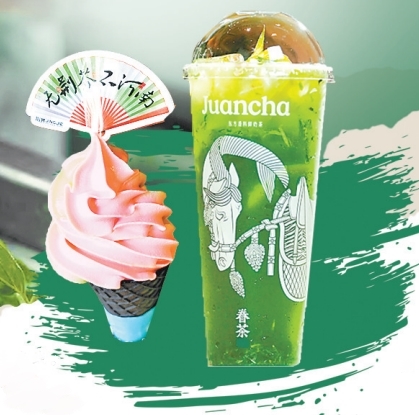
Photo shows ice cream and lemon tea with jingjie. (Photo courtesy of the interviewee)
"Jingjie back home has real bite — the more you eat it, the more you crave it," said Wang Xiaowei, who works in Quzhou, east China's Zhejiang Province, and made a point of eating jingjie dishes during a recent trip home to Xiangcheng in Xuchang.
Jingjie farming today remains largely fragmented, dominated by small individual growers with inconsistent yields and uneven quality. Sales depend heavily on wholesale markets, where prices can swing sharply — a structure ill-suited to supporting an industrialized, standardized consumer market.
Fugou county, known as the "vegetable basket" of central China, has worked to change that, turning Liansi town into a characteristic town centered on jingjie.
Farmer Liu Aimin, who grows the herb in Zhangdian village of the town, said better seed varieties and green farming standards now let him harvest a crop every 20-odd days in summer, yielding 1,500 to 2,000 kilograms per mu (1 mu equals about 0.067 hectares), while winter greenhouse cultivation lets him sell the herb out of season for 40 to 60 yuan (about $5.96 to $8.94) per kilogram.
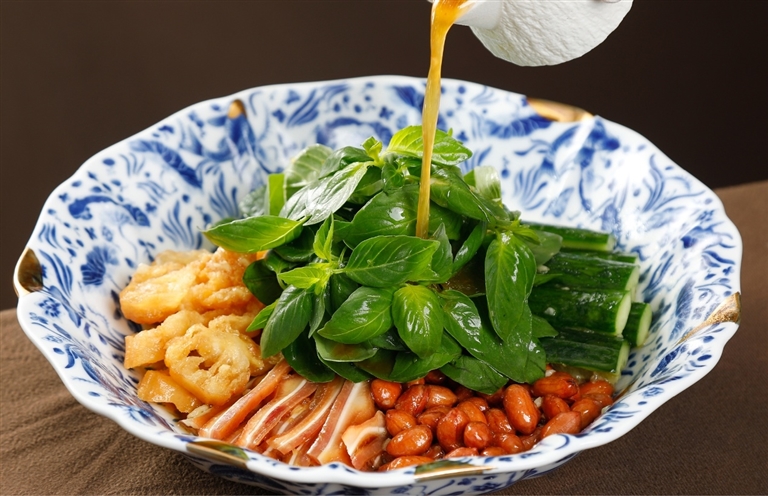
Photo shows a dish of cold jingjie with sauce. (Photo courtesy of the interviewee)
By combining open-field and greenhouse farming, Fugou has turned jingjie into a year-round crop; Liansi town alone now grows it on more than 4,300 mu of farmland, producing over 32,500 tonnes a year.
Younger farmers have embraced e-commerce to sell directly. Sang Jiyuan, 26, livestreams daily harvests from his family's fields, selling more than 100,000 orders online each year.
Fugou has also registered a "Fugou Jingjie" trademark and established standardized procedures covering everything from planting to sales, trucking the herb daily to major agricultural wholesale markets in cities including Beijing, Shanghai and Guangzhou.
In Puyang, Henan, farmer Yuan Zhiwei recalled once selling more than 1,000 kilograms of jingjie to a company in Shandong Province for use in seasoning packets.
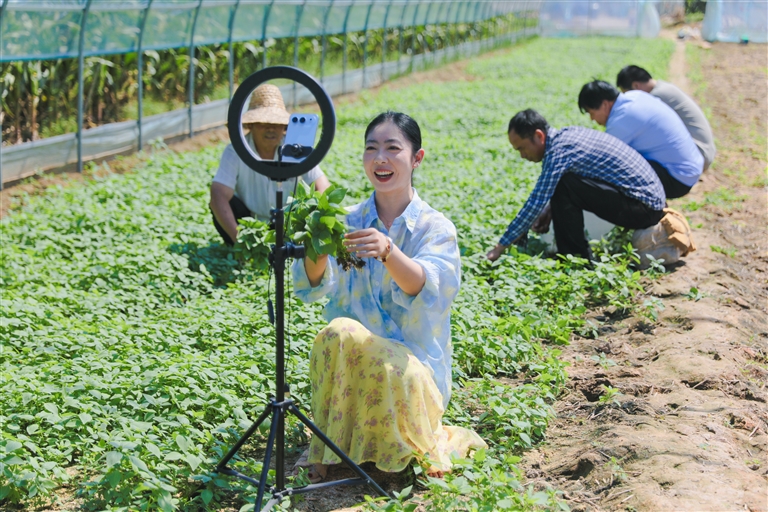
A livestreamer promotes jingjie at a jingjie growing base in Zhangdian village, Liansi town, Fugou county, central China's Henan Province on Aug. 31. (Photo/Song Fuxing)
In Zhengzhou's Weichuan town, farmer Liu Zongfu has supplied a local tea brand called Juancha Zhenxuan since 2025, saying jingjie's fast growth cycle — as short as 20-plus days per harvest, with six to seven harvests a year — combined with stable buyer pricing has increased his per-mu returns nearly tenfold. Quality standards are strict, though: the brand requires large, fresh, fragrant leaves free of pest damage or pesticide residue.
If farming determines jingjie's supply, processing and consumer trends are expanding its potential.
In Puyang, a company's smart factory blends the herb with Ethiopian coffee beans to make cold brew instant coffee.
In Zhengzhou, Juancha Zhenxuan has built part of its brand around jingjie drinks, including a signature jingjie lemon tea that sells an average of 200,000 cups a month. The chain, with more than 80 stores nationwide, uses high-pressure processing to preserve fresh jingjie, which is shipped by cold-chain trucks to a partner factory in south China's Guangxi Zhuang Autonomous Region, where it is processed into frozen juice concentrate to preserve its flavor and nutritional value.
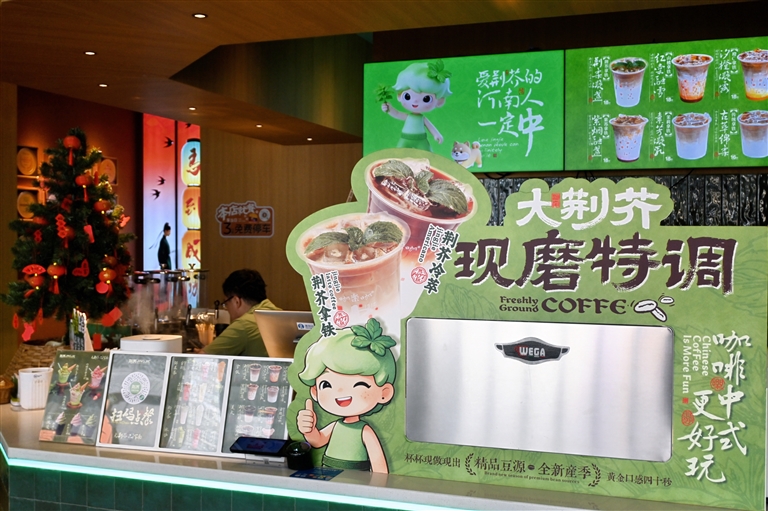
A billboard at a shop shows coffee with jingjie in Zhengzhou, central China's Henan Province. (Henan Daily/Wang Yanhui)
Local restaurateurs in Henan have joined in too. Li Bin, who has run Henan folk-cuisine restaurants for years, rebranded several locations around a signature jingjie dough drop soup in 2024, calling it a dish that taps into a shared culinary memory unique to the province. His flagship store now doubles as a retail showcase, selling jingjie-based products including sauces, beer, ice cream, coffee and even pizza as souvenirs.
Turning a local Henan herb into a genuine viral ingredient and trendy product line depends on strong branding and supply chain integration, finding the right market positioning, and linking agriculture with dining and the cultural and creative industries, said Jin Zhongxing, deputy secretary-general of the Henan Catering and Accommodation Industry Association.

Tel:86-10-65363107, 86-10-65368220, 86-10-65363106
 Scan the QR Code
 Follow Us