





- BRNN
- BRI News
- BRNN News
- Database
Official Documents Polices and Regulations
Inter-government Documents International Cooperation BRI Countries
Business Guide Economic Data BRI Data
Trade
Investment Projects Latest projects
Cases - Content Pool

Parents and children take part in an activity at an adventure park in Lianyungang, east China's Jiangsu Province. (Photo/Wang Jianmin)
China's mountains, trails, and rivers are drawing a new generation into the outdoors. More than 400 million people across the country now take part in outdoor sports, according to the China Outdoor Sports Industry Development Report (2024–2025) — and young people are driving much of that growth.
The report found that young and middle-aged adults make up the bulk of outdoor sports participants, with the 25-to-34 bracket accounting for the largest share and tending to be more highly educated.
Behind this boom is a shift in how young people live and think. For them, outdoor sports are less about fitness than about unwinding and recharging.
Along the Liangma River in Beijing, weekends draw crowds of young people to a stretch of trendy outdoor pursuits — paddleboarding, kayaking, camping, and picnicking.
In recent years, cities including Shanghai, Shenzhen, Guangzhou, and Wuhan have seen a boom in outdoor destinations. For some young people, these spots have become reason enough to get out of the house and into the open air.
For Xiaolin (pseudonym), a young woman born after 1995, her outdoor lifestyle all began with a trip to a trendy getaway.
"I used to spend my weekends at home alone watching variety shows and ordering takeout when I got hungry. Then, for a while, my friends kept posting photos of their camping trips. I was tempted to try it myself, so I invited a few friends to go camping together," Xiaolin said. She gradually accumulated all manner of camping gear and, as the trips became more frequent, fell in love with the outdoors.
Outdoor activities are becoming part of young people's lives in different ways. Some prefer going solo, while others enjoy going with friends. Whatever the way they choose to venture into the outdoors, young people are increasingly valuing the genuine physical and emotional experiences that nature offers along the way.
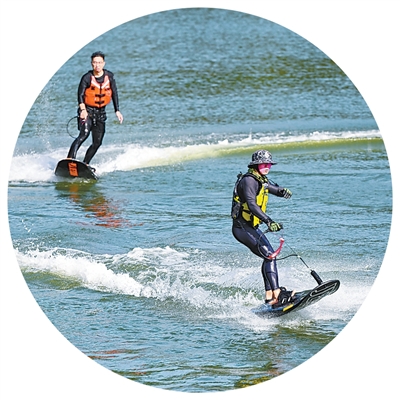
Young people try power surfing at a sports camp in Jishi'gang town, Haishu district, Ningbo, east China's Zhejiang Province. (Photo/Hu Xuejun)
"For a while, I was obsessed with buying outdoor gear, from equipment to clothing, and spent quite a lot of money. Later, I realized that the joy of being outdoors doesn't come from having all the gear or the most expensive gear, but from the genuine experience of being active outdoors," Xiaolin said.
Wang Zhaohong, deputy head of the College of P.E. and Sports under Beijing Normal University, said the outdoor boom reflects changes in the lifestyles and emotional needs of today's youth. Young people are trading material goods for life experiences — and increasingly willing to pay for time outdoors and the feeling it brings. Their concept of health is also evolving, with growing attention to physical fitness and a greater desire for healthier lifestyles.
At the same time, prolonged screen time can leave young people feeling empty, prompting them to step away from their devices and into nature — where they can slow down, clear their heads, and spend time with friends without the pressure to perform.
Why do outdoor activities keep drawing young people in? Ask them, and many give the same answer: stress relief. But that's only part of it. Outdoor pursuits also offer something harder to come by: a sense of accomplishment.
Pei Linru, a counselor at Wuhan University of Science and Technology and an outdoor enthusiast, has witnessed firsthand the growing enthusiasm for outdoor activities among young people across her years of working with students, as well as the many ways such activities contribute to their growth.

Cycling enthusiasts cycle along the bank of Exi River in Fanchang district, Wuhu, east China's Anhui Province. (Photo/Xiao Benxiang)
Pei said the most immediate benefit of outdoor activities is improved physical fitness. Some students who once struggled to complete a 1,000-meter run for their physical fitness tests have seen significant improvements after making outdoor activities a regular habit.
Pei also noted that for young people, efforts at school and in the workplace often take a long time to pay off — and even then, the outcome can be uncertain. Outdoor activities, by contrast, have clear goals, and the payoff usually arrives within a predictable time frame. That, she said, can steadily build young people's sense of self-efficacy and give them an important psychological resource for coping with pressure.

Tel:86-10-65363107, 86-10-65368220, 86-10-65363106
 Scan the QR Code
 Follow Us