





- BRNN
- BRI News
- BRNN News
- Database
Official Documents Polices and Regulations
Inter-government Documents International Cooperation BRI Countries
Business Guide Economic Data BRI Data
Trade
Investment Projects Latest projects
Cases - Content Pool
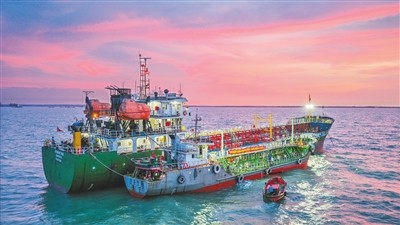
A bunkering vessel operated by an energy subsidiary of Yangpu Holding Co., Ltd. supplies bonded marine fuel to the international vessel Ponpattra. (Photo/Deng Xiaolong)
On a recent afternoon, the waters off Yangpu Port in south China's Hainan Province were calm as the bunkering vessel Yong Cheng 166 pulled alongside a giant ocean-going ship.
A fuel hose was connected between the two vessels, delivering bonded marine fuel into the ship's tanks. In a sense, the ship was having a meal before setting off on its next voyage.
"Fueling a ship now takes about 30 percent less time than it used to," said Lin Lifeng, captain of Yong Cheng 166. "It's like the ship is having fast food."
The scene is becoming increasingly common in Yangpu, which is stepping up efforts to establish itself as an international bonded marine fuel bunkering center, or a "floating gas station" for ships sailing global routes.
For ships, fuel is one of the major operating costs of international voyages. Bonded marine fuel is exempt from customs duties, value-added tax and consumption tax, allowing ships to cut fuel costs by about 15 percent compared with regular fuel.
And in Yangpu, the "menu" is becoming increasingly attractive.
An executive of the company operating a Panama-flagged bulk carrier said he had compared bonded-fuel bunkering costs at several nearby ports and found Yangpu the most competitive.
Including port berthing fees, a single fueling operation in Yangpu can save about 640,000 yuan ($95,000), according to the executive.
The port has also expanded the places where ships can "eat."
Bunkering used to be available mainly at port berths. Now, Yangpu has designated a 38-square-kilometer area as two dedicated outer anchorages, where vessels of up to 200,000 tonnes can bunker without entering the port.
If fueling at a berth is like "dining in," fueling at an outer anchorage is more like "having takeout." The bunkering vessel simply sails out to meet the ship at the designated location.
Yangpu has also introduced a streamlined border inspection service for foreign vessels bunkering at the outer anchorages. Applications and procedures can be handled online, allowing inspectors to board the vessel and complete the required formalities in about 10 minutes.
The "takeout" service has another advantage: foreign vessels bunkering at the outer anchorages can be exempted from tonnage-tax inspection.
"The savings in tonnage tax and fuel costs are expected to reduce international shipowners' operating costs by an average of 500 yuan per tonne," said Xie Yuting, manager of the bonded-fuel department of Sinopec Fuel Oil (Hainan) Co., Ltd.
The delivery range of Yangpu's "takeout service" has also expanded beyond Hainan.
Under an innovative model known as "dual-use vessels plus direct cross-customs-area supply," a bunkering vessel registered with customs can both supply bonded marine fuel to eligible international vessels and transport domestically produced fuel oil over short distances within China.
In other words, one "delivery rider" can take several orders on a single trip.
The model has enabled Yangpu-based bunkering vessels to deliver bonded fuel to ships calling at ports in south China's Guangxi Zhuang Autonomous Region, including Qinzhou Port and Fangchenggang Port.
Before the model was introduced, some ships calling at ports in Guangxi had to make a detour to Yangpu to refuel. Now, they can stay on their original routes while a bunkering vessel delivers fuel from the Hainan Free Trade Port directly to them.
As of the end of May 2026, participating vessels had bunkered more than 580,000 tonnes of bonded fuel and transported more than 230,000 tonnes of oil products under the model, saving fuel suppliers nearly 10 million yuan in annual operating costs.
The growing popularity of Yangpu as a refueling stop is also reflected in the number of ships coming for a fuel-up.
"Previously, only a few ships came here for bunkering each month, and suppliers had to actively seek customers," said Sun Jianpeng, head of the risk prevention and control center of the Yangpu Maritime Safety Administration. "Now we serve more than 20 vessels a month, and many ocean-going ships are choosing Yangpu as a regular bunkering port."
To put it another way, Yangpu used to look for ships to serve. Now ships come looking for fuel.
The port is now preparing a greener menu, too. Yangpu is exploring bonded bunkering policies for biofuels, methanol and liquefied natural gas (LNG), among other clean marine fuels.
In July 2025, China's first methanol dual-fuel container ship, COSCO Shipping Yangpu, made its maiden call at Yangpu International Container Terminal and bunkered 200 tonnes of domestically produced green methanol.
The development of the bunkering business is part of Yangpu's broader ambition to become an international shipping hub. The port currently has 68 container liner routes and is expanding its bonded-fuel storage, trading and bunkering capabilities while improving port infrastructure and shipping connectivity.
As of Aug. 18, 2026, 101 vessels with a combined gross tonnage of more than 5.2 million had been registered under the "China Yangpu Port" ship registry, with total deadweight tonnage exceeding 8.9 million tonnes.
The number of registered vessels and the total deadweight tonnage have continued to rank among the highest in China's free trade zones and ports.
For Xie, Yangpu's ambition goes beyond simply becoming a place where ships stop to refuel.
"Hopefully, the bunkering industry will help raise the overall level of Yangpu as an international shipping center and turn it into a regional bonded-fuel bunkering hub comparable with Singapore and Zhoushan," she said.
As the sun set, Lin guided Yong Cheng 166 through its final bunkering job of the day. The fuel hose was pulled back, and the ship it had just served sounded its horn and sailed into the distance."Refueling used to mean losing time," Lin said with a smile. "Now it means saving time. Yangpu's 'floating gas station' is becoming more and more international."

Tel:86-10-65363107, 86-10-65368220, 86-10-65363106
 Scan the QR Code
 Follow Us