Two German writers retrace the Long March by bicycle
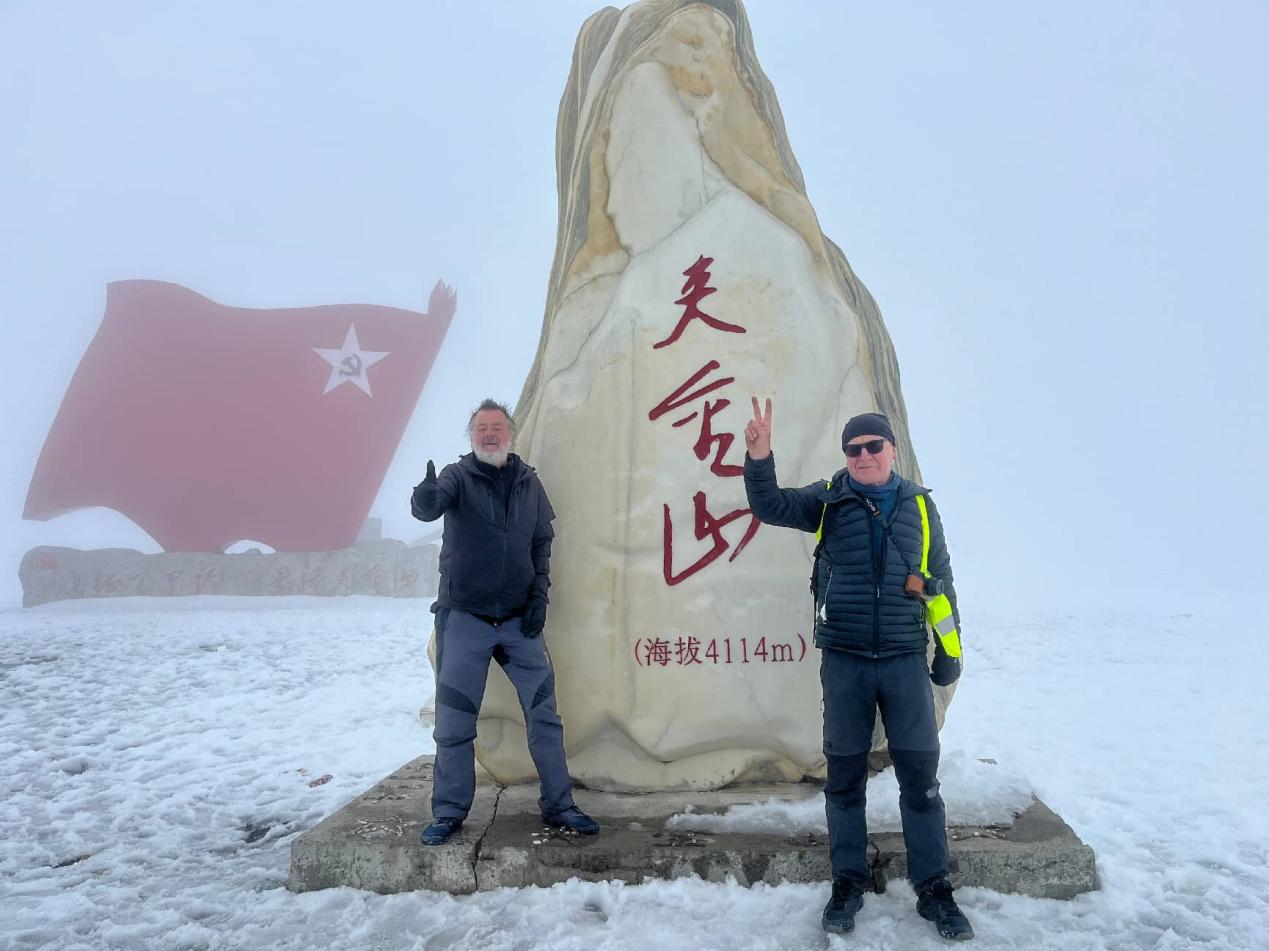
Volker Haering (left) and Christian Y. Schmidt pose for a photo at the 4,114-meter mountain pass of Jiajin Mountain in southwest China's Sichuan province. (Photo courtesy of the interviewees)
The hall of the Chinese Cultural Center in Berlin was filled with anticipation. Many local residents arrived early to hear German writers Volker Haering and Christian Y. Schmidt share the story of their bicycle journey retracing the route of the Long March (1934-1936), a military maneuver by the Chinese Workers' and Peasants' Red Army that later became a defining chapter in modern Chinese history.
In 2023 and 2024, the two men set out from Ruijin, east China's Jiangxi province. Cycling westward and then northward, they followed the path taken by the Central Red Army, eventually reaching Wuqi county in Yan'an, northwest China's Shaanxi province, after more than four months on the road.
"If you don't understand the spirit of the Long March, you cannot truly understand China."
Haering still vividly remembers hearing those words more than two decades ago from a veteran Red Army soldier.
"From that moment on, I knew I had to make this journey myself," he said with conviction.
Following in the footsteps of the Red Army

A local girl in Xingyi, southwest China's Guizhou province, teaches Chinese to Christian Y. Schmidt at a restaurant. (Photo courtesy of the interviewees)
The pair began their story at Jiajin Mountain in Sichuan Province, known locally as the "Mountain of Death."
In June 1935, the Central Red Army arrived at its foot -- the first snow-covered mountain they encountered during the Long March.
"As we climbed higher, the vegetation gradually disappeared. Steep cliffs stretched into the distance, and icy winds mixed with rain and snow cut through us," Haering recalled.
Schmidt, then 67 years old, suffered severe altitude sickness and could only continue with medication. By the time the two cyclists reached the 4,114-meter pass, they were completely exhausted.
"Ninety-one years ago, Red Army soldiers -- wearing thin cotton uniforms and straw sandals, while under enemy pursuit -- crossed these snow-covered mountains over seven days and nights," Haering said. "We were riding electric bicycles and dressed in modern outdoor gear, yet we felt we had reached our physical limits."
Schmidt agreed. "Only after experiencing it yourself can you truly understand how dangerous the snow mountains were, and only then can you fully appreciate the Red Army's resilience and courage."
Haering first learned about the Long March at the age of 15 and was deeply fascinated by its history. Over the following decades, he read extensively about its history.
What has enabled the spirit of the Long March to inspire generations of Chinese people?
Driven by that question, Haering, at age 54, embarked on the journey with his friend Schmidt.
The nearly 7,000-kilometer trip was far more than an adventure. It became a test of both physical endurance and determination.
During freezing nights, they often struggled to sleep. In western Sichuan province, bitter cold, strong headwinds, high altitudes, and continuous mountain roads made even downhill riding extremely difficult. In the latter half of the trip, their electric bicycles also suffered frequent mechanical failures.
Haering told People's Daily that cycling the route helped him better understand the hardships the Red Army endured, and also gave him a greater appreciation of China's transformation over the decades.
Encounters along the Route
If the snow mountains, grasslands and gorges revealed the harsh realities of the Long March, the people they met along the route showed them another side of China.
"We're constantly invited to meals," Haering joked. As they cycled through China, once locals learned they were retracing the Long March, initial reserve and wariness quickly gave way to hospitality and respect.
In a small-town restaurant, while the two were eating, a group of curious children gathered around their table. Before long, the children had become their Chinese-language teachers, patiently helping them practice pronunciation.
"The children's smiling faces remain among the most touching memories of the entire trip," Haering recalled.
In Xichang, Sichuan province, an experienced bicycle shop owner surnamed Dai, who had run his business for more than 30 years, helped replace their chains and tires and offered practical cycling advice. In Yan'an, an English-speaking local tour guide surnamed Li showed them around many revolutionary heritage sites.
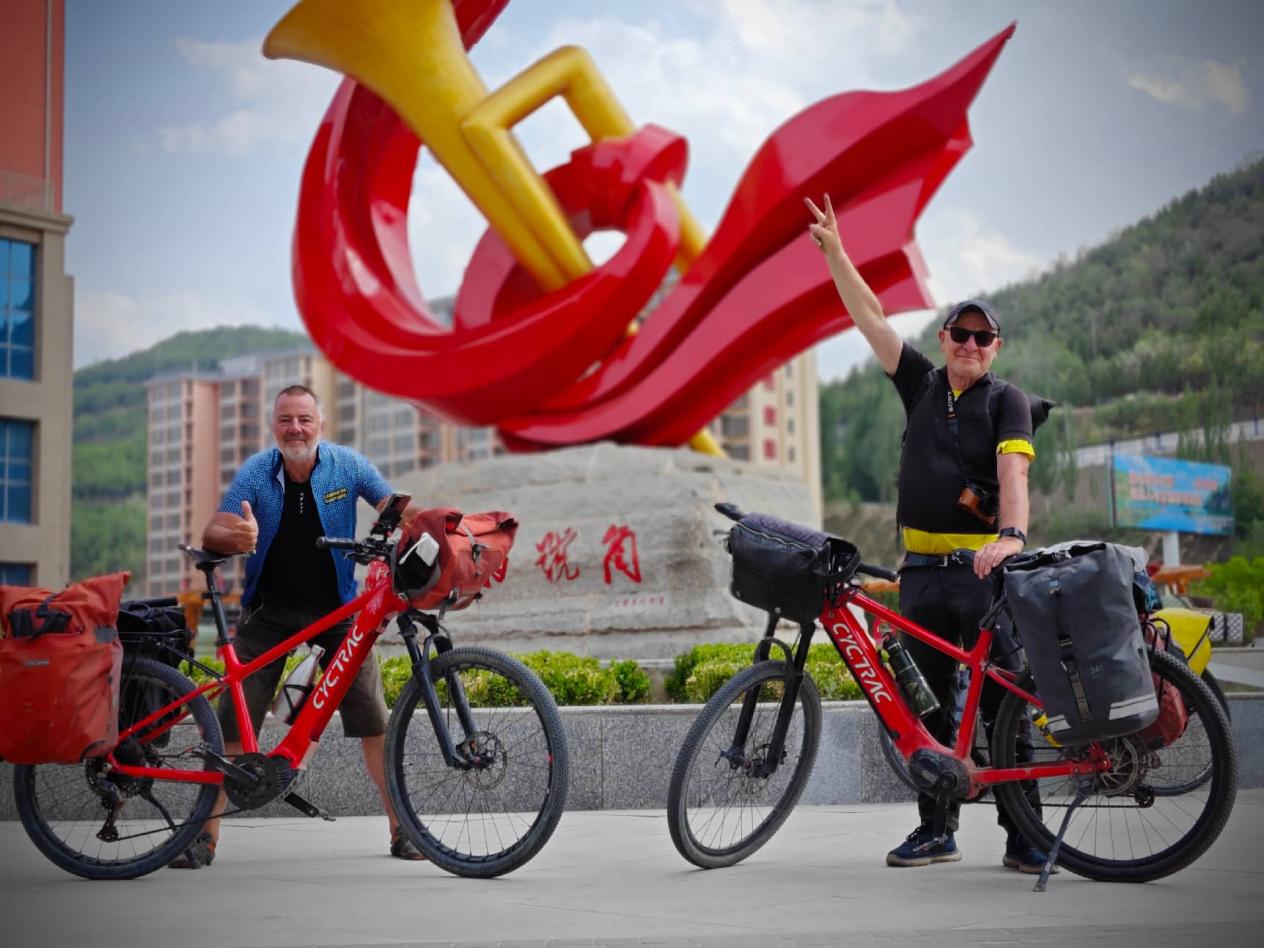
After more than four months of cycling, Volker Haering (left) and Christian Y. Schmidt arrived at Wuqi county in Yan'an, northwest China's Shaanxi province, the destination where the Central Red Army concluded the Long March. The photo shows the two posing in front of a sculpture in memory of the success of the Long March. (Photo courtesy of the interviewees)
Sharing China's story through personal experience
"Meeting so many kind and genuine Chinese people was the greatest reward of the journey," Haering said.
In October 2025, the two published the book Der lange Fahrrad-Marsch: 7.000 Kilometer durch das Reich der Mitte in Germany.
They subsequently held book-sharing events in Hamburg, Leipzig, Berlin, and other German cities, where many readers lined up with copies, waiting for the authors' signatures.
"Books and articles alone are not enough if you want to help Western audiences truly understand China. First-hand experience is essential," Haering said.
He noted that since China expanded its visa-free entry policies, increasing numbers of overseas tourists and content creators have traveled to China, documenting what they see through photos and videos.
"That is a very positive change," he said. "When people see China with their own eyes, they can form their own judgments."
This was far from Haering's first effort to introduce China to Western audiences.
When he first visited China in the 1990s, he knew little about the country. More than three decades later, he has cycled over 60,000 kilometers across China, leading numerous cycling tours through both cities and rural areas. Among his friends, he has become known as a "China expert."
During their journey across the Dadu River in Sichuan, Haering saw many newly built dams, while elevated bridges and high-speed rail lines were under construction.
Infrastructure in China has improved tremendously, he said. "Today, digital technologies such as mobile payment and electronic maps have become deeply integrated into every aspect of travel, making journeys much more convenient."
Schmidt shared the same impression. He recalled that traveling to remote areas, especially plateau regions, once involved long and difficult journeys. Today, China's expanding high-speed rail network has made many destinations far more accessible.
When asked how he understands the spirit of the Long March, Haering said it lies in the strength of unity and the unwavering commitment to a shared goal.
"It is a spirit of solidarity," he added. "When people share the same purpose, work together, and pool their efforts toward a common goal, there is no obstacle that cannot be overcome."
He believes that this spirit continues to shape today's China. "Drawing strength from the spirit of the Long March to overcome challenges, deliver concrete results, and pursue long-term development is, in my view, one of the important reasons behind China's remarkable achievements," Haering said.

 Follow Us
 Scan the QR Code
