More rural residents in China are travelling
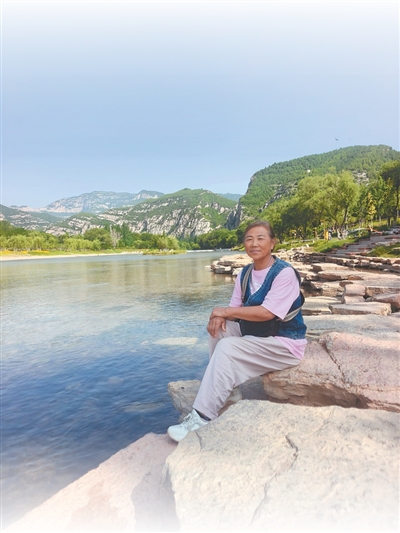
Qin Shifang, a farmer from Anyang, central China's Henan Province, poses for a picture during a trip to Taiyuan, north China's Shanxi Province, in July 2026. (Photo courtesy of the interviewee)
"I'm in my 60s now, and I want to go out and see the beautiful landscapes of my motherland. Once I finish planting wheat, I'll head south."
Two years ago, Qin Shifang, a farmer from Anyang, central China's Henan Province, never imagined that these words, spoken during a livestream with a host, would strike a chord with so many netizens.
Data released by the Ministry of Culture and Tourism showed that in 2025, rural residents in China made 1.53 billion domestic trips, up 22.6 percent year on year. Their travel spending surpassed 1 trillion yuan (about $150 billion), up 21.4 percent year on year.
Qin has spent most of her life in Xixin'an village, Baibi town, Anyang. In the past, she tended her crops throughout the year. Today, large agricultural machinery has moved into the fields, freeing her from farm work during busy seasons. Over the years, Qin has sold vegetables in the city, worked as a cleaner, and run a small convenience store with her husband, significantly boosting their income.
In November 2024, Qin arrived in southwest China's Yunnan Province and stayed at a hotel by the Lancang River through a "work-for-accommodation" arrangement. More than two months later, she traveled to Dali, Yunnan, where she visited Erhai Lake, explored villages and sampled local cuisine, before returning to Henan at the end of April 2025.
In December 2025, Qin set off for Xishuangbanna Dai Autonomous Prefecture of Yunnan, to spend the winter. She took a job at a local restaurant, earning 100 yuan a day.
"The corn harvest will start soon. Once it's finished, I plan to visit Mount Huangshan," she said.
Qin's story reflects the growing number of farmers who want to go out and see more of the world. A survey by the China Tourism Academy showed that in 2025, 81 percent of rural residents expressed a willingness to travel, while rural residents contributed 31.8 percent to the growth in domestic tourist numbers. In the first half of 2026, rural residents made 869 million domestic trips, accounting for about one quarter of all domestic trips.
Zhang Jianxin, a villager from Qili village, Fangshan town, Qufu, east China's Shandong Province, boarded a high-speed train with his wife and daughters. They were heading to Rizhao, Shandong, to see the sea — a long-cherished wish the children had talked about for years.
"It wasn't that we didn't want to travel; we just didn't dare to," Zhang said. "A family trip costs money at every turn — transportation, accommodation, meals, ticket. In the past, those few small plots of land we farmed earned less than 1,000 yuan per mu (one mu is about 0.067 hectares) a year."
Why are they able to travel now?
First, they have more money to spare. In 2024, the village built 20 greenhouses to help farmers achieve common prosperity. Zhang rented one greenhouse and now earns tens of thousands of yuan more each year.
Two years ago, Zhang and his wife had planned to travel, but his father was already in his 70s. They worried that taking him on a long trip would be too physically demanding, while leaving him home alone would leave them concerned about his daily needs. After much consideration, they decided to put the plan on hold.
Today, the village's elderly care services have gradually improved, with a community canteen and senior apartments built to help address older residents' dining and living needs.
"With our worries at home taken care of, we can finally travel with peace of mind," Zhang said.
A combination of measures has made travel something farmers can both afford and enjoy.
"I'm 68 years old, and this is my first time leaving Xinjiang," said Tu'erxunguli Abudigeli, a resident of Yuqiwusitang township in Kuqa, northwest China's Xinjiang Uygur Autonomous Region. In February, she traveled to northwest China's Shaanxi Province with 47 other villagers from the township.
How was the trip funded?
Wang Weiwei, deputy Party secretary of the township, said the village collective covered transportation, accommodation and meals. The township had contacted a cultural and tourism company at the destination in advance, enabling villagers to buy discounted group tickets for scenic spots. Villagers only needed to pay for personal expenses such as shopping.
Organizing trips for villagers with collective funds is not unique to this township. In March 2025, Xiarelejin village and Wurimuzegede village in Beilinharimodun township, Bole city, Xinjiang, jointly invested 130,000 yuan to organize a trip to Hong Kong, Macao and Zhuhai for 59 elderly residents. The villages reimbursed 40 percent of travel expenses for those aged 60 to 65 and 80 percent for those aged above 65.
How can villages in the remote northwest afford to pay for such trips? Beilinharimodun township has 126,000 mu of farmland, 90 percent of which is used for cotton cultivation. In recent years, it has also developed specialty agricultural products such as chili peppers and honeydew melons based on local conditions, further strengthening village collective economies.
"Using village collective funds to subsidize farmers' travel requires strong collective economic strength, which many areas lack," said Xu Chunxiao, a professor at Hunan Normal University, who added that a model in which enterprises offer discounts can benefit a wider range of people, be more sustainable and create greater driving effects.
At a primary school in Qiman town, Kuqa, 6-year-old Aliye Reheman was drawing with colored pencils. "This is my hometown as seen from the plane," she said.
Thanks to a public welfare project that gives rural first-time passengers an aerial view of their hometown, launched in 2024 by China Express Airlines in cooperation with multiple airports in Xinjiang, Aliye Reheman took her first flight in July 2025. She flew from Kuqa Qiuci Airport to Aksu on a China Express Airlines flight and was the youngest among the 17 participants.
So far, the program has benefited 65,000 residents in Aksu, with free flights encouraging more local people to develop an interest in travel.
According to the Civil Aviation Administration of China, fewer than 400 million people in China had experience flying by August 2023. How could the aviation travel demand of the more than 1 billion people who had never taken a flight be tapped?
In September that year, the administration issued guidelines on improving services for first-time air passengers. Since the launch of the services, airports in northwest China alone have handled more than 200,000 trips by first-time passengers.
From Nov. 1 to 30, 2025, the Tianmeng Tourism Area in the Yimeng Mountains, Feixian county, Linyi, Shandong, launched a campaign offering free admission to farmers.
Wan Shijie, general manager of the Tianmeng Tourism Area, said the decision was made after careful consideration.
"From September to October last year, persistent autumn rains hit northern China, and farmers rushed to harvest grain in the rain, helping safeguard the country's food supply," Wan said. "Most scenic areas offer free admission policies for groups such as teachers, doctors and military personnel, but farmers are rarely included. The campaign is a gesture of respect and appreciation for farmers."
November marks the end of the autumn harvest. For farmers, climbing mountains and enjoying the scenery during the farming off-season carries the traditional meaning of praying for favorable weather and bumper harvests. "Choosing this time for free admission is in line with folk traditions," Wan said.
Bringing tourism services closer to farmers, the Ningxia branch of China Travel Service Co., Ltd. has opened nearly 10 branches in towns and townships in recent years, with service outlets covering most counties and districts in northwest China's Ningxia Hui Autonomous Region.
"Farmers look for value for money. They are not after luxury; they care more about whether a trip is worthwhile," said Liang Cheng, deputy general manager of the company.
He noted that November to April is both the farming off-season and the traditional tourism low season, when transportation, accommodation and ticket prices decline, making it a good time to launch travel products tailored to rural residents.
Wang Jianping, a villager from Lihe village, Lihe township, Huinong district, Shizuishan, Ningxia, recently joined a five-city tour of eastern China organized by the company, spending more than 2,000 yuan. "Train tickets, accommodation and meals were all included. It was affordable, hassle-free and great value for money," he said.

 Follow Us
 Scan the QR Code
