To reduce global poverty, the world should partner with China, not exclude it: Insights from a Fellow of British Academy of Social Sciences
Oct. 17 marks the International Day for the Eradication of Poverty. More than 800 million people worldwide still live in extreme poverty. Where does poverty come from? Why has global poverty reduction advanced so slowly? And how did China achieve the historic mission of eliminating absolute poverty?
People's Daily recently spoke with Robert Walker, Fellow of the British Academy of Social Sciences, emeritus professor at the University of Oxford and professor at Beijing Normal University. A leading European scholar in poverty and social policy research, Walker has spent decades studying these issues across multiple regions.

Robert Walker, Fellow of the British Academy of Social Sciences, emeritus professor at the University of Oxford and professor at Beijing Normal University. (Photo/Chen Liping)
Q: You have studied poverty for many years. In your view, where does poverty come from, and why is it so difficult to break free from?
Walker: A pervasive myth attributes poverty to laziness. That is simply inaccurate. I have encountered countless diligent individuals who struggle to make ends meet despite their best efforts. Poverty is often a structural problem caused by a combination of factors, including a lack of resources, inadequate infrastructure and limited development opportunities.
Poverty is also dynamic. People can fall into poverty or climb out of it as circumstances change, for example because of illness or the loss of a job. The same is true of countries, whose development is shaped by historical conditions, resource endowments and the structure of the international economy, among other factors. Eradicating poverty is far more complex than simply raising incomes.
Q: If you have to sum up China's poverty reduction efforts in a few keywords, what would they be?
Walker: Astonishing, complex and arduous, often misunderstood, world-changing -- and the smiles on people's faces.
Q: How did China succeed in eliminating absolute poverty across the country?
Walker: China's achievements in poverty reduction did not happen overnight, nor were they a miracle. I believe several factors were crucial: strong leadership, sustained economic growth, effective policy support and broad-based social mobilization.
Leadership came first. China made the elimination of absolute poverty an explicit goal and drew on its strong organizational and implementation capacity to bring different levels of governance, from the capital Beijing to remote rural communities, together in pursuit of that shared objective.
Economic development provided the material foundation for poverty reduction on a massive scale, while continuously improving poverty alleviation policies helped ensure that resources were allocated effectively and reached those who needed assistance.
Social mobilization was equally important. Through extensive efforts to mobilize society, China helped people understand that poverty was not a personal failing and that escaping it was not beyond their reach. Everyone had the potential to change their circumstances. By creating the right conditions, encouraging participation from all sectors of society and enabling people to take action themselves, China helped build the confidence and intrinsic motivation needed to overcome poverty.
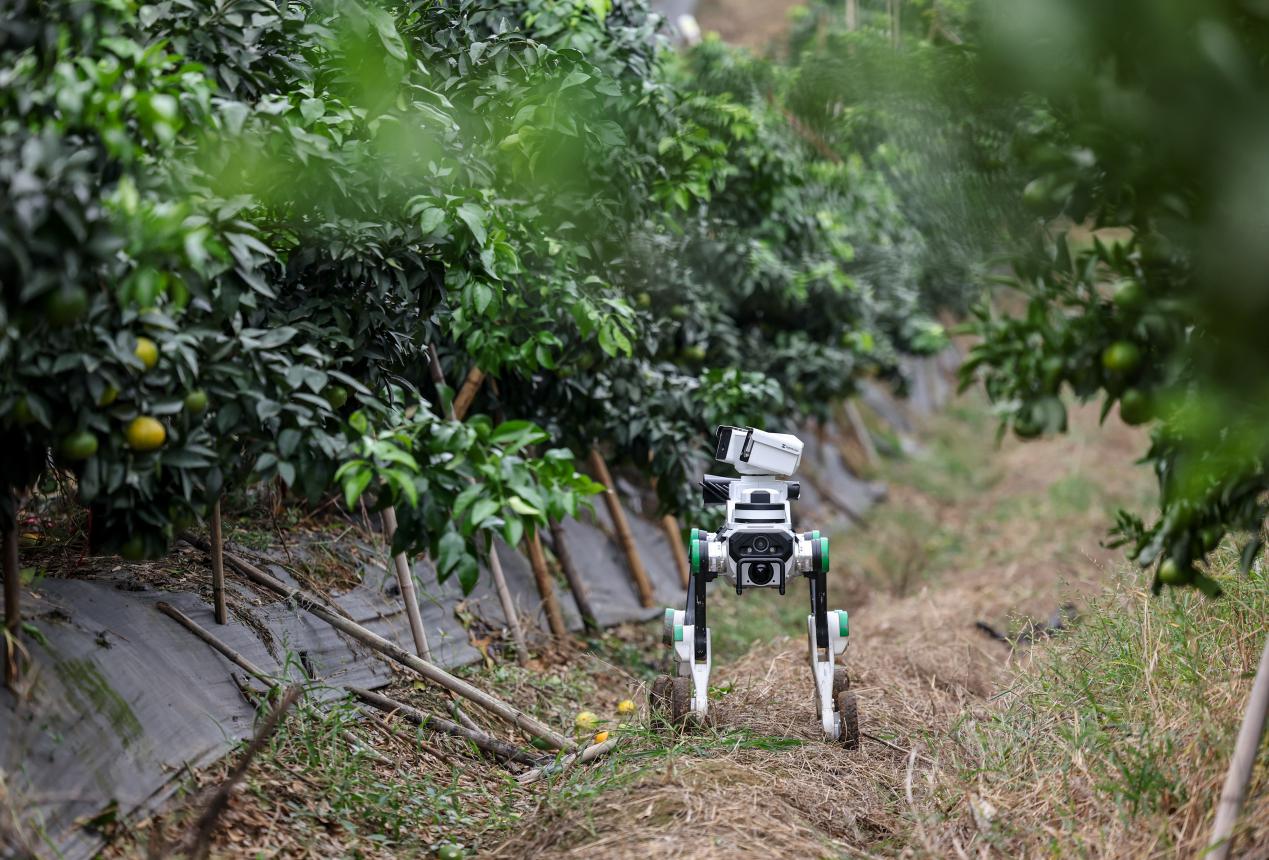
A robot inspects fruit growth in a modern agricultural park in Yangchun township, Jiang'an county, southwest China's Sichuan province. (Photo/Zhuang Ge'er)
Q: What makes China's poverty reduction efforts so complex and arduous?
Walker: China set out to eliminate absolute poverty, not merely improve living standards or alleviate hardship. That meant addressing every household and the unique difficulties behind each case.
During my field visits to rural China, I saw the many challenges faced by grassroots officials. Progress was hard-won, involving repeated steps forward and backward, reflection and renewed efforts.
In 2018, I visited a village in Guizhou where notices related to poverty alleviation were posted outside some houses. At first, I was surprised and worried that they might stigmatize families living in poverty. Upon a closer look, however, I saw that the notices featured photos of officials assigned to be responsible for assisting the families to move out of poverty.
This made me realize just how deeply China's poverty reduction efforts reached into local communities. Officials responsible for poverty alleviation had to understand each household's difficulties, coordinate resources, help families identify ways to escape poverty and arrange the support they needed.
Q: Why do you say China's poverty reduction efforts are often misunderstood?
Walker: Consider a village that has stood on a mountaintop for hundreds of years, where the natural conditions make it difficult for residents to escape poverty. What should be done? China could not simply allow poverty to persist. It had to consult with local people and work with them to find solutions. In some cases, this meant relocating people from where they had previously lived.
Resettlement is far more than moving people to a new place to live. The government must also provide housing, employment opportunities and productive resources to help residents adapt to their new surroundings. It is an intricate, systematic project that requires sustained support and follow-up assistance.
Yet some commentators have portrayed such efforts as forced labor transfers or even labeled them "cultural genocide."

Photo shows a poverty alleviation resettlement community in Rongshui Miao autonomous county, south China's Guangxi Zhuang autonomous region. (Photo/Long Tao)
Q: What significance does China's experience in poverty reduction hold for the rest of the world?
Walker: The essence of China's experience lies in empowerment. People need not only basic living security, productive resources and the capabilities to pursue development, but also the ability to shape their own futures. At the same time, governance bodies at all levels need the capacity to coordinate resources and solve problems. Throughout this process, people must remain at the center.
Q: What is holding back global poverty reduction, and how can the world turn the tide?
Walker: The first goal of the United Nations 2030 Agenda for Sustainable Development is to end poverty in all its forms everywhere. Yet with 2030 drawing closer, global progress remains inadequate. Regional conflicts, economic instability and climate change are among the many obstacles.
The agenda itself also points to a way forward. Goal 17 calls for strengthening the means of implementation and revitalizing the global partnership for sustainable development. Only through stronger cooperation and tangible action by – and between - both developed and developing countries can the world deliver meaningful progress on poverty reduction.
China's experience in poverty reduction and development deserves serious study by the international community, and other developing countries also have valuable practices and lessons to share. We should embrace China rather than treat it as an adversary and shut it out. Such a confrontational mindset overlooks the potential for shared global development. International cooperation on poverty reduction must listen to voices from all sides and draw on the experience and wisdom of countries across the Global South.

 Follow Us
 Scan the QR Code
