106-year-old Red Army veteran recalls the Long March
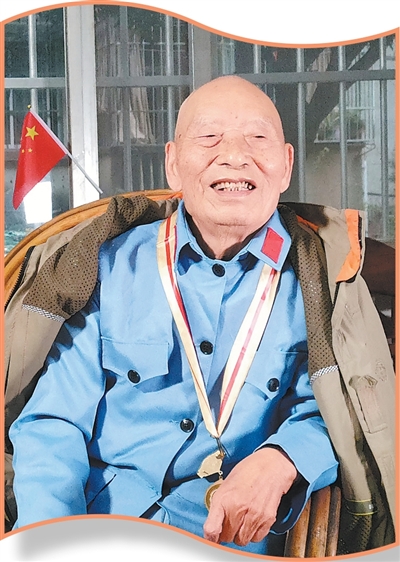
Photo shows Zhao Maolin, a veteran Red Army soldier. (Photo courtesy of Contemporary Guangxi magazine)
My name is Zhao Maolin. I was born in April 1920 in Daxian county, southwest China's Sichuan Province, now part of Dachuan district in Dazhou. I'm 106 years old.
My parents died when I was young. In 1934, at just 14, I joined the Red Army. The following year, I set out on the Long March.
I served as a medic. Over the years, I have traveled many roads, but nothing compares with the hardships of crossing snow-capped mountains and vast marshlands.
Jiajin Mountain, for example, was notoriously difficult to cross. Beneath the snow lay hidden sheets of ice, making the mountain paths very slippery. Every step took enormous effort, and one wrong move could send a person tumbling down the slope.
I was small and had short legs, so climbing was especially difficult. The higher we went, the thinner the air became, and my body shook uncontrollably from the cold and exhaustion.
The weather in the mountains could change in an instant. Howling winds whipped snow and ice into our faces. When the wind died down, sunlight reflecting off the snow was so intense that it hurt our eyes. Our thin, coarse-cloth uniforms offered little protection against the bitter cold. Snow settled on our clothes and melted, only to freeze again, leaving the fabric stiff as a shell of ice.
Along the way, fallen comrades lay beneath the snow, their outlines still visible. But we could not stop. Anyone who sat down risked never getting back up.
Beyond the mountains lay the marshlands, another deadly obstacle. Beneath the grassy surface were pools of dark, stagnant water. In some places, the water reached our knees. In others, it was deep enough to swallow a person whole. We had to move cautiously, following the footprints of those ahead and stepping only on patches of tangled grass roots.
Many comrades never made it out alive.
Our food supplies soon ran out. When we stopped to camp, we searched for grass roots and wild greens, boiling them into a soup to stave off hunger.
One veteran soldier handed me half a handful of highland barley. As a medic, I could not bring myself to eat the barley. Instead, I boiled it into thin porridge and shared it with wounded and sick comrades, giving each person just a small mouthful.
After surviving the snow-capped mountains and marshlands and coming through so many life-and-death ordeals, the hardships that lay ahead no longer seemed insurmountable.
In 1942, I joined the Communist Party of China (CPC). After the founding of the People's Republic of China in 1949, I transferred to a civilian post in south China's Guangxi Zhuang Autonomous Region and retired in 1981.
Retirement hasn't dulled the resolve the Long March gave me, not for a moment. In idle hours, I often think of the comrades who remain in the snowy mountains and marshlands, and of that journey where survival was never certain.

 Follow Us
 Scan the QR Code
