





- BRNN
- BRI News
- BRNN News
- Database
Official Documents Polices and Regulations
Inter-government Documents International Cooperation BRI Countries
Business Guide Economic Data BRI Data
Trade
Investment Projects Latest projects
Cases - Content Pool
Southwest China's Xizang Autonomous Region is drawing visitors eager to experience a different side of the region during winter.
Tourists are flocking to iconic sites, such as Barkhor Street near the Jokhang Temple, Lhasa's most revered monastery, to admire Tibetan-style architecture and shop for traditional folk items. At the foot of the world's highest peak, Mount Qomolangma, visitors eagerly capture the mountain bathed in golden sunlight with their cameras.
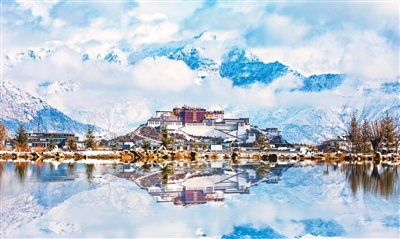
Photo shows a view of the Potala Palace, a UNESCO World Heritage site, in Lhasa, southwest China's Xizang Autonomous Region. (Photo courtesy of Xizang's culture and tourism department)
Xizang's harsh natural environment once posed major challenges for tourism development. However, the regional government and local businesses have made active attempts to break the seasonal limitations. In 2018, the first "winter tour of Xizang" campaign was launched, with various incentives that proved popular.
The region received nearly 2.67 million domestic visits from January to April that year, a 63.5 percent year-on-year increase, and generated over 3.5 billion yuan ($492.5 million) in tourism revenue, up 62.8 percent year on year.
"The campaign has been like a shot in the arm, energizing the winter tourism market and helping Xizang gradually shake off the traditional off-season," said Tang Wei, manager of a hotel in the regional capital Lhasa. Winter scenery in Xizang is distinct from other seasons, offering visitors unique experiences, Tang added.
In recent years, Xizang's ice and snow tourism has gained momentum. Cities including Nyingchi and Shannan have rolled out tourism products featuring skiing, ice skating and snow viewing, drawing substantial tourist flows.
By turning cold resources into a booming hot economy, the campaign has earned growing recognition and praise from domestic and international tourists.
On Barkhor Street, a young woman surnamed Su, dressed in traditional Tibetan attire, poses for photographs under the guidance of a photographer. Nowadays, the street draws crowds of tourists every year, many of whom are like Su.
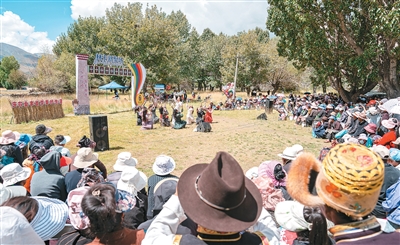
Local residents watch a performance at a "Lingka" festival in Qiongjie county, Shannan, southwest China's Xizang Autonomous Region. (Xinhua/Tenzin Nyida)
Su, from Hefei in east China's Anhui Province, is spending her annual leave on a long-awaited trip to Xizang. "I thought it would be the off-season, yet there are still many tourists. I'm enjoying favorable policies on accommodation, dining and transportation, and I've saved a lot on admission to scenic spots," she said with a smile.
The favorable policies Su mentioned are part of the eighth "winter tour of Xizang" campaign, which was launched on Nov. 1. During the campaign, all A-level scenic areas in Xizang — except temple sites — offer free admission, including the Potala Palace, a UNESCO World Heritage site.
In recent years, Tibetan costume photoshoots on Barkhor Street or at the Potala Palace square have become a popular experience for many young visitors to Xizang.
Chunyu, Su's photographer, runs a Tibetan costume photography studio. "Our standard package costs 399 yuan. During peak season, we average 60 to 70 bookings daily, and even now we receive over 30 a day," Chunyu said. Years ago, she rented a storefront on Barkhor Street before moving into a courtyard that now houses more than a dozen photography studios. In July 2023, over 100 local studios formed the Barkhor Street photography industry association to standardize their services.
As the "winter tour of Xizang" campaign continues to grow in popularity, cities across the region are introducing diverse tourism products tailored to local characteristics.
Data shows that in the first 10 months of 2025, Xizang received nearly 67.72 million domestic and international visits, up 10.89 percent year on year, generating about 78.18 billion yuan in tourism revenue, up 9.62 percent from the same period last year. These figures highlight not only the strong growth momentum and vast market potential of Xizang's tourism industry, but also its promising prospects, said Xiao Chuanjiang, an official of the regional culture and tourism department.

Tel:86-10-65363107, 86-10-65368220, 86-10-65363106
 Scan the QR Code
 Follow Us