





- BRNN
- BRI News
- BRNN News
- Database
Official Documents Polices and Regulations
Inter-government Documents International Cooperation BRI Countries
Business Guide Economic Data BRI Data
Trade
Investment Projects Latest projects
Cases - Content Pool
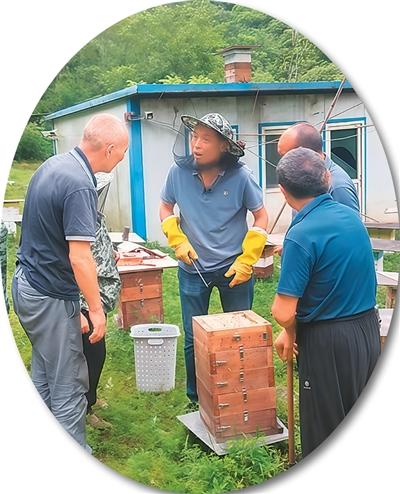
Zhang Yubo (center) teaches villagers how to keep bees in Pingwu county, Mianyang city, southwest China's Sichuan Province. (Photo courtesy of the interviewee)
Zhang Yubo, who works in Pingwu county, Mianyang city, southwest China's Sichuan Province, has earned the legendary nickname "Dr. Bee," surprising many with his remarkable career shift.
A Ph.D. graduate from Beijing Forestry University who later studied ecology at Duke University in the U.S., Zhang spent years working at the Chinese Research Academy of Environmental Sciences after returning home. Then, in early 2019, a phone call changed everything. After much deliberation, he made a startling decision: to quit his job and head into the mountains of Pingwu county to keep bees.
The caller was Tang Zhenghua, the Party chief of Jinfeng village in Pingwu's Mupi Tibetan township, who requested assistance after more than 80 percent of the village's bees died.
Zhang visited Jinfeng village in 2005 as a master's student, learning about the protection of the area's giant panda habitat, and had stayed in touch with the villagers ever since. He immediately sent materials to Tang, but they didn't solve the problem.
Encouraged by his former advisor, Zhang launched his beekeeping venture in Jinfeng village, establishing a family farm. Despite his theoretical knowledge, his lack of hands-on experience presented serious challenges early on.
Once, less than a minute after opening a hive, his left arm was stung 30 to 40 times. "I didn't think much of it at first, but by the third day, I was almost in shock," he said. The villagers rushed him to the hospital, where doctors issued a critical condition notice.
After recovering, his parents begged him to give up beekeeping. He refused. Instead, he threw himself into studying bee behavior more closely.
Through observation, Zhang found that traditional horizontal wooden hives harmed a large number of larvae during honey extraction, thereby damaging the bees' living environment.
Drawing inspiration from a book from the Ming Dynasty (1368-1644), he designed a vertical hive. "The vertical, layered design allows us to harvest honey on the upper layer without disturbing the larvae below," Zhang explained.
"Honey output doubled compared with traditional hives," Tang recalled, prompting local villagers to immediately learn the technique.
Zhang repeatedly demonstrated his hive assembly methods to the villagers. When some villagers struggled with modifications, he bought 500 hive sets at his own expense and distributed them free of charge.
Before long, Zhang developed solar-powered hives equipped with Internet of Things technology, allowing beekeepers to remotely monitor colony conditions without opening the hives. To help villagers sell their honey, he established online sales channels, reaching first-tier cities and building a growing base of repeat customers.
"Beekeeping isn't just an industry. Bees pollinate flowers and help improve the ecosystem of the Giant Panda National Park," Zhang said.
Earlier this year, Zhang received a national honorary title in recognition of his dedication. Determined to help more people learn about ecological conservation through beekeeping, he has now established a nature education center, welcoming children eager to explore the natural world.

Tel:86-10-65363107, 86-10-65368220, 86-10-65363106
 Scan the QR Code
 Follow Us