





- BRNN
- BRI News
- BRNN News
- Database
Official Documents Polices and Regulations
Inter-government Documents International Cooperation BRI Countries
Business Guide Economic Data BRI Data
Trade
Investment Projects Latest projects
Cases - Content Pool
In recent years, specialized industry schools in China have helped integrate vocational education with industrial needs, contributing to talent cultivation, the sustainable development of specialty industries, and the modernization of the vocational education system.
Luosifen, or river snail rice noodles, is a signature delicacy of Liuzhou in south China's Guangxi Zhuang Autonomous Region and has become a calling card for the city. Its transformation from a street snack to a 10 billion yuan ($1.4 billion) industry represents not only the rise of a popular food brand but also the integration of the sector with vocational education.
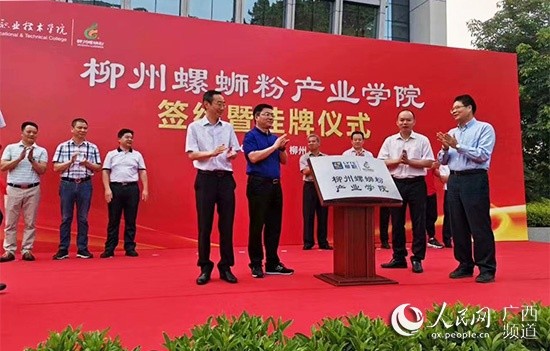
The Luosifen Industry School is inaugurated in Liuzhou, south China's Guangxi Zhuang Autonomous Region, in 2020. (Photo courtesy of Liuzhou Vocational and Technical College)
In May 2020, the Luosifen Industry School was established at what was then Liuzhou Vocational and Technical College, now Liuzhou Polytechnic University. The school set up a training base and designed programs aligned with the industry supply chain to train skilled professionals.
At the training base, an automated packaging line for luosifen stands out immediately. Zhang Feiran, an instructor at the school, explained that the line resulted from joint research and development with enterprises.
According to Liuzhou's commerce bureau, the luosifen sector generated 38.24 billion yuan in sales revenue in the first half of this year. There are now 49,000 brick-and-mortar luosifen restaurants nationwide, while pre-packaged products are sold in over 30 countries and regions.
The Luosifen Industry School connects seven majors and four colleges within the polytechnic university to the wider industry, said Chen Fang, the school's head.
As luosifen expands internationally, the industry-education integration model has also gone global. The participation of Thailand's Roi Et Technical College in a regional specialty food industry consortium led by Liuzhou Polytechnic University exemplifies this development.
The consortium plans to advance several collaborative initiatives in Thailand, including a luosifen-focused innovation and entrepreneurship competition, the joint establishment of an international entrepreneurship academy and the introduction of Chinese regional cuisines to Thai campuses.
In Zixi county, Fuzhou, east China's Jiangxi Province, a bread school opened in January, training more than 400 students to date.
"Each graduating student typically receives two to three suitable job offers, as the baking industry faces strong demand for talent," said Xiao Peng, director of the school's baking training center.
"Our school offers flexible curricula, ranging from three-day classes to one-year systematic programs, with course arrangements tailored to market needs," Xiao said. Currently, the most popular programs are short-term training courses lasting 45 to 60 days.
For aspiring entrepreneurs, the school provides yearlong courses and customized training for enterprises.
Zixi county has rolled out multiple supportive measures for the school's establishment, including preferential equipment and facility leasing, assistance with enrollment and promotion, and subsidies for vocational skills training.
Despite a population of less than 100,000, Zixi has seen more than 40,000 people join the baking industry, generating an annual output value of around 30 billion yuan.
On Nov. 21, at the Qianjiang Crayfish School of Jianghan Art Vocational College in Qianjiang, central China's Hubei Province, instructor Yuan Hui was guiding students through every procedure in a cooking training session.
The annual output value of Qianjiang's crayfish industry now exceeds 87 billion yuan, creating jobs for more than 200,000 people and supporting over 4,000 branded stores nationwide.
Behind this thriving industry lies an increasingly urgent demand for talent. During peak season, chef shortages become acute, said a local restaurant enterprise manager.
Responding to this growing need for skilled professionals, the Qianjiang Crayfish School was established in 2016.
As the crayfish industry has developed, the school's program offerings have expanded accordingly, growing from its initial culinary major to six disciplines, including aquaculture, covering the entire crayfish supply chain.
The school currently has more than 1,400 students. It has trained over 2,000 technical professionals, including experts in rice-crayfish co-culture, chefs who have helped develop hundreds of crayfish flavor varieties, and farmers skilled in e-commerce livestreaming.

Tel:86-10-65363107, 86-10-65368220, 86-10-65363106
 Scan the QR Code
 Follow Us