





- BRNN
- BRI News
- BRNN News
- Database
Official Documents Polices and Regulations
Inter-government Documents International Cooperation BRI Countries
Business Guide Economic Data BRI Data
Trade
Investment Projects Latest projects
Cases - Content Pool
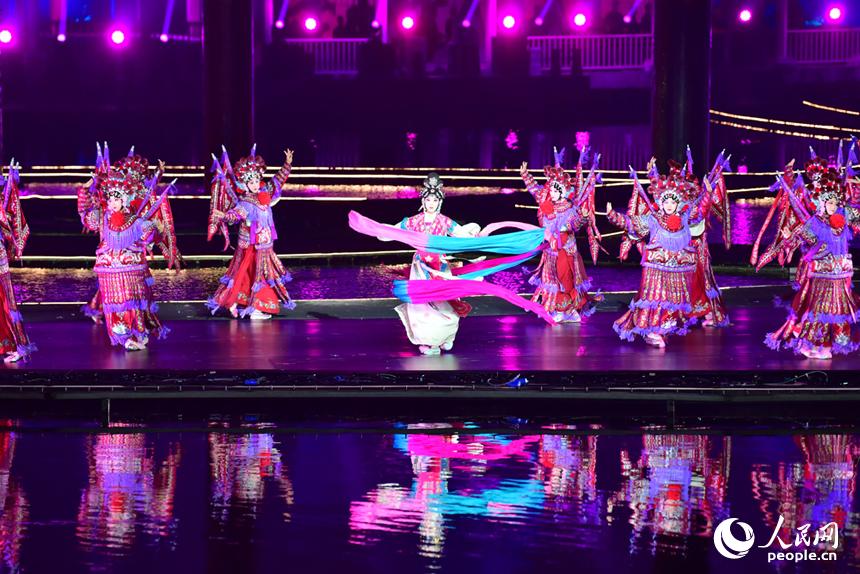
The 7th Tang Xianzu International Theater Exchange Month kicks off. (Photo/Shi Yu)
As evening descended and city lights illuminated the streets, an immersive theatrical performance unfolded in Wenchangli, Fuzhou, east China's Jiangxi province. On stage, a symbolic "dialogue across time and space" between Chinese playwright Tang Xianzu and William Shakespeare marked a highlight of the 7th Tang Xianzu International Theater Exchange Month.
Co-hosted by the Jiangxi provincial government, the Chinese People's Association for Friendship with Foreign Countries, and the China Theater Association, this year's event brought together playwrights, actors and scholars from 12 countries and regions. With live performances, a youth theater creation camp, themed forums, and relevant activities, the event celebrates theater as a medium of cultural exchanges and global engagement.
In 2015, during his visit to the UK, Chinese President Xi Jinping said that Tang Xianzu, a Chinese playwright, was contemporary of William Shakespeare, as both passed away in 1616. He noted that China and Britain could jointly commemorate the legacy of the two literary masters to promote people-to-people exchanges and deepen mutual understanding.
Over the past decade, theater has become a bridge for cultural exchanges, transforming commemorative activities into platforms for inter-civilizational dialogue. It has become a powerful medium for fostering global engagement through culture. Exceptional theatrical works transcend time and space, resonating across generations and borders.
"Fuzhou is the birthplace of Tang Xianzu and where he wrote plays," said Wu Fengchu, director of the Center for International Studies of Tang Xianzu in Fuzhou. Tang's classic "The Four Dreams of Linchuan" expresses profound human emotions and enduring humanistic values. Today, its emotional resonance continues to reach global audiences.
Along the River Avon in Stratford-upon-Avon, the UK stands the Peony Pavilion -- a traditional Chinese structure gifted by Fuzhou to Shakespeare's hometown. With its signature upturned eaves and red railings overlooking the water, the pavilion has become a prominent cultural landmark that brings Chinese aesthetics into a Western setting. Similar pavilions have since been built in Perm, Russia, and Lusaka, Zambia, symbolizing a shared cultural vision and offering international audiences a window into Chinese artistic expression.

The 7th Tang Xianzu International Theater Exchange Month kicks off. (Photo/Shi Yu)
"In April last year, during the Shakespeare birthday celebrations in Stratford-upon-Avon, I portrayed Du Liniang and performed an English-language excerpt from Tang's "The Peony Pavilion" with my classmates in the Peony Pavilion," said Emily C. A. Snyder from the Shakespeare Institute at the University of Birmingham, who brought her team to this year's exchange month. "I had always dreamed of visiting China. Like Du Liniang, my dream has come true."
"Huo Xiaoyu's monologue on wealth in Tang's "The Legend of the Purple Hairpin" echoes the critique of materialism in Shakespeare's Timon of Athens. Similarly, the satire on power and fame in Tang's 'A Dream Under the Southern Bough' and 'Handan Dream' also resonates themes familiar to Western viewers," said Huang Bikang, professor at Peking University's School of Foreign Languages and Chair of the Shakespeare Society of the Institute of Foreign Literature under the Chinese Academy of Social Sciences.
Ten years ago, Fuzhou's commemorative event extended an invitation to the world. Today, it welcomes theater artists and young enthusiasts from across the globe, transforming into a vibrant hub of international cultural exchanges.
This year, the original production "Dreaming Under the Bough" received enthusiastic acclaim. Inspired by Tang's "A Dream Under the Southern Bough" and Shakespeare's "A Midsummer Night's Dream," the play was collaboratively created and performed by students from the University of Leeds in the UK, the University of International Business and Economics in China, and other institutions. By merging Eastern and Western literary classics with youthful interpretations, the production has breathed new vitality into traditional imagery.
"We want to show through theater that dreams know no borders," said a student actor from the UK. Through rehearsals and performances, students forged lasting friendships and deepened mutual understanding. Li Jun, a professor at the University of International Business and Economics and one of the directors of the play, remarked, "This collaboration represents a meaningful dialogue. Students from both institutions are pursuing their dreams together."
Faculty and students from the University of Birmingham also presented an English poetic adaptation of "The Peony Pavilion," giving the production its debut performance in China. "The translation employs Shakespeare's signature iambic pentameter," said Michael Dobson, director of the Shakespeare Institute, University of Birmingham.
"A classic work poses enduring questions that each generation seeks to answer in their own way. Shakespeare delved into the complexities of human nature, while Tang Xianzu explored the pursuit of the soul. Both confronted the question: 'What is the meaning of life?' This shared inquiry forms the foundation for continued dialogue between Eastern and Western theater," Dobson explained.
Like a dream, theater continues to resonate in the hearts of audiences. This shared emotional journey reflects the broader vision of building a community with a shared future for humanity, fostering cultural exchanges, mutual learning and deeper understanding among civilizations.

Tel:86-10-65363107, 86-10-65368220, 86-10-65363106
 Scan the QR Code
 Follow Us