





- BRNN
- BRI News
- BRNN News
- Database
Official Documents Polices and Regulations
Inter-government Documents International Cooperation BRI Countries
Business Guide Economic Data BRI Data
Trade
Investment Projects Latest projects
Cases - Content Pool
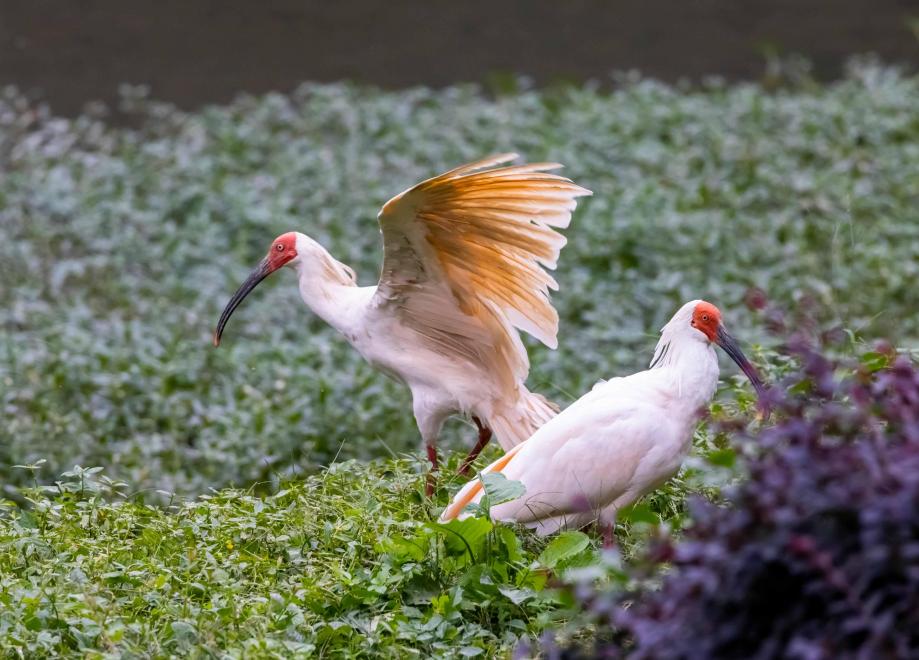
Photo shows crested ibises in Yangxian county, Hanzhong, northwest China's Shaanxi province. (Photo/Chen Xianlin)
Yangxian county in Hanzhong, northwest China's Shaanxi province, is renowned as the "Home of the Crested Ibis."
As evening descended, People's Daily reporters followed staff members from Shaanxi Hanzhong Crested Ibis National Nature Reserve to a natural roosting site to observe the return of the birds. Soon, a flock of crested ibises, distinguished by their long beaks, scarlet faces and white plumage, swept across the lake and settled on a small island, nestled among the lush branches.
The crested ibis, often referred to as a "living fossil" of the avian world, has a history dating back 65 million years. However, in the mid-20th century, habitat degradation led to a dramatic decline in its population. In 1981, researchers discovered only seven surviving wild crested ibises in Yaojiagou, Yangxian county. Over the past four decades, concerted conservation efforts have resulted in a steady recovery of the species.
"The survival and reproduction of the crested ibis rely on healthy wetland and forest ecosystems. Over the years, we have developed a systematic conservation model that prioritizes in-situ protection, complemented by ex-situ conservation, wild reintroduction, technological advancements, and collaboration between government and society. This holistic approach ensures a harmonious coexistence between humans and the ibises," said Lu Baozhong, former deputy director of Shaanxi Hanzhong Crested Ibis National Nature Reserve Administration. Today, the global population of crested ibis exceeds 11,000.
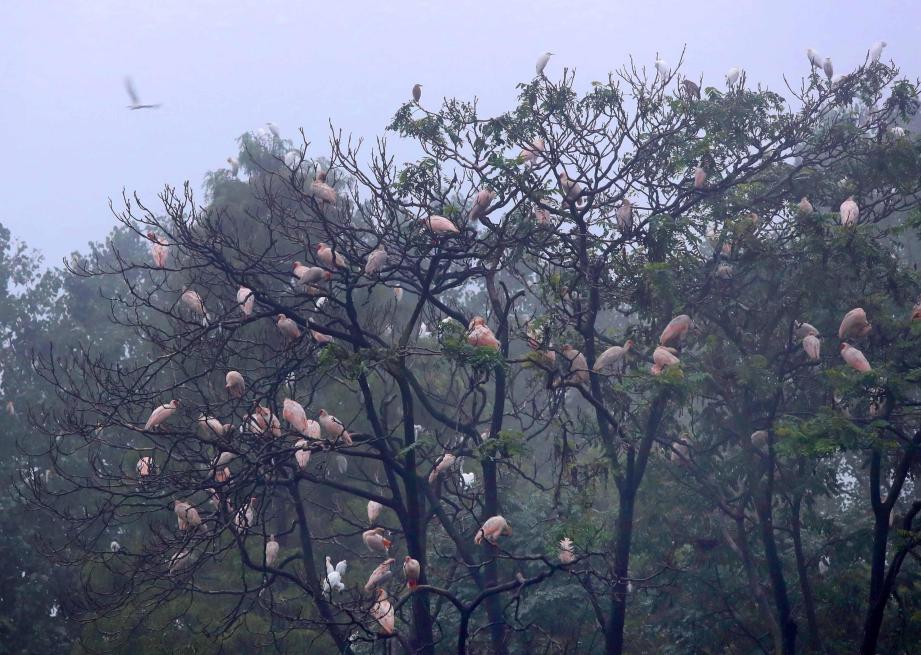
Crested ibises and egrets rest on trees near a reservoir in Yangxian county, Hanzhong, northwest China's Shaanxi province. (Photo/Xu Congjun)
Local residents in Yangxian have actively supported the protection of the crested ibises by nurturing forests, planting trees and grasses, restocking fish populations, restoring wetlands, and minimizing the use of pesticides and fertilizers. These efforts have created an ideal environment for the species to thrive.
Hua Ying, president of the Yangxian Crested Ibis Bird-Lovers Association and a native of Caoba village, Yangxian county, has a deep emotional connection with the species. Recognizing the importance of public involvement in successful conservation, Hua and fellow bird enthusiasts founded the association in 2006. The group organizes educational campaigns to raise awareness about bird protection.
"In winter, when temperatures drop and food becomes scarce, elderly or weak crested ibises are more vulnerable to illnesses or injury. Whenever local residents encounter an injured bird, they report it immediately," said Zeng Jianwen, an engineer with the reserve administration. He explained that the timely rescue and rehabilitation of sick or injured crested ibises is a crucial part of conservation efforts. Information from local residents enables rapid intervention, which plays an important role in maintaining the species' long-term population stability.
Witnessing the steady increase in crested ibis population, Hua said: "Since the 1990s, crested ibises have roosted, foraged and bred in our village. Now, villagers can observe them from their doorsteps." A persimmon tree in front of his home has become a nesting site where crested ibises return to breed every spring.

Photography enthusiasts take photos of birds in Yangxian county, Hanzhong, northwest China's Shaanxi province. (Photo from the WeChat official account of the publicity department of Hanzhong)
The peak tourist season in Yangxian occurs in March and April, when fields of rapeseed stretch beneath the spring sun, thousands of pear trees bloom like drifting snow, and crested ibises soar gracefully across woodlands and wetlands. These picturesque scenes attract many photography enthusiasts, and a local community of "bird guides" has emerged, offering services such as photography route planning and bird identification.
"The surge in birdwatching has brought more visitors, fostering a comprehensive industrial chain, from bird guides to homestays, dining, and educational tours," Hua explained. A bird guide earns at least 200 yuan ($28.23) per day, and up to 1,200 yuan when accompanying large study tours. Last year, Yangxian received 6.38 million tourists, generating more than 4 billion yuan in tourism revenue.
The commitment to strict ecological protection has also created favorable conditions for the development of organic agriculture. The county boasts 115 certified organic products across 15 categories, making it the largest organic production area in Shaanxi province, with 43 processing enterprises and an organic industry output value exceeding 5.5 billion yuan.
Through the sustainable management of its natural resources, Yangxian has turned ecological advantages into development opportunities. By fostering a harmonious coexistence between humans and crested ibises, the "Home of the Crested Ibis" has paved the way for a prosperous and sustainable future, improving the lives of its residents.

Tel:86-10-65363107, 86-10-65368220, 86-10-65363106
 Scan the QR Code
 Follow Us