





- BRNN
- BRI News
- BRNN News
- Database
Official Documents Polices and Regulations
Inter-government Documents International Cooperation BRI Countries
Business Guide Economic Data BRI Data
Trade
Investment Projects Latest projects
Cases - Content Pool
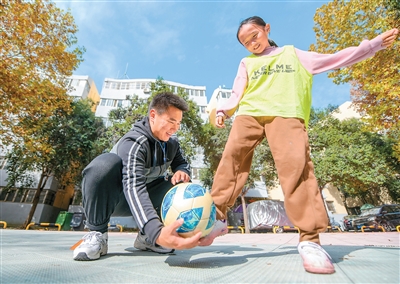
Soccer coach Liang Haojie provides "sports takeout" services at a community square in Jianxi district, Luoyang, central China's Henan Province. (Photo/Zhang Yixi)
Parents across Chinese cities are booking professional sports coaches to their neighborhoods with a tap on their smartphones. This on-demand coaching model, dubbed "sports takeout," is reshaping traditional athletic training.
On a fitness trail in a Beijing park in November, a 14-year-old boy practiced long jumps and sprints under his coach's guidance while his father, surnamed Liu, watched and logged the session on a mobile app.
"In the past, taking my son to fitness classes meant an hour of travel time back and forth. Now the coach comes directly to our neighborhood, and the time we save can be spent reading together," Liu said. The coach arrived with sports equipment and began training in an open space near the park, igniting the boy's enthusiasm for exercise.
Sports takeout is a new business model that integrates physical education with the on-demand economy. It breaks free from traditional training's reliance on fixed venues by turning community parks, open spaces and even homes into workout locations.
Li Hai, dean of the School of Economics and Management at Shanghai University of Sport, noted that by integrating resources through digital platforms, sports takeout offers convenient, flexible, and personalized sports services while creating new employment and entrepreneurial opportunities for professionals.
The mini-program of Beijing-based home-service sports platform Leshi Sports offers a wide range of courses: PE test preparation for students, fitness training for office workers, and Tai Chi for seniors. Emerging sports such as frisbee and pickleball have also proven popular on the platform.
Chen Xueli, co-founder of the platform, said that within 12 months, the company's sports takeout services attracted over 300,000 users across more than 100 Chinese cities, with a repurchase rate of 45 percent.
Li emphasized that for sports takeout to achieve sustainable development, unified service standards and effective regulatory mechanisms are urgently needed. Government departments overseeing sports, market regulation, education and other areas should cooperate to set clear standards and improve regulatory policies, bringing sports takeout into the supervision scope of existing after-school sports training, Li said.
Wang Yuxiong, director of the Sports Economics Research Center at the Central University of Finance and Economics, said that priority should be given to strengthening supervision, establishing access mechanisms, and setting quality standards to ensure consumer safety and service reliability.
As early as 2021, the General Administration of Sport of China issued codes of conduct for after-school sports training, clearly requiring coaches to hold relevant certification.
Industry insiders suggest implementing electronic service agreements to clarify safety responsibilities and protect user privacy and personal safety. They also recommend increasing the supply of public sports venues, encouraging schools to open their facilities in an orderly manner, and building a comprehensive insurance system.

Tel:86-10-65363107, 86-10-65368220, 86-10-65363106
 Scan the QR Code
 Follow Us