





- BRNN
- BRI News
- BRNN News
- Database
Official Documents Polices and Regulations
Inter-government Documents International Cooperation BRI Countries
Business Guide Economic Data BRI Data
Trade
Investment Projects Latest projects
Cases - Content Pool
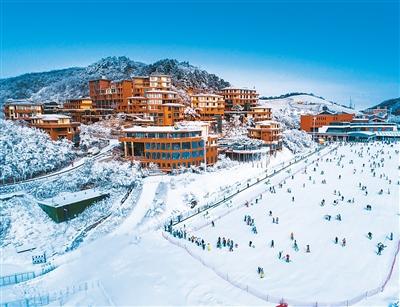
Tourists ski at Skyland Ski Resort in Anji county, Huzhou, east China's Zhejiang Province. (Photo courtesy of the Skyland Ski Resort)
Despite lacking natural ice and snow resources, the ice and snow economy has become a new driver of the consumer market in east China's Zhejiang Province during winter.
On a recent weekend, Taihu Lake Longemont Ice World in Huzhou, Zhejiang was packed with visitors. Across more than 20,000 square meters of indoor skiing terrain, tourists enjoyed skiing, snow tubing and snowball fights. Ski coach Zhang Shiyu guided a group of children.
"Our facility normally employs nearly 30 coaches, expanding to about 80 in the winter peak season, yet demand still exceeds supply," Zhang said. The venue operates from 9:30 a.m. to 10:30 p.m., with peak daily attendance surpassing 10,000.
In Zhejiang, indoor ski resorts have become the mainstream venues for winter sports.
An employee at Taihu Lake Longemont said families with children from the local area and neighboring cities form the main customer base, and visitor numbers are expected to continue rising as the winter tourism season arrives.
Data shows Zhejiang currently has 26 commercial ice and snow sports venues, including 18 ski resorts — eight of which are indoors — placing the province among the top in southern China.
In Anji county, Huzhou, Skyland Ski Resort is the largest and best-equipped outdoor alpine ski resort in east China. It drew more than 4,000 tourist visits on New Year's Day alone this year.
The ski resort, covering nearly 400,000 square meters, officially opened in 2019. Its ski runs stretch 3.8 kilometers in total and can accommodate 15,000 skiers simultaneously. Located in a mountainous area, visitors can enjoy views of rime ice, mountain mist and seas of clouds.
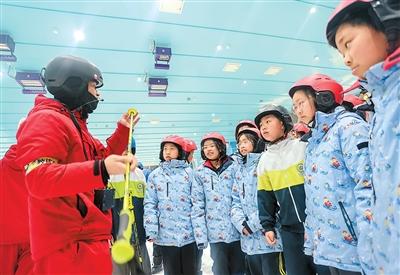
A coach instructs children at Taihu Lake Longemont Ice World in Huzhou, east China's Zhejiang Province. (Photo/Wu Zheng)
"We leverage the mountainous terrain and adopt snow-making and refrigeration technology to meet demand for winter sports in southern regions," said Ding Hao, vice president of Yunshang Tourism Group, operator of the resort. Ding added that the resort's average tourist visits reach 250,000 each ski season, contributing around 80 percent of its annual revenue.
Ice and snow tourism continues to fuel the broader ice and snow economy. Data shows that during the 2024-2025 ski season, over 2 million people in Zhejiang participated in winter sports.
As winter sports gain popularity, sales of related equipment have also surged.
In a livestream session of Zhejiang Kuqu Intelligent Technology Co., Ltd., a host promoted a children's pullover hat.
Beyond livestreaming, the company's products are also sold on multiple e-commerce platforms. On Taobao alone, an ear-protection hat priced at 37.9 yuan (about $5.36) sold more than 15,000 units in one month. "Sales have been climbing since November, and we are ramping up inventory," said Zhu Linqiang, the company's operations director.
Based in Tongxiang, a county-level city in Jiaxing, the company previously focused on developing, manufacturing and selling children's outdoor products. As the ice and snow economy grew, it shifted toward winter sports equipment.
From September to November this year, the company's children's ski wear, goggles, gloves and hats generated more than 70 million yuan in sales, up 40 percent year on year, Zhu said.
At the Yiwu International Trade Market in Yiwu, vendor Chen Jing in District 3 sorted ice skates on her shelves. As winter sports heat up, Chen expanded her product range from roller skates to ice skates and ski helmets, serving customers in Russia, Kazakhstan and other countries.
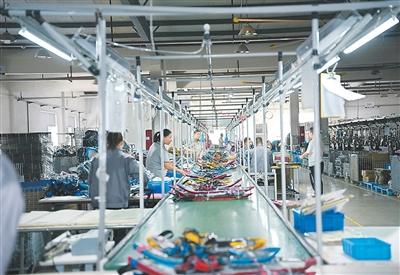
Employees produce snowshoes at a workshop in Shenquan town, Ninghai county, Ningbo, east China's Zhejiang Province. (Photo/Tan Ling)
Ice and snow products are distributed across Districts 1, 3, 4 and 5 of the trade market, including snow tubes, skis, ski goggles, crampons, ski helmets, ski boots, ski masks, gloves, ear warmers, protective eyewear, ice skates and derivatives.
Shenquan town in Ninghai county, Ningbo is known as "China's sports pole hub." The town houses 34 enterprises producing sports poles — mainly ski poles, trekking poles and hiking poles — along with mountaineering and outdoor leisure products. Over 90 percent of their output is exported, capturing about 60 percent of the global market.
"The domestic ice and snow season runs from November to March, so we begin production scheduling for domestic orders in September," said Liu Wen, administrative manager of Ninghai Xingda Tourism Products Co., Ltd.
"Domestic demand keeps rising. We've received many inquiries from customers in northeast China, and we expect domestic ski pole sales to grow by more than 50 percent from last year," Liu said. As consumers pursue more diverse and high-quality winter tourism experiences, market potential will continue to expand, Liu said.
In Luqiao district, Taizhou, the annual output value of snow boots exceeds 1 billion yuan, accounting for about one-third of national output.
Data indicates Zhejiang Province now has over 500 enterprises involved in ice and snow equipment, forming a complete industrial chain from ski wear and goggles to snow removal vehicles and snowmobiles.

Tel:86-10-65363107, 86-10-65368220, 86-10-65363106
 Scan the QR Code
 Follow Us