





- BRNN
- BRI News
- BRNN News
- Database
Official Documents Polices and Regulations
Inter-government Documents International Cooperation BRI Countries
Business Guide Economic Data BRI Data
Trade
Investment Projects Latest projects
Cases - Content Pool
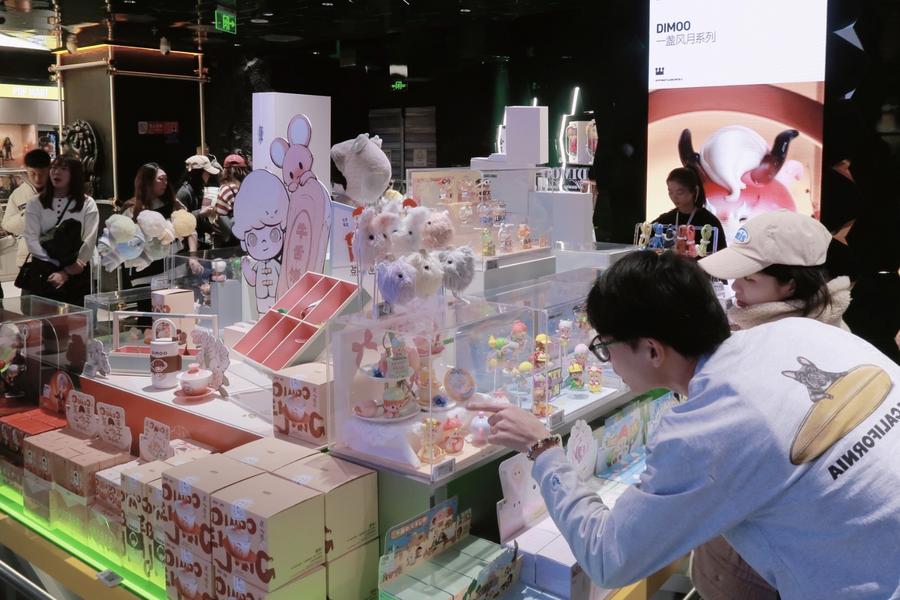
Consumers select blind boxes at a Pop Mart store in Xidan Joy City, a shopping mall in Beijing, capital of China, Dec. 28, 2024. (Xinhua/Shi Yifei)
Trendy toy brands are securing prime ground-floor spaces in shopping malls, drawing shoppers in with their playful appeal. Behind this shift lies a changing retail landscape that is increasingly shaped by emotion-driven consumption.
As young consumers seek a sense of emotional satisfaction — and are willing to pay for it — malls are moving beyond functional goods and focusing on creating emotionally engaging experiences.
Lu, a fashion professional in Shanghai, is an avid fan of the UK toy brand Felt so good. "The toys are so beautifully made that they lift my mood the moment I see them," Lu said.
According to a report by the Shanghai Youth and Children Research Center, 56.3 percent of young people are willing to spend money on products that bring happiness and emotional comfort, an increase of 16.2 percentage points from 2024. Plush toys, aromatherapy items and stress-relief products are among the top categories delivering emotional value.
Consumers are increasingly seeking products that offer emotional benefits. Store staff noted that while most shoppers are between 15 and 35, plenty are in their 40s and 50s. In fact, many parents who come in with their children often end up being the ones having the most fun.
Fang, a devoted Pop Mart fan in her early 40s, has worked in the editorial industry for many years. She first got into fashion toys while trying to secure limited items for her child. Over time, she developed the habit of visiting trendy toy stores in the mall every week, with Pop Mart and Jellycat always on her route.
Why are malls willing to give these brands prime locations?
According to industry insiders, ground-floor tenants must match the mall's overall positioning and complement existing categories. They also need to attract young customers and those with strong spending power. On top of that, brands in these locations must operate in a standardized, stable way to ensure long-term performance.
A marketing executive at a Beijing mall explained that brands built around emotional value draw in crowds, keep shoppers on-site longer, and encourage social sharing.
Unlike traditional retail, which relies on necessity-driven foot traffic, today's consumption emphasizes experience. Stores focused on emotional value tend to be visually striking and interactive. They make great spots for photos and often become hubs for online content. And with most products priced around 100 yuan (about $14.12), they convert more easily into actual sales. Compared with traditional apparel, shoes or bags, these brands are more stable performers and more effective at drawing in new customers.

Tel:86-10-65363107, 86-10-65368220, 86-10-65363106
 Scan the QR Code
 Follow Us