





- BRNN
- BRI News
- BRNN News
- Database
Official Documents Polices and Regulations
Inter-government Documents International Cooperation BRI Countries
Business Guide Economic Data BRI Data
Trade
Investment Projects Latest projects
Cases - Content Pool
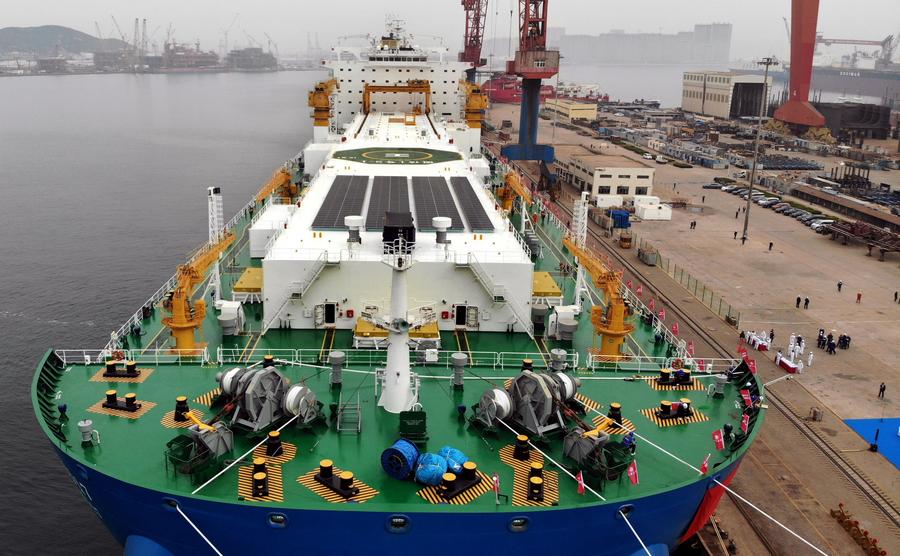
An aerial drone photo taken on April 17, 2025 shows a deep-sea intelligent aquaculture vessel berthed at the port of Beihai yard in Qingdao, east China's Shandong Province. (Xinhua/Li Ziheng)
"We go wherever the water is best," said Sun Linlin, production director in charge of Guoxin 1 2-1, a 150,000-tonne deep-sea smart aquaculture vessel.
The vessel employs a roaming tank system, relocating to areas with optimal temperature, currents and water quality — much like nomadic herders seeking abundant water sources and lush pastures. This mobility ensures the fish are always in the most suitable natural environment, according to Sun.
Now stationed in the waters off Zhoushan, east China's Zhejiang Province, Guoxin 1 2-1 is the world's first vessel of its size dedicated to smart aquaculture.
The vessel, an upgraded version of the world's first 100,000-tonne smart aquaculture vessel Guoxin 1, was launched in April and immediately began trial operations.
In early May, more than 1 million juvenile large yellow croakers were introduced into its rearing tanks, and by Nov. 20, the ship had recorded a single haul of over 46,000 adult fish.
The ship features 15 standard rearing tanks for large-scale commercial fish farming, four circular exercise tanks that promote fish activity and serve as transitional holding areas, and 22 experimental tanks for feed trials and health studies.
Despite a total water volume of 96,000 cubic meters, the vessel operates with just 35 crew members, of whom only 16 are technical staff and workers responsible for aquaculture operations.
A highly efficient centralized aquaculture control system and automated systems are central to the efficiency of the mobile fish farm, according to Sun.
Over 200 cameras and 2,000 sensors form a smart aquaculture network that monitors the entire production cycle, Sun said.
Inside the monitoring room, an electronic screen displays real-time data on current speed, oxygen levels, temperature and feed volume, among other factors.
"The rearing tanks are equipped with an advanced environmental control system. Even though the tanks are enclosed, water keeps circulating. This helps purify the water naturally while keeping the fish active and healthy," Sun explained.
Nearly all key operations on the vessel are now performed by machines, from the stocking of juvenile fish and the feeding process to the harvesting and processing of market-ready fish.
The vessel has achieved a mechanization rate of over 90 percent, with automation levels up 45 percent compared to its predecessor. The intelligent system can even make up to 30 percent of farming decisions, leading to a 20-percent reduction in labor costs.
An automated feeding system handles the vessel's daily operations, which require 1 to 1.5 tonnes of feed per tank. With automatic loading, rail-guided trolleys for delivery, on-board storage bins, and timed dispensing, just two workers can complete feeding for the entire vessel each day, Sun said.
"In terms of layout, farming systems, renewable energy use, and information integration, the ship incorporates over 160 technological breakthroughs and optimization innovations," Sun added.
Guoxin 1 2-1 is driving an overall upgrade in the marine aquaculture industrial chain.
Special feed formulas and intelligent software are raising product quality, while logistics systems deliver fresh fish to markets within six hours for distances up to 500 kilometers and within 15 hours for distances up to 1,000 kilometers. Downstream processing is producing a range of products — from fresh fish to pre-cooked meals — to meet growing consumer demand.
The success of Guoxin 1 2-1 is just the beginning.
Its sister ship Guoxin 1 2-2, dedicated to salmon, trout and other high-value cold-water fish species, has already been launched.
When all three ships in the Guoxin 1 series operate at full capacity, annual production is expected to exceed 10,000 tonnes.
"These ships free aquaculture from the uncertainties of the sea, enabling seasonal and geographic flexibility. We can now raise southern fish species in northern waters and northern species in southern waters," Sun said. "Industrialized offshore farming improves efficiency and resource utilization, transforming the deep sea into a sustainable blue granary."

Tel:86-10-65363107, 86-10-65368220, 86-10-65363106
 Scan the QR Code
 Follow Us