





- BRNN
- BRI News
- BRNN News
- Database
Official Documents Polices and Regulations
Inter-government Documents International Cooperation BRI Countries
Business Guide Economic Data BRI Data
Trade
Investment Projects Latest projects
Cases - Content Pool
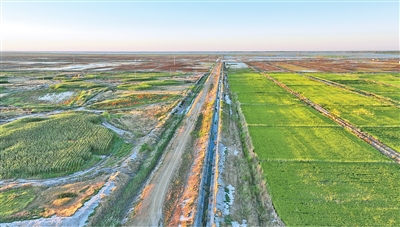
The right section of this photo shows saline-alkali land planted with Manchurian wild rice in Zhenlai county, Baicheng city, northeast China's Jilin Province. (Photo/Pan Shengyu)
In more than 1,000 mu (66.67 hectares) of Manchurian wild rice fields in Zhenlai county, Baicheng city, northeast China's Jilin Province, Song Zhenbo, head of Baicheng Tianyuan Ecological Agriculture Development Co., Ltd., is busy leveling the fields.
"On this land, which has high levels of salinity and alkalinity, we are able to harvest more than 500,000 kilograms of Manchurian wild rice stems, and the soil has been improved," said Song.
"This land used to be barren — nothing would grow here," said Zhou Shufeng, a senior agronomist at the Zhenlai County Agriculture and Rural Affairs Bureau.
The turnaround began with a group of people bold enough to try something new. Ding Wei, a grower from east China's Zhejiang Province, was one of them. Ding's work with saline-alkali land started when he decided to contract abandoned farmland.
In 2022, Wang Zhenyu, a farmer in Gashigen township, Zhenlai county, leased his 120 mu of saline-alkali land to Ding for Manchurian wild rice cultivation. Later, after the soil improved, Wang reclaimed the fields and planted rice instead.
"The soil is so much better now. I'm using far less fertilizer, and the yields are higher than before," he said.
Why can Manchurian wild rice thrive in saline-alkali soil? According to Hou Ligang, director of the Rice Research Institute at the Jilin Academy of Agricultural Sciences, the plant is remarkably tolerant of such conditions. As a native aquatic vegetable, its roots naturally secrete acidic substances that neutralize alkaline compounds in the soil.
In 2024, Ding decided to partner with Baicheng Tianyuan Ecological Agriculture Development Co., Ltd. to conduct a large-scale planting trial on heavily saline-alkali land in Zhenlai county.
Of the seedlings planted in May of that year, only about 40 percent survived. "We had to replant three times, and the late seedlings often couldn't catch up with the season," Song said.
But the plants that did survive exceeded expectations. "Each stem weighed 350 to 400 grams. Once peeled, they were tender, white, and incredibly crisp and sweet," Ding said.
Ding sent the harvest by refrigerated truck to the Yangtze River Delta, where the Manchurian wild rice stems quickly became a hit.
"A whole truckload sold out in just half an hour. We were able to sell them for over 30 percent more than the price of the local variety. Even with the low yield, we still broke even," Ding said.
Despite this initial success, the cultivation process itself remained a challenge.
"The seedlings weren't surviving, and the yields were disappointing — it was a constant source of stress," Ding said. At first, his efforts were nothing but trial and error. He had to figure everything out on his own, from growing the seedlings to preparing the soil, making plenty of mistakes along the way.
At a conference on reclaiming saline-alkali soil, Wen Bolong, an associate researcher at the Northeast Institute of Geography and Agroecology under the Chinese Academy of Sciences, shared data showing how Manchurian wild rice could help improve saline-alkali soil.
Recognizing the direct link to Ding's work, the Zhenlai County Agriculture and Rural Affairs Bureau quickly arranged a meeting between Ding and Wen.
"When we first met, Wen brought a stack of materials, including guidelines for soil improvement, as well as details on the fertilizer needs and salt tolerance of Manchurian wild rice at various growth stages," Ding recalled.
Wen suggested bringing in seedlings from south China and prioritizing the reduction of soil salinity and alkalinity. This approach aimed to improve both survival rates and growth.
"Studies have shown that Manchurian wild rice thrives in soil with a pH below 8.5. Once the pH level exceeds 9.5, its growth begins to struggle. To fix this, we irrigated with river water, which helps flush out some of the salt each time," Wen explained.
This spring, Ding and Song followed the research team's planting guidelines. First, they improved the soil by adding organic fertilizer and using irrigation and drainage to wash out the salt. Next, they introduced high-quality seedlings from south China and cultivated them locally. After planting, they monitored the crops' growth on a regular basis.
As a result, the seedling survival rate exceeded 90 percent. By September, the yield had reached over 1,250 kilograms per mu. Zhou added that this year, the total area planted with Manchurian wild rice in Zhenlai county has grown to nearly 5,000 mu.
According to statistics, Manchurian wild rice cultivation has created jobs for nearly 200 villagers in Zhenlai county this year, with each villager earning an average of over 10,000 yuan ($1,400) from the business.
Soil monitoring data from the Northeast Institute of Geography and Agroecology revealed that before planting, the pH of the topsoil in the saline-alkali fields averaged 9.32. After harvest, it dropped to 9.0, and the soil's organic matter content increased by 10 percent.

Tel:86-10-65363107, 86-10-65368220, 86-10-65363106
 Scan the QR Code
 Follow Us