





- BRNN
- BRI News
- BRNN News
- Database
Official Documents Polices and Regulations
Inter-government Documents International Cooperation BRI Countries
Business Guide Economic Data BRI Data
Trade
Investment Projects Latest projects
Cases - Content Pool

File photo shows a view of the "An Era in Jinling: A Digital Art Exhibition" at the Deji Art Museum in Nanjing, east China's Jiangsu Province.
Across excavation sites, research laboratories, restoration workshops, and museum exhibition halls, artificial intelligence is creating new paradigms for preserving the legacy of Chinese civilization, bringing fresh vitality and possibilities to cultural protection and development.
In Chengdu, southwest China's Sichuan Province, the Baodun City Ruins date back 4,500 to 3,900 years, making them the earliest and largest prehistoric urban site found in the upper reaches of the Yangtze River.
"We've built a digital pottery database from the Baodun culture period, and AI has shown tremendous potential in handling the complex challenges of pottery shard classification," said Wan Jiao, a researcher at the Sichuan Provincial Cultural Relics and Archaeology Research Institute.
Her interdisciplinary team of archaeologists and AI experts is exploring AI applications in Sichuan's pottery archaeology. Using AI models, the team has successfully dated highly fragmented pottery shards from the Baodun culture period — pieces that contain very limited information. This gives archaeologists new tools for quickly determining the age of artifacts.
AI has triggered another evolutionary leap in archaeology, not only generating new research outcomes and application scenarios but also enhancing efficiency and enabling deeper insights.
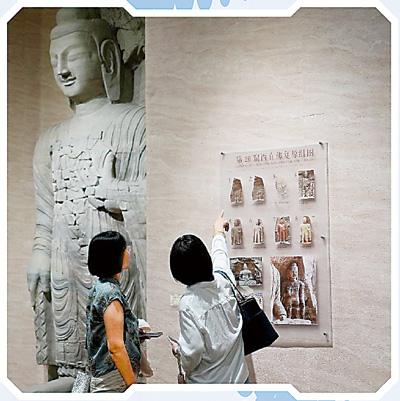
Tourists view a 3D-printed replica of a standing Buddha from Cave No. 20 of the Yungang Grottoes, a UNESCO World Heritage Site in north China's Shanxi Province, during an exhibition. (Xinhua/Liu Ying)
AI is breathing new life into this discipline that explores the past through its powerful data processing and pattern recognition capabilities, noted Zhang Guowen, a professor at Nankai University's Faculty of History.
AI models are also helping piece together oracle bone rubbings, illustrating how AI is applied to ancient script research.
Rejoining oracle bone fragments requires synthesizing various types of information to restore pieces into complete or near-complete forms. Mo Bofeng, a professor at the Center for Oracle Bone Studies at Capital Normal University, noted that the task was previously done manually, relying heavily on scholars' personal experience and memory while consuming vast amounts of time and energy. Today, AI provides valuable support in rejoining fragments, identifying characters and finding duplicate inscriptions.
The integration of AI and archaeology now also extends to talent development. Starting in the fall semester of last year, Fudan University in Shanghai launched a course on AI and archaeology for graduate students.
Wen Shaoqing, an associate professor at the Institute for Archaeological Science at Fudan University, founded the course to provide students with a comprehensive understanding of AI's diverse applications in archaeology, while broadening their thinking about how AI can be applied across various fields.
During excavation and protection work, researchers can use AI to analyze satellite and remote sensing data to preliminarily identify vanished ancient sites, Wen said. Researchers can also create digital twins of archaeological sites using AI technology.
AI can be applied across the entire archaeological process, greatly improving research efficiency and precision, Wen added.

File photo shows the official virtual cartoon figure Jiayao of the Mogao Grottoes, a UNESCO World Heritage Site in Dunhuang, northwest China's Gansu Province.
Cutting-edge digital technologies, represented by AI, are also playing a growing role in the conservation and restoration of cultural relics.
This October, the "Gazing over the Clouds and Sea: The Yungang Grottoes Art Exhibition" opened in Shanghai, featuring a 3D-printed, life-size replica of a standing Buddha from Cave No. 20 of the Yungang Grottoes, a UNESCO World Heritage Site in north China's Shanxi Province, that amazed visitors.
This 1,500-year-old Buddha collapsed during the Northern Wei Dynasty (386-534), and no historical records describe its original appearance, leaving its form a millennium-old mystery.
"During excavation at the cave entrance, we discovered many fragments of the standing Buddha. Using traditional restoration methods would have been extremely laborious," said Hang Kan, director of the Yungang Research Institute.
"In 2014, we began to reassemble it. We initially matched fragments by hand, but later adopted 3D laser scanning for precise measurement and AI-based analysis to virtually reconstruct more than 100 fragments," said Li Lihong from the digital protection center at the Yungang Research Institute.
The biggest challenge was virtually restoring the missing Buddha head and the drapery patterns on the body. With no records of this statue's original appearance, the digitization team examined similar statues from the same period. Using more than 10 algorithmic models and expert verification, they ultimately produced what experts believe is the most accurate restoration possible.
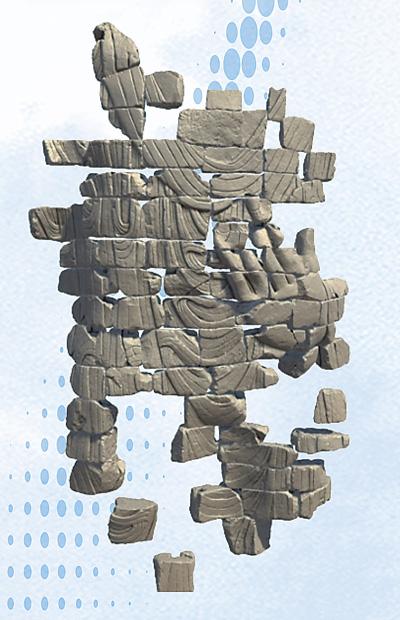
A digital rendering shows reassembled fragments of a standing Buddha from Cave No. 20 of the Yungang Grottoes, a UNESCO World Heritage Site in north China's Shanxi Province. (Photo courtesy of the interviewee)
AI technology now ensures the intelligent protection of cultural relics. Whether analyzing environmental data, warning of potential risks, or predicting deterioration, technology is making preservation more proactive, precise and intelligent.
AI is also merging with virtual reality, augmented reality, and digital twin technologies, breathing new life into Chinese civilization in the digital world.
The "An Era in Jinling: A Digital Art Exhibition" at the Deji Art Museum in Nanjing, east China's Jiangsu Province, was recently highlighted at a UNESCO dialogue as a case of the country's innovative practices in using digital technologies to revitalize cultural heritage.
The exhibition lets visitors immerse themselves in the ancient painting "An Era in Jinling" and virtually encounter 533 residents of the ancient city of Jinling (now Nanjing), said Ai Lin, director of the museum.
The integration of AI and other new technologies transforms museum collections into vivid cultural experiences, enabling visitors to appreciate art more conveniently and gain deeper insights into the evolution of Chinese civilization, Ai added.

Tel:86-10-65363107, 86-10-65368220, 86-10-65363106
 Scan the QR Code
 Follow Us