





- BRNN
- BRI News
- BRNN News
- Database
Official Documents Polices and Regulations
Inter-government Documents International Cooperation BRI Countries
Business Guide Economic Data BRI Data
Trade
Investment Projects Latest projects
Cases - Content Pool
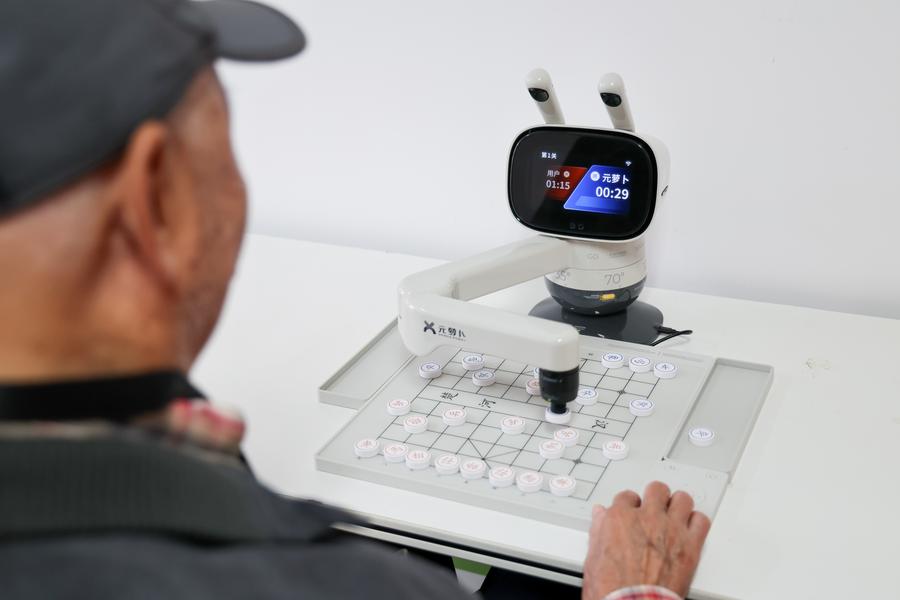
A senior resident plays chess with a robot at Shenzhen Nursing Home in Shenzhen, south China's Guangdong Province, March 3, 2025. (Xinhua/Liang Xu)
In many places, eldercare robots have quietly become part of seniors' daily lives, acting as tech companions that assist them around the clock.
At a nursing home in Shenzhen, south China's Guangdong Province, there are over 100 eldercare robots of various sizes. The facility accommodates more than 460 elderly people, with each caregiver responsible for at least three residents on average. With robot assistants, the staff's workload is significantly reduced.
A small, round, palm-sized robot serves as a "trainee" in the facility, monitoring residents' daily activities and acting as an "electronic extension" of the caregivers. The company behind it has developed specialized solutions for elderly care. In an emergency, the robot can instantly detect the situation and send alerts, allowing staff to respond without delay.
By the end of 2024, Shenzhen had 1.58 million residents aged 60 and above, and this number is expected to rise to 2.58 million by 2029. Though a young and fast-growing city, Shenzhen is gradually aging. But in this hub of innovation, technology is already used for elderly care.
Ninety-three-year-old Liang Caitang spends most of her day in a wheelchair. Her nursing home houses 96 seniors, with an average age over 86. 97 percent of residents have moderate to severe disabilities or dementia, and most are unable to stand or walk.
Recently, the facility introduced a lower-limb exoskeleton. Once Liang's legs and feet are secured and the motorized seat lifts her, she can "walk" along the corridor with the robot's assistance.
Even seniors who rely entirely on wheelchairs are experiencing improved mobility. This year, another company launched an all-terrain embodied mobility robot that combines robotics technology with wheelchair design.
By the end of 2024, China had 310.31 million residents aged 60 and above, 22 percent of the country's total population. Roughly 45 million of them had disabilities or dementia.
At a Shenzhen nursing home, long-term bedridden residents with severe disabilities are now being cared for by a smart incontinence-care robot, reducing their dependence on human caregivers.
When a resident uses it, the robot quickly detects waste and automatically begins a cleaning cycle, processing, washing, drying, and deodorizing. The entire process takes just two to three minutes, effectively keeping odors at bay.
Smart eldercare and tech-driven solutions are increasingly the focus of research institutions. Zhao Guoru and his team at the Shenzhen Institutes of Advanced Technology, Chinese Academy of Sciences, are developing more capable eldercare robots that address seniors' most pressing needs. Their research focuses include fall prevention, muscle loss and strengthening, rehabilitation, and intelligent nursing.
Over the past five years, the team has developed more than 10 projects, including instability warning devices and gait stabilizing robots designed to prevent falls.

Tel:86-10-65363107, 86-10-65368220, 86-10-65363106
 Scan the QR Code
 Follow Us