





- BRNN
- BRI News
- BRNN News
- Database
Official Documents Polices and Regulations
Inter-government Documents International Cooperation BRI Countries
Business Guide Economic Data BRI Data
Trade
Investment Projects Latest projects
Cases - Content Pool
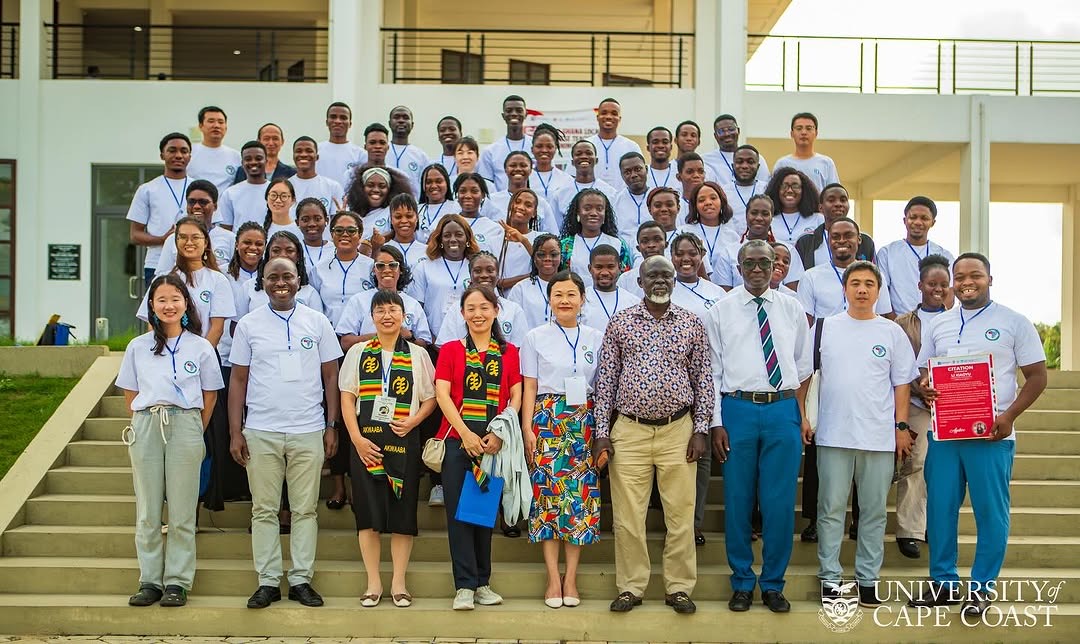
The 2025 Ghana Local Chinese Teachers' Training Program is held at the Confucius Institute of the University of Cape Coast, Ghana, June 27-30, 2025. (Photo provided to People's Daily Online)
Dorcas Ntim Pomaa, 21, born in Ghana, speaks fluent Chinese, a journey she began three years ago alongside 400 other students at the University of Ghana.
She developed an interest in the Chinese language after a friend introduced her to a Chinese movie. "After watching it, I became fascinated by the sound of the Chinese language. Eventually, I chose to study Chinese when filling out my university application," she recalled.
When she shared her decision to study Chinese, her family was fully supportive, understanding her passion for the language.
"They knew I had an interest in the language and the field I wanted to pursue," she said. However, some friends questioned its practicality, asking how Chinese would benefit her career.
"It made me wonder if I had made the right choice, but I didn't let it discourage me," Pomaa reflected.
At first, Pomaa found learning Chinese difficult, especially with its characters and tones. "A slight mix-up could change the meaning completely," she said. But each time she mastered a character or tone, it felt like an accomplishment, making the process rewarding.
Pomaa's journey has inspired others to pursue Chinese as well. "Several people have reached out to me, especially after hearing about my achievements in the Chinese language," she shared, adding that it's been rewarding to see others motivated by her progress. "I'm proud to see that my achievements have inspired others to learn the language."
Her proudest moments came from being able to speak Chinese fluently and excel in competitions. "I won the Chinese Ambassador's Award in both my first and second years, in 2023 and 2024, respectively, and was also a first runner-up in the 'Chinese Bridge' competition for foreign college students in Ghana in 2024," she said. These milestones reinforced her passion for the language and kept her motivated.
Now studying as a language exchange student at Zhejiang University of Technology, Pomaa plans to return to Ghana after her studies in China. She hopes to use her Chinese language skills to bridge the gap between the two countries and inspire others. "I'll encourage my friends and others to learn Chinese, as it opens up a wide range of opportunities," she said.
Julia Duncan, 24, a political science and Chinese language graduate from the University of Ghana, said her love for languages and China's growing global influence drew her to study Chinese language.
"I wanted to be able to take part in conversations from both sides, especially as China's growing influence and the deepening China-Africa relations continue to shape the global landscape," she said.
Duncan's deep love for Chinese culture inspired her to actively participate in various Chinese-related activities during her time at university.
"I participated in several Chinese cultural activities at the Confucius Institute, including the 2023 'Chinese Bridge' Competition for College Students, which I won. I also had the honor of representing Ghana in the global competition in China," she said.
Right after graduating, Duncan received numerous opportunities to work with Chinese companies, United Nations agencies, and educational institutes in Ghana. She believes that being a Chinese speaker opens up a wealth of opportunities.
"I've received offers from companies unrelated to my political science background, but directly tied to my ability to speak Chinese," she said. "It really makes you stand out in the job market."
Currently, she works at the Sino-Africa Union Educational Institute, an organization dedicated to improving educational exchanges between schools in China and Africa. The institute helps African students build their futures in China through education, just like Duncan did.
Pomaa and Duncan's experience reflects the growing enthusiasm for Chinese learning among Ghanaian youths amid China's growing global influence and deepening China-Ghana bilateral relations.
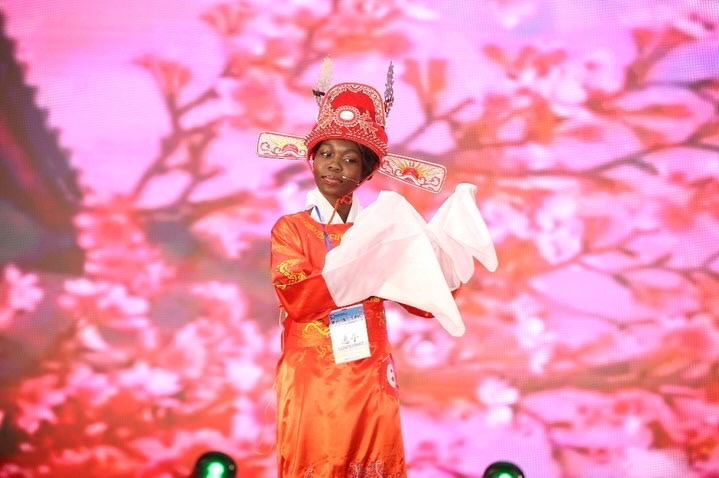
A Ghanaian Chinese language learner participating in the 2025 fifth "Chinese Bridge" Chinese proficiency competition for foreign primary school students in Ghana. (Photo courtesy of the Confucius Institute at the University of Cape Coast)
Mohammed Ikililu, a Ghanaian Ph.D. student studying International Chinese Language Education at Beijing Language and Culture University and a part-time Chinese language lecturer at the University of Ghana, aspires to become a Chinese language lecturer to inspire more Ghanaians to learn the language.
"My goal is to use my personal experience as a Chinese teacher to inspire more students to learn the language. After completing my Ph.D., I plan to return to Ghana and share the knowledge I've gained, especially in the field of Chinese language education," he said.
Ikililu, who has noticed a surge in Chinese language learners in Ghana in recent years, highlighted the rapid growth of the Chinese economy and China's increasing influence in global affairs as key factors.
"As China continues to open up internationally, many Chinese companies have expanded globally, including to Ghana. This has created more job opportunities for those who can speak Chinese, making the language an asset in the job market," he said.
Currently, three major Confucius Institutes have been established at public tertiary institutions in Accra, Cape Coast and Kumasi, facilitating educational and cultural exchanges and promoting mutual understanding between China and Ghana.
Professor Ou Yamei, the Chinese director of the Confucius Institute at the University of Cape Coast, told People's Daily Online that Chinese language education has become an important bridge in China-Ghana relations.
Since 2016, Chinese language programs have expanded steadily across Ghana, reaching thousands of learners each year. Ou noted that many students are now using their language skills to access new opportunities — from translation work and internships with Chinese enterprises in Ghana to scholarships and cultural exchange programs in China.
She also highlighted the growing recognition of Chinese within Ghana's education system, saying that universities are exploring new degree programs such as a Bachelor of Education in Chinese. This, she believes, signals deeper cultural and educational cooperation between the two countries.
"We anticipate more students will enroll in Chinese language programs, and that cultural exchanges between China and Ghana will continue to deepen," Ou shared.

Tel:86-10-65363107, 86-10-65368220, 86-10-65363106
 Scan the QR Code
 Follow Us