





- BRNN
- BRI News
- BRNN News
- Database
Official Documents Polices and Regulations
Inter-government Documents International Cooperation BRI Countries
Business Guide Economic Data BRI Data
Trade
Investment Projects Latest projects
Cases - Content Pool
"Look at its dandelion-like face. It's so adorable!"
Wei Yuanjia, a third-year college student, cradled a chubby dwarf rabbit before the camera, feeding it hay while chatting with viewers during a pet livestream at an e-commerce park in Yantou village, Caoqiao township, Xinyi, a county-level city in east China's Jiangsu Province.
In the pet-focused e-commerce park, shared livestreaming studios stay lit well past 10 p.m. This communal workspace model has effectively spurred the business of entrepreneurial teams like Wei's, which now sells 100 to 200 rabbits daily on average.
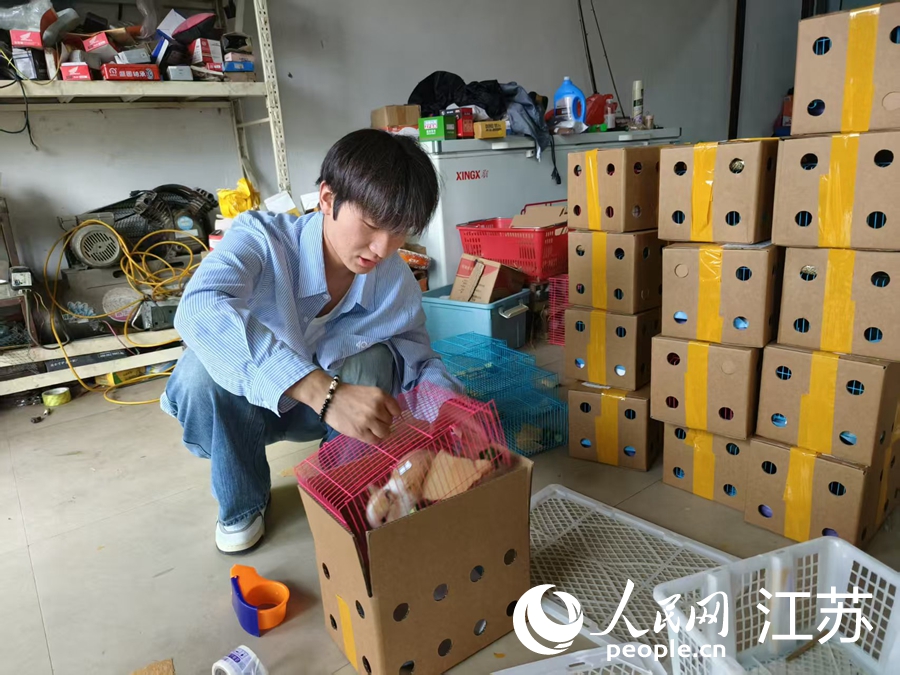
Wei Yuanjia, a third-year college student who sells pet rabbits via livestreaming, packs a pet rabbit for delivery. (People's Daily Online/Zhang Hantian)
The e-commerce park serves as a vivid illustration of Xinyi's thriving pet economy, which boasts a full-fledged ecosystem.
A wide variety of animals are bred in the city, from peacocks and parrots to rabbits.
The local pet industry has seen breeding methods evolve from traditional farming to smart, climate-controlled systems. At the same time, sales channels have expanded from offline transactions to online services such as livestreaming. Rural tourism has also been enriched through the integration of culture, travel and the pet industry.
In Caoqiao township, the pet economy generates more than 500 million yuan ($71.37 million) in annual output and provides jobs for over 1,000 people.
Yantou village, with a tradition of rabbit breeding dating back to the 1990s, has benefited greatly from the development of its rabbit breeding industry.
In 2022, the village set up a professional cooperative for pet breeding and partnered with the Jiangsu Academy of Agricultural Sciences to launch the province's first pet rabbit quarantine and testing zone.
The move helped the local rabbit breeding industry overcome its small-scale, fragmented and slow-growth model, providing technical guidance for farmers while reducing logistics costs from over 20 yuan to 5-12 yuan per rabbit.
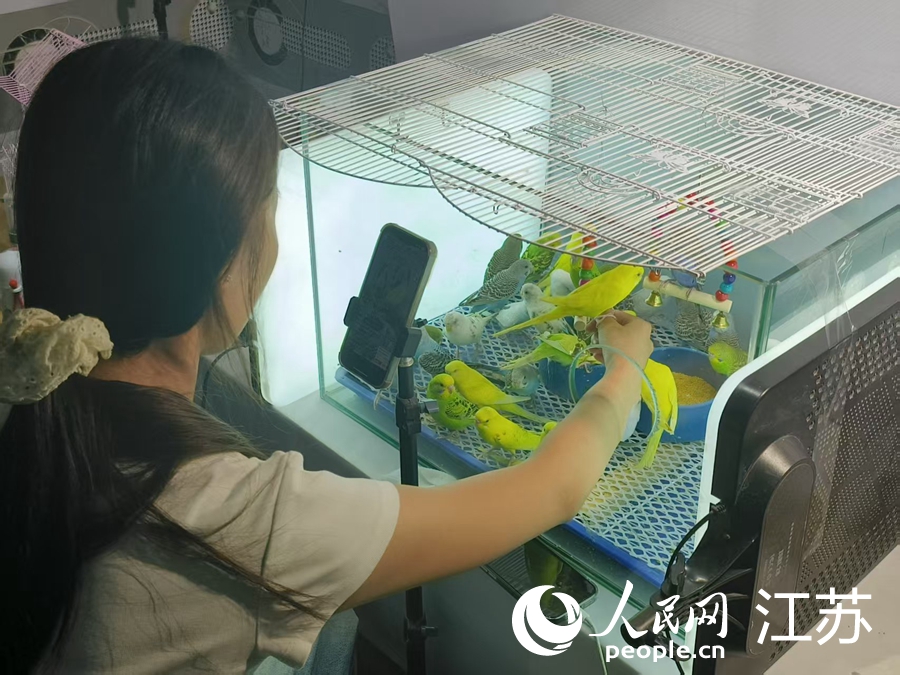
An e-commerce livestreamer promotes budgies online in Xinyi, east China's Jiangsu Province. (People's Daily Online/Zhang Hantian)
"From scattered household breeding to large-scale operations, more than 50 households in Yantou village now breed rabbits, with annual incomes of around 500,000 yuan per household," said Liu Lilun, head of the livestock department at Xinyi's agriculture and rural affairs bureau.
The sales side has seen even faster transformation. To ride the e-commerce wave, Caoqiao township has built the pet-focused e-commerce park and launched a livestreamer incubation initiative.
As a result, more than 500 e-commerce vendors from Yantou village are active across major platforms, with sales rising 15 percent year on year.
In addition to pets, e-commerce has also driven sales of a variety of pet-related products, including feeds, toys and care products, according to Wu Xuelei, secretary of the Communist Party of China (CPC) Yantou village general branch.
Meanwhile, an industrial model integrating pet breeding and cultural tourism has emerged as a new highlight of rural revitalization efforts in the area.
Family farms combining local cuisine and pet-themed study tours attract tens of thousands of visitors each year.
The booming rabbit breeding industry has motivated many people to return to their hometown to pursue career opportunities.
Ma Xianshuai is one of them. In 2016, Ma returned to Yantou village and started a rabbit breeding business with just a few dozen rabbits. Today, he raises more than 2,000 rabbits at a breeding facility in the village.
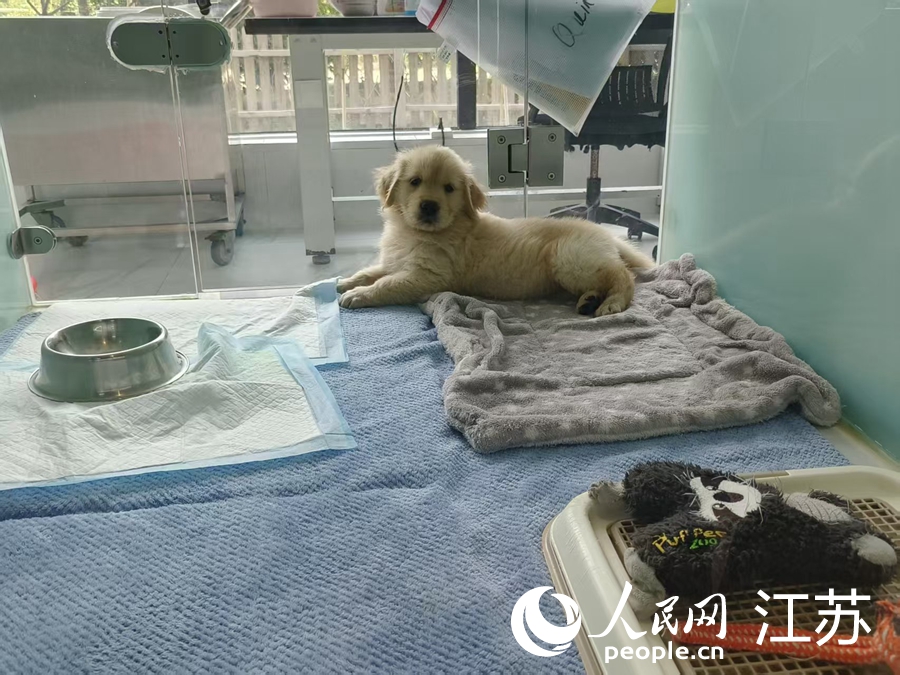
Photo shows a dog bred using cloning technology at a company in Xinyi, east China's Jiangsu Province. (People's Daily Online/Zhang Hantian)
The boundaries of the pet industry are also expanding in Xinyi.
In the Xinyi Economic and Technological Development Zone, a subsidiary of Sinogene, China's first enterprise with fully independent intellectual property rights for commercial pet cloning, has raised more than 10 animals using cloning technology, including dogs and cats.
Sinogene has established a technology platform covering multiple species, including dogs, cats and horses.
Xinyi's pet industry is leaping into upstream technology, noted Huang Jigang, a member of the Party working committee of the Xinyi Economic and Technological Development Zone.
Currently, several major investment projects in pet economy-related products are taking shape, Huang said. These include a 1.3 billion yuan investment in a smart pet food supply chain, a large-scale premix feed company with an annual output of 70,000 tonnes and a smart manufacturing facility covering 500 mu (33.33 hectares).
These projects are helping build an integrated industry ecosystem encompassing research and development, production and retail in Xinyi, according to Huang.
Behind the prosperity of the pet industry is targeted policy support from the municipal government.
Recognizing the pet industry as one of its four emerging sectors, Xinyi rolled out eight special policies to promote the pet economy, set up industry and venture funds, offered talent subsidies and provided support for electricity and other operating costs.
"From a cluster of single-focus enterprises to a fully upgraded industrial chain, Xinyi aims to become a national high ground of the pet industry," said Li Sheng, secretary of the CPC Xinyi Municipal Committee.

Tel:86-10-65363107, 86-10-65368220, 86-10-65363106
 Scan the QR Code
 Follow Us