





- BRNN
- BRI News
- BRNN News
- Database
Official Documents Polices and Regulations
Inter-government Documents International Cooperation BRI Countries
Business Guide Economic Data BRI Data
Trade
Investment Projects Latest projects
Cases - Content Pool
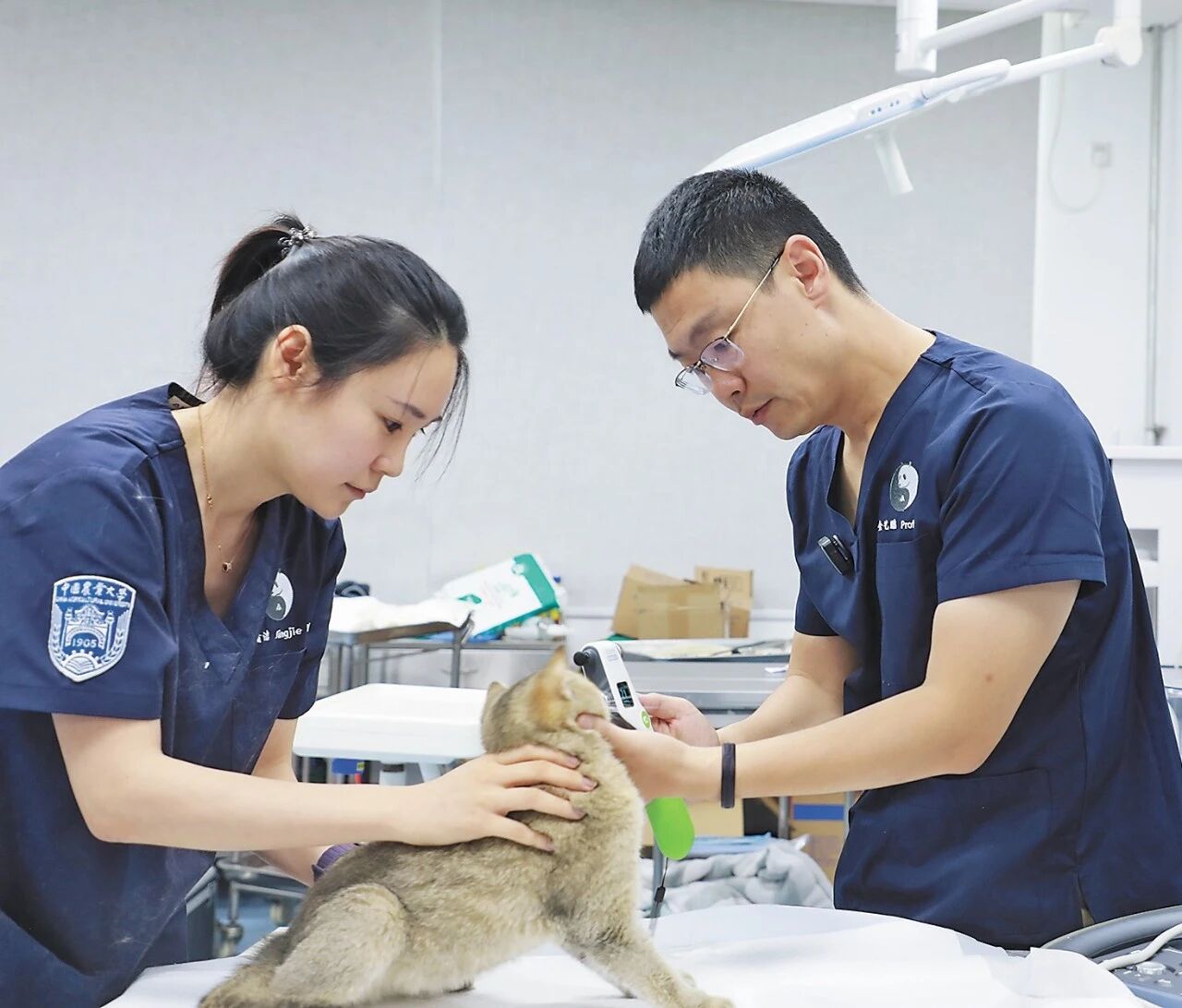
Jin Yipeng (right) guides a student in using the examination equipment. (Photo/Yang Hao)
For Jin Yipeng, vice dean and professor at the College of Veterinary Medicine of China Agricultural University, clinical practice rarely unfolds in a conventional operating room. His patients -- some of the world's most endangered species -- are often found deep in mountain forests or high on alpine plateau.
Specializing in wildlife medicine, Jin has devoted his career to the rescue and treatment of endangered animals, from giant pandas to snow leopards. Over the years, each successful rescue has left behind not only medical records but also vivid moments captured on his phone.
Scrolling through the photos, the 47-year-old recalled each encounter. "This is Tangtang, a giant panda -- when released back into the wild, a butterfly landed on its back," he shared. "And this is Meng'er; the discoloration around its eyes was later resolved."
Jin smiled as he spoke of Yimao, a male panda: "Now when Yimao sees me, it sometimes rolls over and sits close beside me. That kind of mutual trust -- it feels really rewarding." Among the animals he has treated, giant pandas account for the largest share.
"Our team began rescuing giant pandas in 2008 at the Foping National Nature Reserve in Shaanxi," Jin recalled.
"As a male, Yimao often gets injured in fights," Jin explained. Once, Yimao was bitten by another panda -- its teeth were loosened and displaced, its face covered in blood, and immediate treatment was needed.
Startled, Yimao fled ahead, with Jin and his team chasing after it at full speed. The panda eventually stopped by a stream, exhausted. To avoid alarming it further, Jin laid down in the icy water.
"It was winter, and I was wearing a down jacket," Jin recalled. "I half swam, half crawled through the stream for over 20 minutes, inching closer until I was within about four meters. I then shot it with a blow dart to administer anesthesia and carried out the subsequent treatment."
Over more than a decade, Jin has conducted over 10 medical examinations and treatments of varying complexity on Yimao. Now 21 years old -- considered elderly for a giant panda -- Yimao has seen its foraging ability decline significantly.
In May 2025, Jin's team launched a field-based rehabilitation and health maintenance program for wild giant pandas. "We assigned a full-time veterinarian to locate Yimao daily, supplement its nutrition through dietary therapy, and administer targeted medication," Jin said. "The animal's recovery has been very encouraging."
"Recent follow-up examinations show that all indicators are close to normal," he added. "We hope this approach will help extend its lifespan."
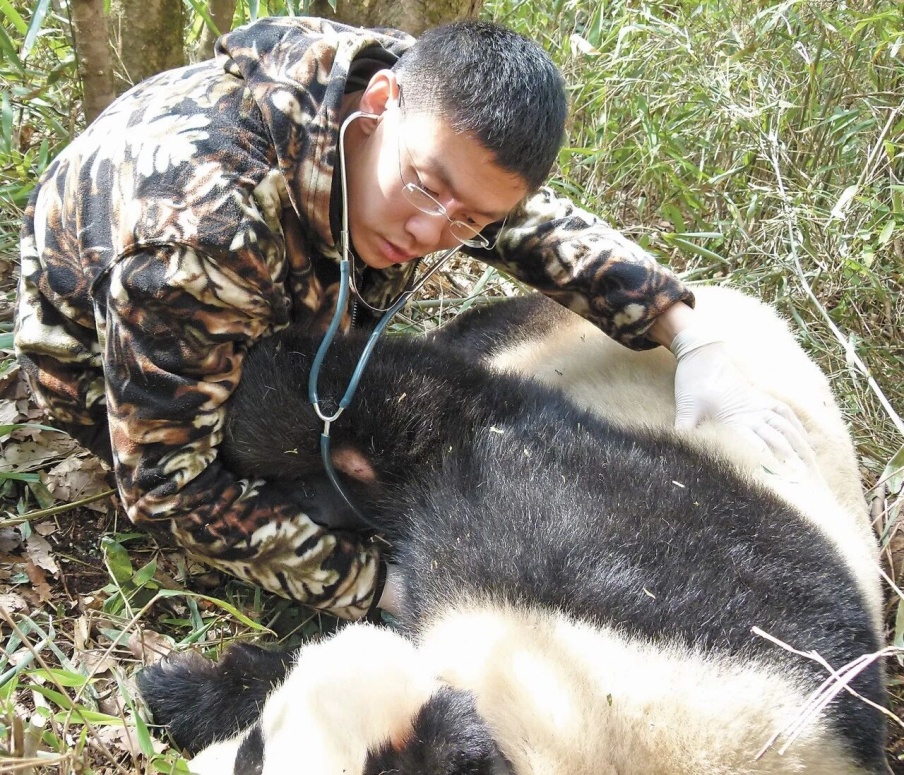
Jin Yipeng carries out a medical checkup on a wild giant panda. (Photo provided by Jin Yipeng)
Why did Jin choose to dedicate himself to wildlife rescue? He has a clear answer.
In 2007, Jin went to the United States as a visiting scholar to study wildlife medicine, marking the beginning of his professional journey in this field.
"After returning to China, I interned at a wildlife breeding institution," he said. "During one giant panda rescue operation, I realized the limits of our treatment capabilities -- we still need to consult foreign experts and follow overseas medical standards."
"That moment solidified my resolve to change the situation," Jin recalled.
Over more than decade-long career, Jin has treated more than 1,000 wild animals, ranging from giant pandas and snow leopards to Asian black bears and Chinese mountain cats.
In early 2019, his team received an emergency case at the Qinghai Wildlife Rescue and Breeding Center in northwest China's Qinghai province: a severely injured elderly male snow leopard, near shock from life-threatening wounds. Jin and his team immediately rushed to Xining, Qinghai's provincial capital. "During the examination, we found that its left eye had a corneal perforation caused by trauma, and the right eye had a severe cataract that required surgical treatment," Jin added.
Performing phacoemulsification cataract surgery on a wild snow leopard was unprecedented. "While this technique is routine for domestic cats and dogs, the real challenge was designing a suitable intraocular lens," Jin said. "We contacted every manufacturer but found no existing snow leopard lens molds."
Undeterred, Jin adapted equine three intraocular lenses -- ordering three from overseas and modifying them based on years of research. The successful surgery restored the snow leopard's vision.
"Just two years ago, we performed another cataract surgery on a snow leopard," Jin stated proudly. "This time, we used China's first domestically developed snow leopard-specific intraocular lens -- a technologically superior and more cost-effective breakthrough."
Through years of hands-on rescue work, Jin has witnessed the rapid development of wildlife medicine in China.
"In the early days, we could only perform basic examinations using stethoscopes and test strips," he said. "Today, we have wildlife medical vehicles, portable ultrasound devices, and X-ray machines with fully independent intellectual property rights, enabling on-site examinations and treatment directly in the field."
In recent years, Jin has devoted considerable effort to preventive conservation. At the Foping National Nature Reserve in Shaanxi, he has gone door to door vaccinating villagers' dogs.
"Unvaccinated domestic can transmit fatal diseases to pandas and other wildlife," Jin explained. "Small preventive measures yield significant protection," Jin observed. He remains committed to raising public awareness, fostering a shared societal responsibility for wildlife conservation.

Tel:86-10-65363107, 86-10-65368220, 86-10-65363106
 Scan the QR Code
 Follow Us