





- BRNN
- BRI News
- BRNN News
- Database
Official Documents Polices and Regulations
Inter-government Documents International Cooperation BRI Countries
Business Guide Economic Data BRI Data
Trade
Investment Projects Latest projects
Cases - Content Pool
China's automotive industry has once again drawn widespread international attention. From Chinese carmakers grabbing global attention at the Consumer Electronics Show in Las Vegas to Canada announcing adjustments to its import policy on Chinese electric vehicles, global enthusiasm for Chinese automobiles continues to surge.
In 2025, automobile production and sales in China both exceeded 34 million units. In particular, new energy vehicle (NEV) production and sales each surpassed 16 million units, topping global rankings for the 11th consecutive year. These impressive outcomes underscore the industry's strong momentum for innovation and its leadership in green development.
The sector's strength stems from China's efficient intelligent manufacturing system, resilient domestic supply chain, rapid pace of technological upgrading, and continuous rollout of competitive products. This momentum demonstrates the strong momentum generated by the combination of the country's innovation capacity and its vast domestic market.
From stumbling forward decades ago by importing foreign technologies, China has now evolved into a hub where multinational automakers are actively engaging in "co-creation and joint research and development (R&D)." This shift marks the arrival of a "Joint Venture 2.0" era and mirrors the shifting contours of opportunity in today's China.
"China leads in developing and deploying new technologies," remarked a multinational executive, stressing that keeping up with "China speed" is critical to gaining a competitive edge in the era of electrification and smart transformation.
The Advanced China Development Center of French carmaker Renault Group developed its first electric vehicle in just 21 months, while Volkswagen established its largest R&D hub outside Germany in Hefei, east China's Anhui province, shortening development cycles by approximately 30 percent.
These examples show how established international automakers are drawing on China's momentum to drive global technological transformation and operational efficiency. This mutually collaboration creates multidimensional win-win outcomes, contributing to a more open, inclusive, and dynamic industrial ecosystem.
China's accelerating green transition provides critical momentum for global sustainable mobility.
In 2025, NEVs accounted for more than half of new vehicle sales in China, and over half of the world's NEVs are now on Chinese roads. At the same time, China exported over 2.61 million NEVs last year, doubling the figure from a year ago.
Chinese automakers are driving down costs across the entire industrial chain through technology and scale, making green mobility a more accessible option for countries worldwide, especially developing ones.
The growth of the global NEV industry requires not just high-quality products and technologies, but also practical, system-wide solutions. China's experience shows that widespread adoption of green transportation is closely tied to easing "range anxiety." During the 14th Five-Year Plan period (2021–2025), China built the world's largest electric vehicle charging network, capable of supporting over 40 million NEVs. These proven solutions provide a strong, actionable reference for other nations in transition.
With a strengthened industrial foundation, China's automotive sector is accelerating its global reach, directly contributing to development worldwide. Evolving from "product export" to "ecosystem expansion," Chinese automakers' commitment to openness and collaboration stands as a compelling case of "openness triumphing over protectionism."
In recent years, Chinese carmakers have stepped up localization strategies overseas--building factories and strengthening local supply chains so that more communities can benefit from industrial upgrading.
BYD and Great Wall Motor have built plants in Thailand, supporting the country's automotive transformation; JAC Motors operates an assembly plant in Algeria, providing vocational training for local workers; and Chery's joint venture with Spain's Ebro in Barcelona has given a significant boost to the regional economy.
"Chinese enterprises bring us more than factories; they offer a new pathway for development," said Jerônimo Rodrigues, Governor of Brazil's Bahia State.
The leapfrog development of China's automotive industry is a vivid reflection of the qualitative advancement and innovation within the country's manufacturing sector. As China enters the 15th Five-Year Plan period (2026–2030), its industrial system is set to further evolve toward greater intelligence, greener development, and more integrated growth.
Through continued openness and cooperation with nations worldwide, the shared benefits of development will keep expanding, injecting new momentum into the global economy and creating more opportunities for all.
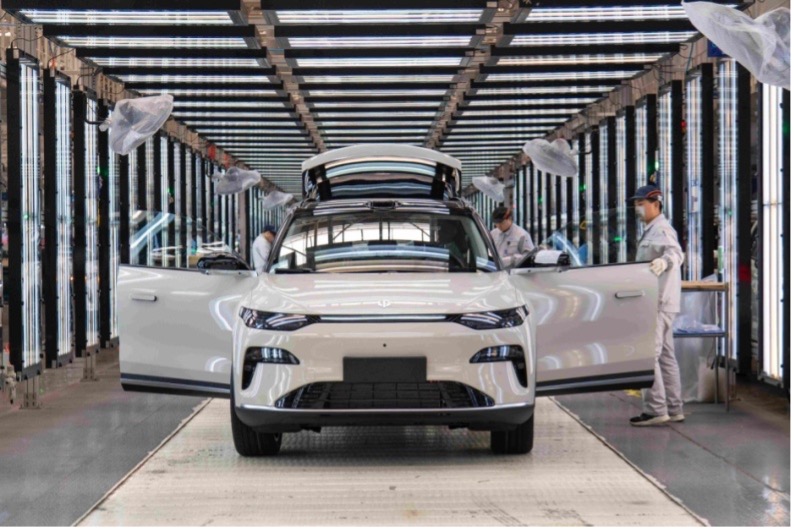
New energy vehicles are assembled in an intelligent workshop of Chinese automaker Leapmotor in Jinhua, east China's Zhejiang province. (Photo/Hu Xiaofei)
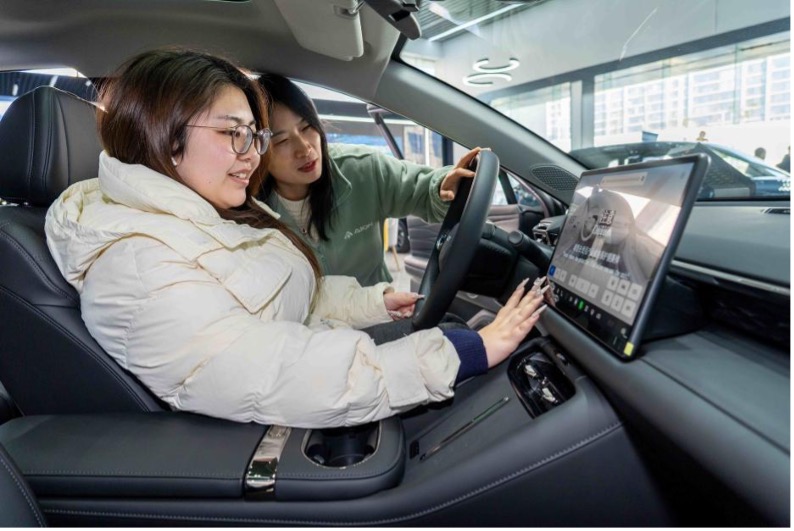
A woman tries out a new energy vehicle at a dealership in Zhangjiagang, east China's Jiangsu province. (Photo/Xing Bin)
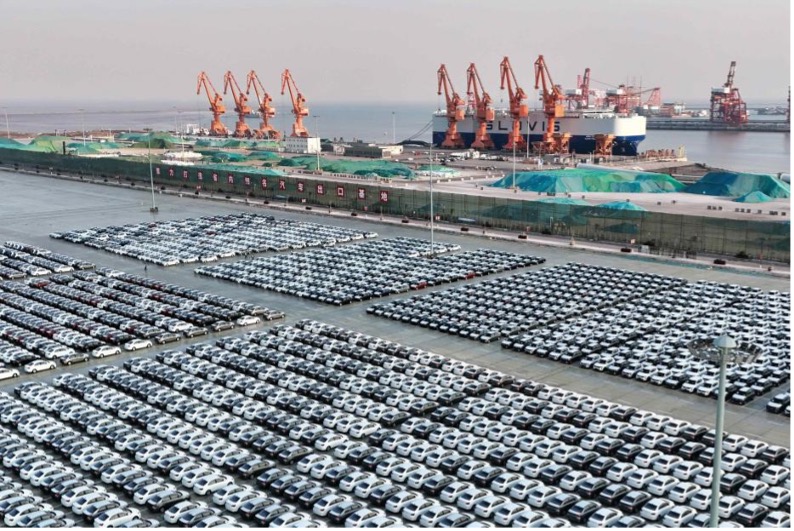
Chinese automobiles are about to be loaded onto ships in Yancheng, east China's Jiangsu province. (Photo/Li Gen)

Tel:86-10-65363107, 86-10-65368220, 86-10-65363106
 Scan the QR Code
 Follow Us