





- BRNN
- BRI News
- BRNN News
- Database
Official Documents Polices and Regulations
Inter-government Documents International Cooperation BRI Countries
Business Guide Economic Data BRI Data
Trade
Investment Projects Latest projects
Cases - Content Pool
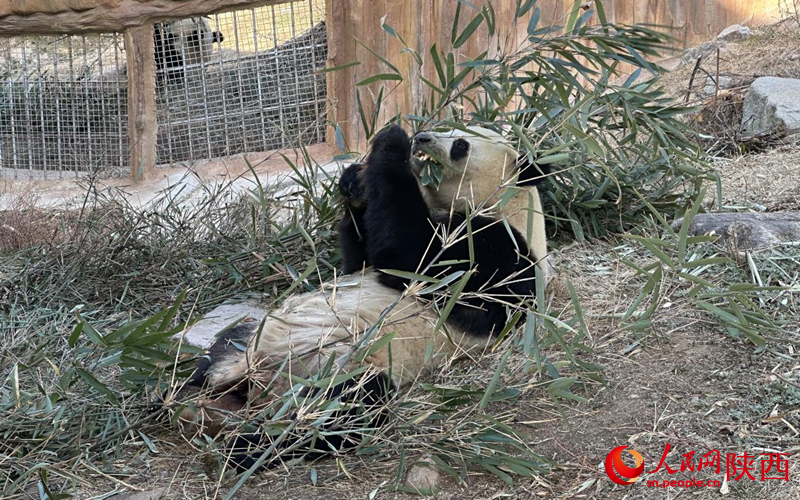
Giant panda "Dang Sheng" eats bamboo shoots at the Foping Rescue, Breeding and Research Base of Qinling Giant Panda in Foping county, Hanzhong, northwest China's Shaanxi Province. (People's Daily Online/Bai Ge)
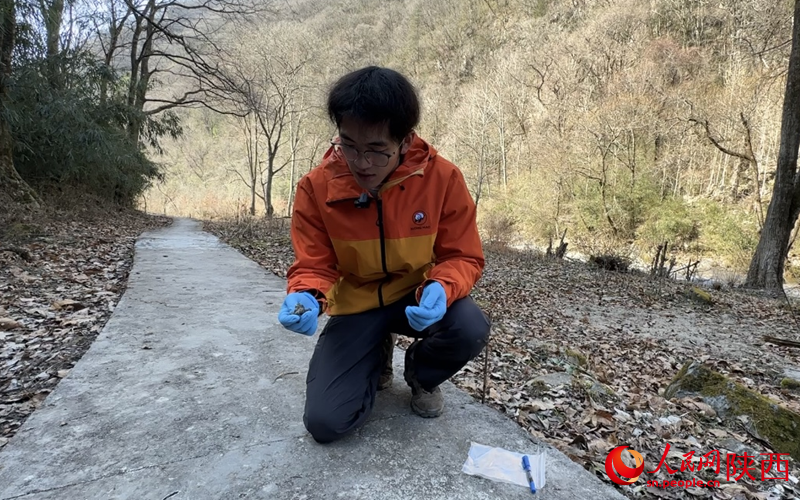
He Jiao patrols a mountain in Foping county, Hanzhong, northwest China's Shaanxi Province. (People's Daily Online/Bai Ge)
Foping county in Hanzhong, northwest China's Shaanxi Province, is home to more than 130 giant pandas, making it the area with the highest density of wild giant pandas in the country.
He Jiao, a research assistant on Professor Jin Yipeng's team at the College of Veterinary Medicine, China Agricultural University, has returned to Daguping, a village in Foping, to work as a giant panda guardian.
He's family has a long tradition of protecting giant pandas. He's great-grandparents once fed a giant panda cub named "Ping Ping" milk after it had wandered away from its mother and was rescued by the protection station.
He's family, their village, and even the surrounding mountains share an inseparable bond with giant pandas.
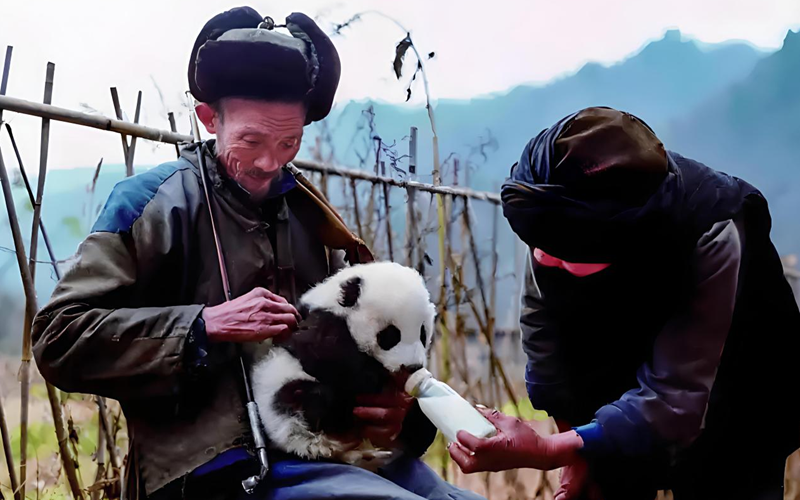
He Jiao's great-grandfather (left) and great-grandmother feed giant panda "Ping Ping" milk. (Photo courtesy of the interviewee)
In 1978, the Foping National Nature Reserve was established. Since then, Daguping village has taken part in over 40 giant panda rescue missions.
"In the past, giant pandas could only be seen deep in the mountains; now they often appear right outside our doors," said local villagers.
The frequent visits of giant pandas are not only a vivid sign of ecological improvement but have become a driving force for the village's green development.

Photo shows a wild giant panda in a village in Foping county, Hanzhong, northwest China's Shaanxi Province. (Photo courtesy of the Publicity Department of the Communist Party of China Foping County Committee)
At the village entrance, 52-year-old Song Zhaohua was preparing to brief an upcoming study tour group. He is a jack-of-all-trades in the village. When tourists arrive, he is a lively ecological guide. In his spare time, he runs a small shop. He is also a panda patroller, a cornus grower and a beekeeper.
"Last year, I earned over 4,000 yuan (about $578.73) as a guide, more than 10,000 yuan from honey sales, nearly 10,000 yuan from the shop, plus over 1,000 yuan in village collective dividends, not to mention my patrol officer salary," Song said with a smile.

Photo shows a B&B in Foping county, Hanzhong, northwest China's Shaanxi Province. (Photo courtesy of the interviewee)
With a forest coverage rate exceeding 91 percent, Foping is using the giant panda IP as a key to unlock both ecological conservation and economic development, exploring a distinctive path toward revitalization.
"Giant pandas are Foping's core tourism resource and a top-tier IP," said Pu Ke, Party secretary and director of the Foping county Bureau of Culture and Tourism. In recent years, the county has hosted cultural and tourism events such as the Panda Music Season and created the "Call of the Panda" tourism route, continuously expanding the panda value chain.
As night fell on the high-speed train from Foping to Xi'an, capital of China's Shaanxi Province, many passengers were carrying cute panda plush toys. Modeled after the giant pandas in Foping, the cultural creative IP has expanded into more than 30 product categories, including plush toys, clothing, water bottles and agricultural products, with annual sales of between 2 million and 3 million yuan.

Tel:86-10-65363107, 86-10-65368220, 86-10-65363106
 Scan the QR Code
 Follow Us