





- BRNN
- BRI News
- BRNN News
- Database
Official Documents Polices and Regulations
Inter-government Documents International Cooperation BRI Countries
Business Guide Economic Data BRI Data
Trade
Investment Projects Latest projects
Cases - Content Pool
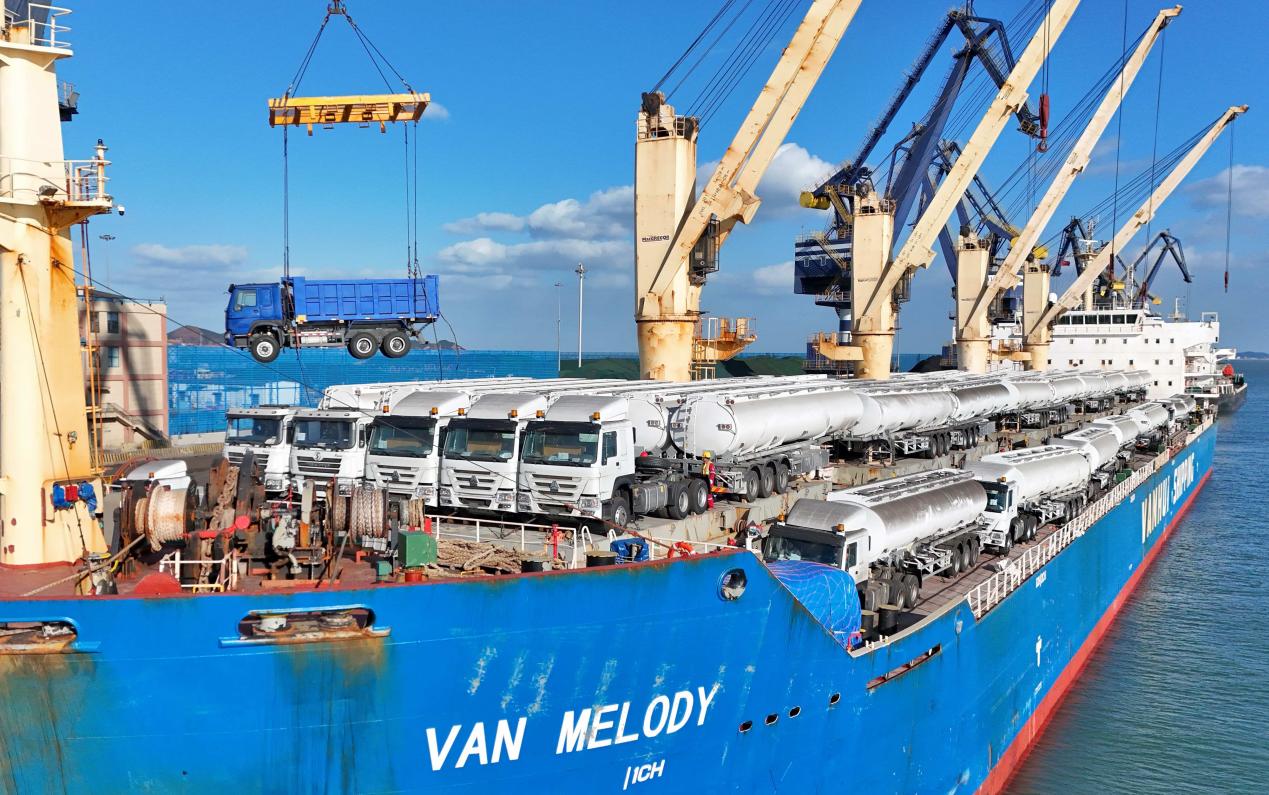
Chinese trucks bound for Africa are loaded onto a China-Africa freight vessel at Yantai Port in east China's Shandong province, Jan. 7, 2026. (Photo/Tang Ke)
In 2025, China's foreign trade demonstrated strong resilience and vitality.
China's total imports and exports reached 45.47 trillion yuan ($6.55 trillion) in 2025, a record high that consolidated the country's position as the world's largest trader in goods.
Foreign trade rose 3.8 percent, marking the ninth consecutive year of growth -- the longest uninterrupted expansion since China joined the WTO.
A closer look at this impressive performance reveals the most distinctive feature: diversity.
Diversity in markets
In April 2025, the United States announced so-called "reciprocal tariffs" on all its trading partners, including China, and repeatedly escalated the measures, triggering an unprecedented tariff war. As tensions mounted, the world watched closely to see how China would respond.
At that moment, at the Yiwu International Trade Market in Yiwu, known as "the world's capital of small commodities" in east China's Zhejiang province, merchants remained unfazed by market volatility, steadily expanding into emerging markets across Africa, Central Asia, and Latin America.
At Ningbo-Zhoushan Port, also in Zhejiang, a real-time global shipping map revealed the densest cluster of routes converging on Chinese ports.
Further northwest, at the Horgos Port in Xinjiang, trains and trucks destined for Central Asia were laden with premium Chinese goods.
By tapping into these emerging markets, China's foreign trade has become more resilient to external shocks.
China's foreign trade network continues to broaden, with partners spanning the globe. In 2025, China engaged in trade with 249 countries and regions. Notably, import and export volumes increased with more than 190 of them.
Trade partnerships with China are deepening: 14 countries and regions traded over 1 trillion yuan, 62 surpassed 100 billion yuan, and 137 exceeded 10 billion yuan--up by 2, 6, and 10, respectively, from 2024.
This expansion illustrates how China's foreign trade is reducing its dependence on any single market and achieving more balanced and resilient growth.

Foreigners buy skis at the Yiwu International Trade Market in Jinhua, east China's Zhejiang province, Jan. 7, 2026. (Photo/Shi Bufa)
Diversity in products
Trade diversification means more than just reaching new markets -- it drives higher quality, greater efficiency, and newer growth engines. Today, a growing array of "Made in China" products is gaining global traction by aligning with international demand through innovation and supporting the worldwide shift toward low-carbon development through sustainable practices. Its innovation-driven value and eco-friendly credentials continue to rise.
Artificial intelligence offers a vivid example. Chinese intelligent robots not only perform tasks such as dancing, running marathons, and practicing tai chi, but also drive efficiency in production. In overseas infrastructure and transportation projects, handling robots equipped with vision systems and algorithms can intelligently avoid obstacles, while welding robots automatically scan and model workpieces to calculate optimal welding solutions. In 2025, exports of both types of robots grew by more than 60 percent.
These "quality Chinese products" enrich the lives of consumers worldwide and play a key role in global industrial and supply chains, providing strong support for international industrial cooperation.
Diversity in imports
The vast potential of China's ultra-large market continues to unlock new opportunities for global businesses seeking access.
Recent data indicates that in the first three quarters of 2025, China became the main export destination for 79 countries and regions, three more than in the whole of 2024. China imported goods worth 18.48 trillion yuan in 2025, accounting for about 10 percent of global imports.
The effective release of production and consumption demand in this ultra-large market has provided broad market space and cooperation opportunities for countries around the world.
A range of policies to stabilize foreign trade have helped enterprises secure orders and expand markets, providing solid support for diversification. Pilot measures to facilitate cross-border trade have been implemented first in pilot areas and then replicated nationwide, helping businesses reduce costs and improve the efficiency and smooth flow of cross-border logistics.
Logistics corridors are reaching more markets, paving a broader path for trade diversification.
At Yantai Port in east China's Shandong province, shipments on China -- Africa liner services rose by 49 percent year on year in 2025, hitting a record high and linking China's vast market with Africa's distinctive industries.

Smart mattresses bound for overseas markets are manufactured in a workshop of a furniture company in Quanzhou, southeast China's Fujian province. (Photo/Xie Guiming)
At Ningbo-Zhoushan Port in Zhejiang province, the world's first China-Europe Arctic container express route was launched, offering faster and lower-carbon international logistics options for China's high-end manufacturing, cross-border e-commerce, and new energy industries.
Driven by open channels such as China-Europe freight trains, the New International Land-Sea Trade Corridor, and the China-Laos Railway, border provinces and regions are steadily moving toward the forefront of opening up.
Diversity has become a source of confidence for China in navigating external risks and a key pillar of its foreign trade resilience. Looking ahead, with global uncertainty still high and pressure mounting to stabilize trade, China is expected to step up efforts in innovative trade development, injecting greater certainty into global growth and creating new opportunities worldwide.

Tel:86-10-65363107, 86-10-65368220, 86-10-65363106
 Scan the QR Code
 Follow Us