





- BRNN
- BRI News
- BRNN News
- Database
Official Documents Polices and Regulations
Inter-government Documents International Cooperation BRI Countries
Business Guide Economic Data BRI Data
Trade
Investment Projects Latest projects
Cases - Content Pool
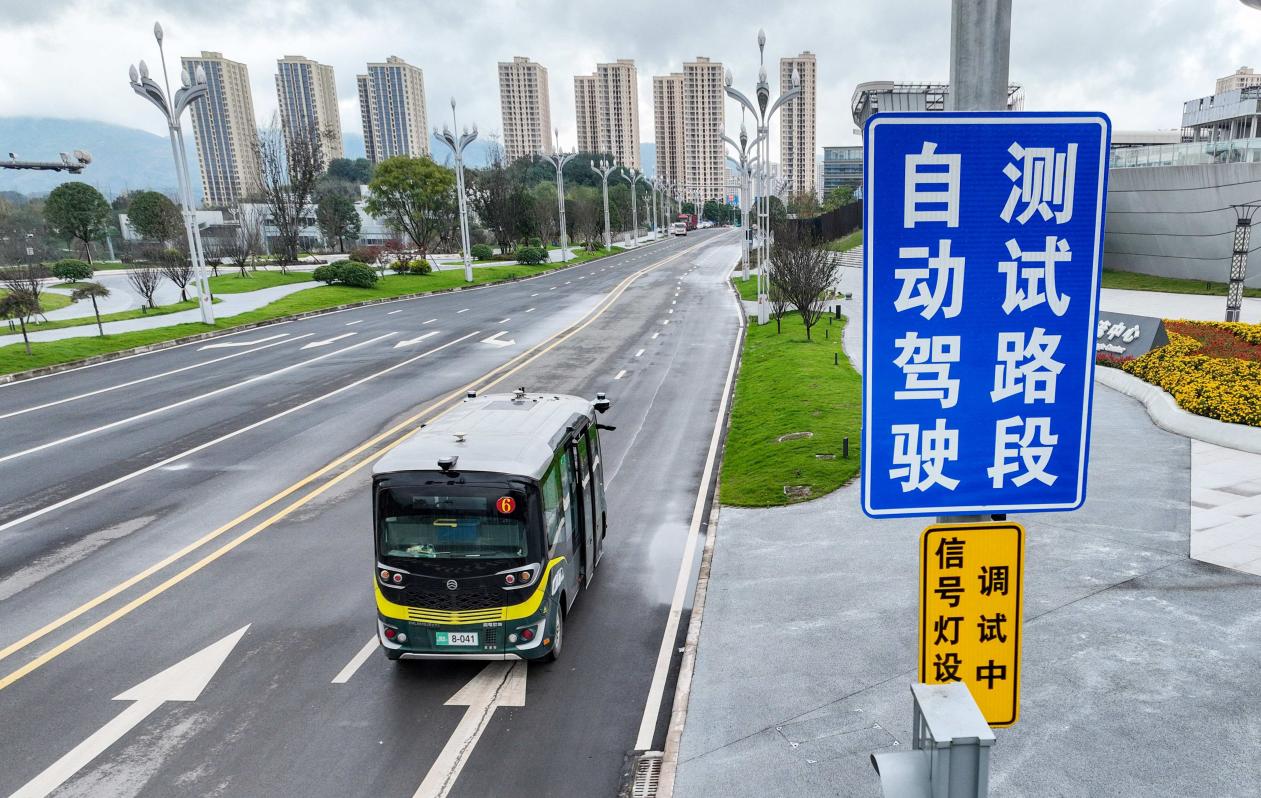
An autopilot bus runs on a test road in Chongqing's Western Science City in southwest China's Chongqing municipality. (Photo/Long Fan)
Chongqing, a pivotal hub in China's intelligent vehicle industry, is transforming its urban roads into digital proving grounds for automotive innovation.
At a demonstration zone in the Western Science City Innovation Center of Intelligent and Connected Vehicle (WICV) in the city, an autonomous electric vehicle recently navigated a scenario emblematic of real-world challenges: as a pedestrian stepped onto a crosswalk, roadside sensors instantly detected the movement, relayed data to the cloud, and triggered a command for the vehicle to slow down and yield -- all without human intervention.
This facility exemplifies a future where vehicles communicate, roads perceive, and cloud platforms orchestrate decisions.
"In the demonstration zone, all data streams integrate and update in real time," said Chang Xueyang, deputy director of the cloud control technology center at the WICV, gesturing to a live monitoring screen. "Through vehicle–road–cloud integration, these routes function as true digital training grounds."
Unlike conventional closed test tracks, this 50-kilometer network spans complex urban environments -- from highways and interchanges to neighborhood streets -- simulating real-world situations such as pedestrians and cyclists crossing, or broken-down vehicles blocking lanes.
"For test vehicle, every run is a real-traffic simulation," Chang noted. "And for the road's intelligent system, every day delivers stress testing under authentic loads."
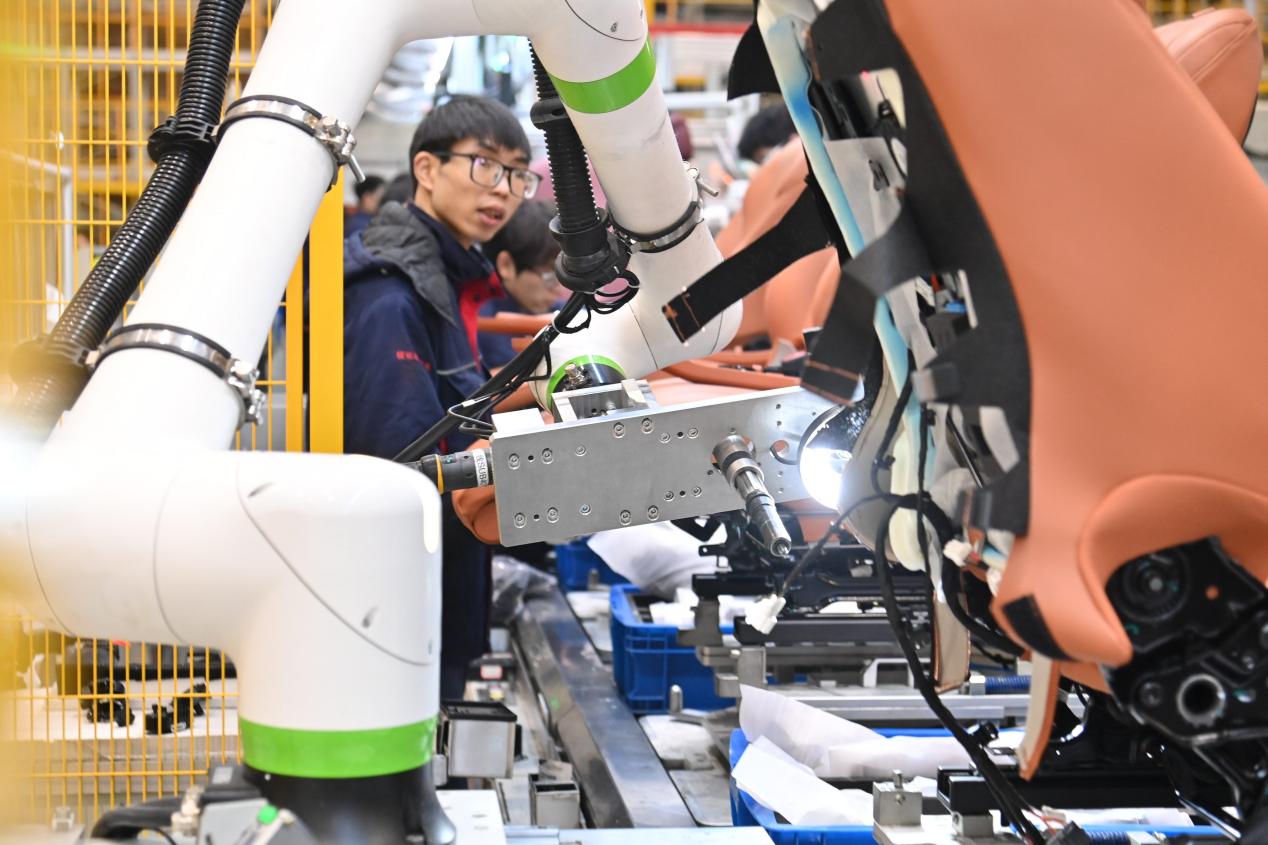
Automobile seats are manufactured in a smart workshop of Lear Dongshi Automotive Seating Co., Ltd. in southwest China's Chongqing municipality. (Photo/Sun Kaifang)
The zone supports not only intelligent connected new energy vehicles, but all vehicle types. With the installation of compliant communication terminals and positioning devices, ordinary private cars, logistics vehicles, and buses can access the system and upgrade their connectivity capabilities.
While benefiting from enhanced safety and convenience, these vehicles also contribute large volumes of real-world data. To date, the system has connected with more than 1,000 vehicles of various types.
"With just a small device installed, our logistics vehicles can run on an intelligent connected system. Parcel deliveries are now linked to traffic signals, real-time road conditions and cloud platforms -- making trips safer and smoother," said Li, a logistics vehicle driver.
With continuous accumulation of massive real data -- from different vehicle models and driving behaviors -- the system's decision-making models keep evolving, helping innovative technologies move from the lab into broader application.
According to Lai Chenguang, dean of the School of Vehicle Engineering at Chongqing University of Technology, the zone tackles key industry challenges -- bridging the gap between closed testing environments and real-world traffic conditions, and eliminating long-standing "information silos" across systems.
"By combining single-vehicle intelligence with networked capabilities, the zone allows automakers to validate technology in realistic scenarios, reduce research and development (R&D) and mass-production risks, and ultimately accelerate the commercialization of intelligent driving-assistance systems," he added.
Policy innovation further fuels progress. Chongqing has introduced a series of targeted policies to promote full coverage of perception, decision-making, and control services based on vehicle–road–cloud integration within the demonstration area.
At the same time, the city has explored institutional innovations to address key obstacles to open-road testing, such as fragmented management, road access restrictions, and data fragmentation.
These efforts include breaking down departmental barriers and promoting coordinated governance among transportation, industry and information technology, and public security authorities; innovating test license issuance and traffic accident insurance mechanisms to reduce constraints on road testing; and establishing unified data sharing and security platforms to enable cross-system integration of vehicle, road, and cloud.
With targeted policy support in place, road-testing scenarios have expanded rapidly, generating strong spillover effects for industrial development.
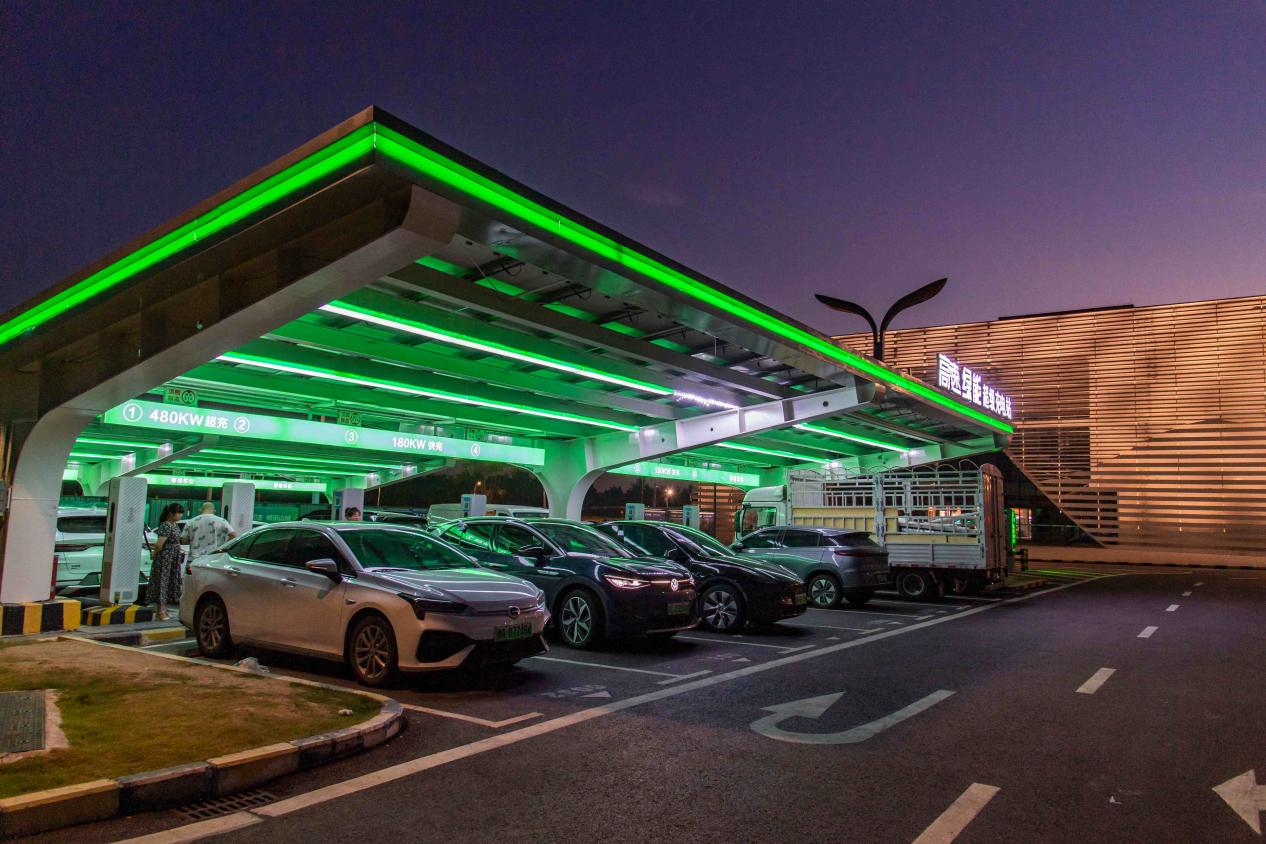
New energy vehicles are charged at a charging station in an expressway service area in southwest China's Chongqing municipality. (Photo/Sun Kaifang)
Attracted by the testing environment, 15 automakers have conducted joint testing under unified standards. Test vehicles from companies such as Toyota and Changan have accumulated extensive datasets, accelerating iteration in connected driver-assistance systems and virtual–real integrated testing technologies.
Supporting enterprises like AI Drive and West Genesis have emerged with robust R&D platforms and order-filled product pipelines. Meanwhile, institutions like China Merchant Testing Vehicle Technology Research Institute Co., Ltd. advance innovations such as full-vehicle thermal runaway simulation for safety design.
Today, Chongqing's Western Science City has brought together more than 60 intelligent connected vehicle-related enterprises, spanning vehicle manufacturing, key components, charging infrastructure, and autonomous driving operations.
Today, Chongqing hosts more than 270 automotive R&D institutions, including a State Key Laboratory of Intelligent Vehicle Safety Technology. The city has launched an automotive "industrial brain" platform and established four future-ready factories in the automotive sector.
Besides, Chongqing is now home to 754 high-tech enterprises and 3,543 technology-based enterprises in the automotive industry.

Tel:86-10-65363107, 86-10-65368220, 86-10-65363106
 Scan the QR Code
 Follow Us