





- BRNN
- BRI News
- BRNN News
- Database
Official Documents Polices and Regulations
Inter-government Documents International Cooperation BRI Countries
Business Guide Economic Data BRI Data
Trade
Investment Projects Latest projects
Cases - Content Pool
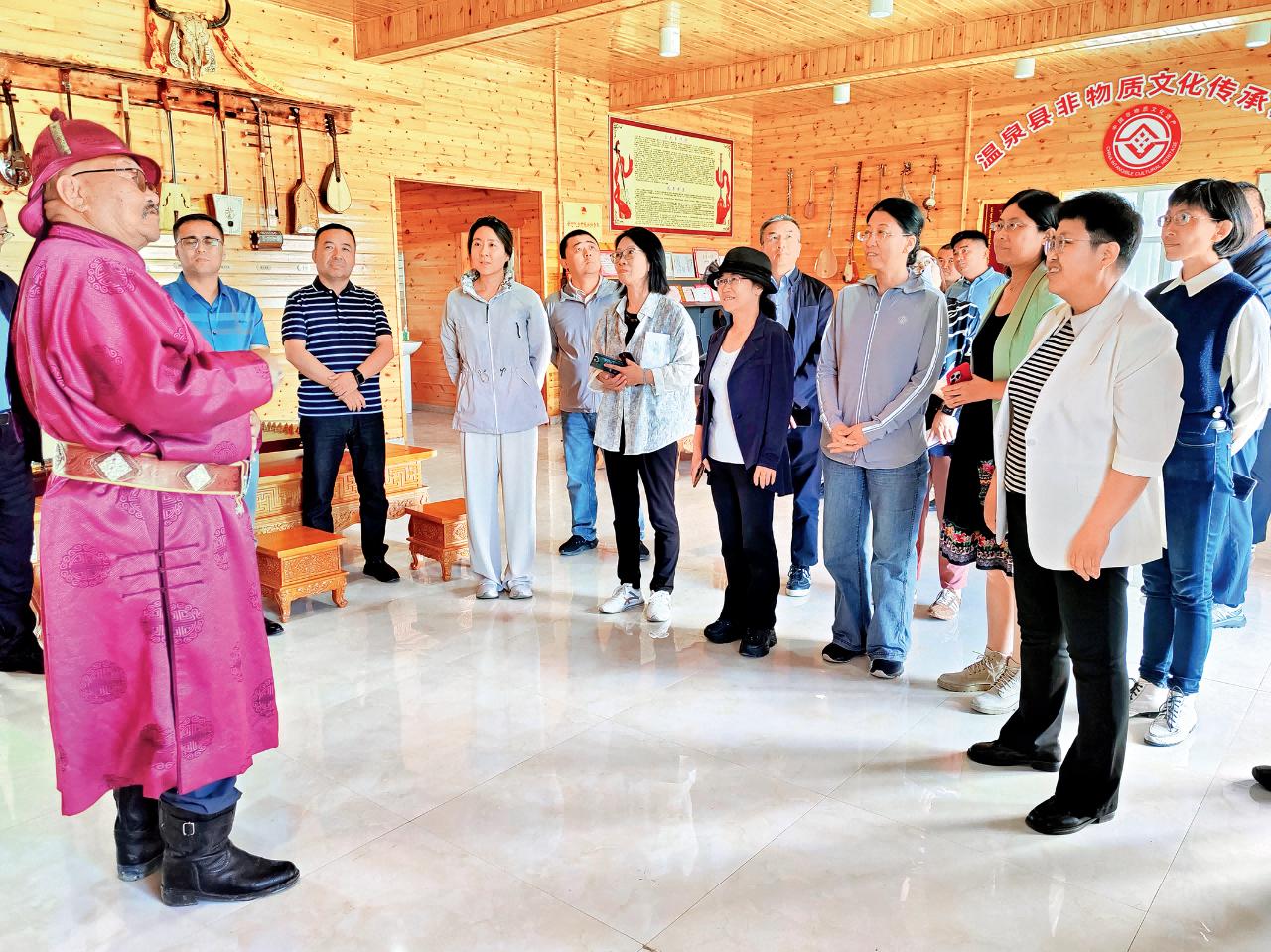
Zhong Ying (fourth from left on the front row) leads a research team in northwest China's Xinjiang Uygur autonomous region. (Photo provided by Zhong Ying)
At Alashankou Port in northwest China's Xinjiang Uygur autonomous region, China-Europe freight trains shuttled back and forth, carrying goods across borders and linking markets along the route.
After a day of field research here, Zhong Ying, a member of the National Committee of the Chinese People's Political Consultative Conference (CPPCC) and a researcher at the Institute of Contemporary China Studies under the Chinese Academy of Social Sciences, sat down to organize her notes.
"Proposals require deep understanding of realities and public concerns," said Zhong, whose work has taken her to border regions including Xinjiang, Xizang, Guangxi, and Yunnan. She conducts on-site investigations with officials, experts, and residents, transforming findings into policy recommendations.
In recent years, her research and consultation work has taken her across Inner Mongolia, Xinjiang, Xizang, Guangxi, and Yunnan. From border ports to industrial parks, from pastoral areas to demonstration farms, she has conducted on-site investigations and held discussions with officials, experts, and local residents. These experiences have become the foundation of her proposals.
As a CPPCC member representing the ethnic minority sector, Zhong has focused her efforts on promoting high-quality development in ethnic regions by closely integrating her academic expertise with her duties as a political advisor.
During her research, she found that although Alashankou serves as a key hub in high-quality Belt and Road cooperation, its development is constrained by factors such as population size and resource endowments.
She has therefore proposed leveraging the China (Xinjiang) Pilot Free Trade Zone to strengthen infrastructure, enhance its role as a transportation hub, and improve the facilitation of cross-border trade.
"Border areas need to build on their resource endowments and geographical advantages to explore differentiated development paths, so as to achieve a positive interplay between border area development and ethnic unity and progress," Zhong noted.
Drawing on her professional background and extensive fieldwork, she has developed a number of well-researched proposals, including those on promoting sound interaction, exchange, and integration among ethnic groups in the context of digitalization, and on accelerating the "East Data, West Computing" initiative to facilitate cross-regional data flows.
Proposals shaped through in-depth field research have received strong attention from relevant authorities, with some suggestions being adopted and translated into concrete policy measures.
"Government departments have actively responded to public concerns, and the effective implementation of proposals has further strengthened members' sense of responsibility and engagement," Zhong said.
For Zhong, transforming academic research into high-quality proposals has long been a consistent pursuit. During the 2025 "two sessions," she submitted five proposals covering topics such as fostering new quality productive forces, boosting consumption and expanding domestic demand, and advancing high-quality development in border regions -- all based on the research projects she had led.
Her schedule remains tightly packed. "Only by grounding proposals in frontline research and aligning professional expertise with the needs and expectations of the people can proposals be both impactful and relevant," she said.
Proposals are a key means for CPPCC members to perform their duties. In 2025, more than 5,900 proposals were submitted by members of the CPPCC National Committee, over 5,000 of which were filed. Some suggestions have been incorporated into relevant policy documents.
The overall quality of proposals has continued to improve, and follow-up supervision has become more effective. Over the past year, the General Office of the CPPCC National Committee and its special committees organized 68 supervision activities, producing 85 outcomes. Suggestions from proposals have been adopted in nearly 400 policy measures, special initiatives, and key tasks of departments.

Tel:86-10-65363107, 86-10-65368220, 86-10-65363106
 Scan the QR Code
 Follow Us