





- BRNN
- BRI News
- BRNN News
- Database
Official Documents Polices and Regulations
Inter-government Documents International Cooperation BRI Countries
Business Guide Economic Data BRI Data
Trade
Investment Projects Latest projects
Cases - Content Pool
Li Guangli is a deputy to the National People's Congress (NPC), China's top legislature, and deputy secretary of the Party branch of Longshan village in Mashan district, Jixi city, northeast China's Heilongjiang Province. The village sits deep in a remote mountain area where most arable land clings to hillsides.
"Breaking through geographical constraints and finding a distinctive development path for the villagers has been the toughest challenge I've faced since taking office. I had to find ways to increase their incomes," said 52-year-old Li.
The push to unlock new potential from the land began several years ago. Confronted with the meager returns of conventional farming, Li, together with members from the Party branch of the village and the villagers' committee, traveled to learn from successful experiences elsewhere and invited agricultural experts for on-site guidance.
They ultimately settled on a tiered development model: economic forests on the hillsides, high-oil soybeans and corn on the flatlands, and ecological rice in the paddies. To win over skeptical villagers, Li took the lead, piloting ecological rice and sea buckthorn cultivation and personally teaching others the techniques.
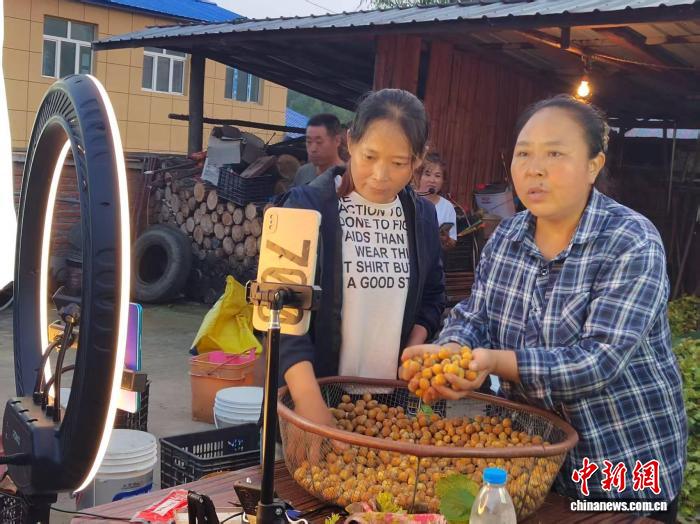
Li Guangli (first from right) sells agricultural products during a livestream session. (Photo courtesy of the Publicity Department of the Communist Party of China Jixi Municipal Committee)
She later helped establish a rice cooperative and an edible fungi cooperative, registered a trademark to bring the village's agricultural products — including rice, wood ear mushrooms, and honey — under a single brand, and promoted deeper processing, significantly raising their market value.
To develop the non-timber forest-based economy, Li also led villagers in planting hazelnut and sea buckthorn trees, while introducing chicken raising under sea buckthorn and ecological beekeeping, opening up multiple income streams.
Li set up a sales group for agricultural products, attended e-commerce training courses, and began posting promotional videos online to market local goods. Her efforts inspired a group of farmer-turned-livestreamers in the village, and agricultural product sales reached 200,000 yuan ($29,000) last year — fundamentally shifting villagers' approach to production and marketing.
"Combining modern marketing concepts with traditional farming and breeding industries is the way forward for rural development," she often says.
Over the past three years, Li has submitted more than 10 suggestions at NPC sessions. Several have been adopted and implemented, including measures to extend pension benefits to urban and rural residents aged 60 and above, introduce comprehensive crop insurance for rural farmland, and increase grain purchase prices.
For two consecutive years, she has also submitted proposals calling for greater support for Heilongjiang's former revolutionary base areas. Those efforts have borne fruit at home: the village has since completed a red culture exhibition hall dedicated to the Northeast Anti-Japanese United Army and a 2,300-square-metre red culture plaza.
Plans are now underway to leverage the resources of nearby Jilong Lake to develop a tourism project centered on red culture heritage, aiming to further boost the village's cultural and tourism sector.

Tel:86-10-65363107, 86-10-65368220, 86-10-65363106
 Scan the QR Code
 Follow Us