





- BRNN
- BRI News
- BRNN News
- Database
Official Documents Polices and Regulations
Inter-government Documents International Cooperation BRI Countries
Business Guide Economic Data BRI Data
Trade
Investment Projects Latest projects
Cases - Content Pool
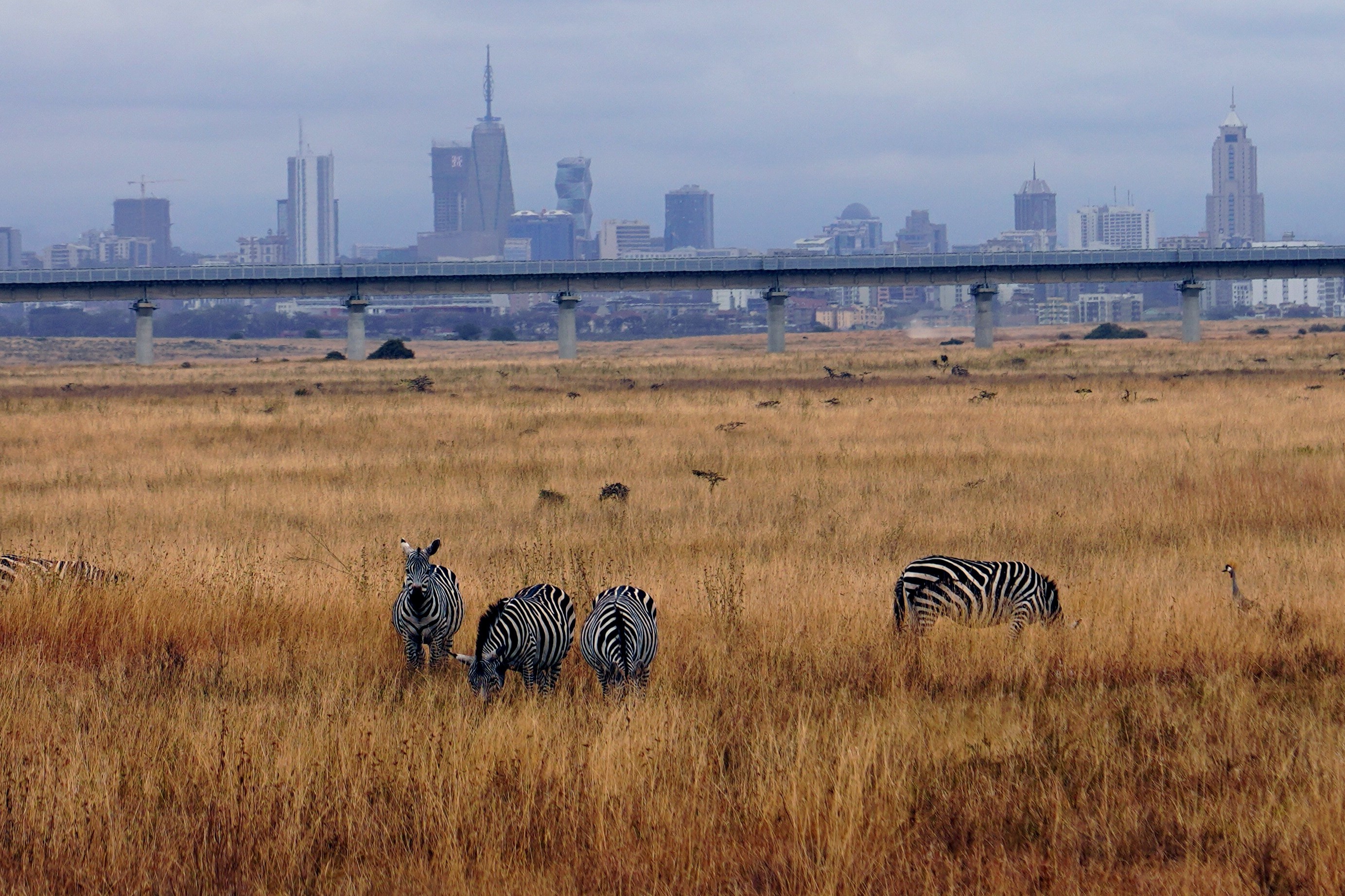
The Mombasa-Nairobi Standard Gauge Railway runs through a nature reserve in Kenya. (Photo/Huang Weixin)
Erik Solheim, former Under Secretary-General of the United Nations and Executive Director of the UN Environment Programme, currently serves as co-chair of the Europe-Asia Center.
A longstanding champion of global ecological cooperation, Solheim has both observed and contributed to China's sustainable development initiatives, maintaining active engagement with the nation's green transformation efforts.
Q: A growing number of Chinese projects are receiving the UN's highest environmental honor, the "Champions of the Earth" award. What does this signify?
A: When I first joined the UN, I noticed something surprising: very few Chinese projects had received the Champions of the Earth Award. This was not because China lacked successful cases. Many reviewers were sitting in offices thousands of kilometers away, far from the field, and unable to truly see the green transformation taking place in China and other developing countries. My takeaway was simple: if people are willing to go to China and see it for themselves, they will find green stories across the country.
In a relatively short period, China has achieved remarkable environmental outcomes while significantly improving people's quality of life. China's experience offers valuable lessons for many developing countries.
Q: How has China managed to achieve rapid progress in green transformation?
A: President Xi Jinping proposed the concept that "lucid waters and lush mountains are invaluable assets" resonates deeply with me. It sends a clear message: China no longer views economic growth and ecological protection as conflicting priorities. Instead, they advance simultaneously and synergistically.
The key to China's rapid green transformation lies in its highly stable and continuously advancing ecological governance system.
First, China's policies show long-term consistency. From the long-range objectives through the year 2035 to the 'two centenary goals' looking toward 2049, China is adept at formulating strategic visions that span decades and implementing them steadily through successive Five-Year Plans. This kind of strategic continuity is a unique institutional strength that many countries can learn from.
At the same time, China's market remains vibrant and competitive. Enterprises continuously drive technological progress, reduce costs and expand capacity. By combining effective government guidance with effective market resource allocation, China's green transition has accelerated dynamically.

In Hangzhou, China's east Zhejiang province, Solheim (left) joins local residents in an environmental volunteer activity. (Provided by Solheim)
Q: In China's 15th Five-Year Plan, what aspects are you paying most attention to?
A: I focus most on new quality productive forces and green development. The former encompasses cutting-edge technologies such as AI, big data and advanced manufacturing; the latter drives comprehensive green transformation. These are not separate -- they are interdependent and mutually reinforcing.
On the one hand, new technologies are accelerating the green revolution. For example, Huawei uses AI-powered acoustic analysis to track Hainan gibbon, enabling targeted conservation. Energy companies use intelligent algorithms to coordinate power grids, integrating wind, solar, hydropower, and storage systems.
On the other hand, green energy is the foundation for technological progress. Without low-cost, large-scale clean energy, we cannot sustain the immense power demands of AI data centres. Green energy powers technological development, which in turn advances green development.
Q: Is environmental protection solely an idealistic pursuit?
A: If the green transition were driven only by idealism, it would lack sustainability. It must also demonstrate economic viability. Compared to two decades ago, the price of solar modules has fallen to less than 5 percent of its 2005 level. This 95 percent cost reduction stems from intense market competition and continuous technological progress, with China playing a pivotal role.
In many developing regions, people urgently need to escape poverty and gain reliable electricity, but energy must be affordable. Without China, the global green transition would not cease, but it would be far more expensive and much slower. If some Western countries take a more open approach to global green efforts, including cooperation with China, the outcome could be mutually beneficial. In this context, China can further promote the global green transition through investment, cooperation and technology sharing.
Q: Some argue that using Chinese green technologies could lead to a loss of energy independence. What is your perspective?
A: Exactly opposite is the case. Every country has natural resources that can be developed. When you import Chinese green technologies, such as solar panels, you are utilizing your own domestic resources -- this is very different from importing energy like oil. By basing economic development on solar, wind or hydropower, a country taps into its own resources and can achieve energy independence. In this way, international cooperation can help upgrade local technologies and promote industrial development.
We must recognize that addressing climate change, tackling ecological crises and eliminating poverty are shared global responsibilities. Through cooperation, these challenges are solvable. However, division and confrontation can render even minor problems insurmountable.

Tel:86-10-65363107, 86-10-65368220, 86-10-65363106
 Scan the QR Code
 Follow Us