





- BRNN
- BRI News
- BRNN News
- Database
Official Documents Polices and Regulations
Inter-government Documents International Cooperation BRI Countries
Business Guide Economic Data BRI Data
Trade
Investment Projects Latest projects
Cases - Content Pool
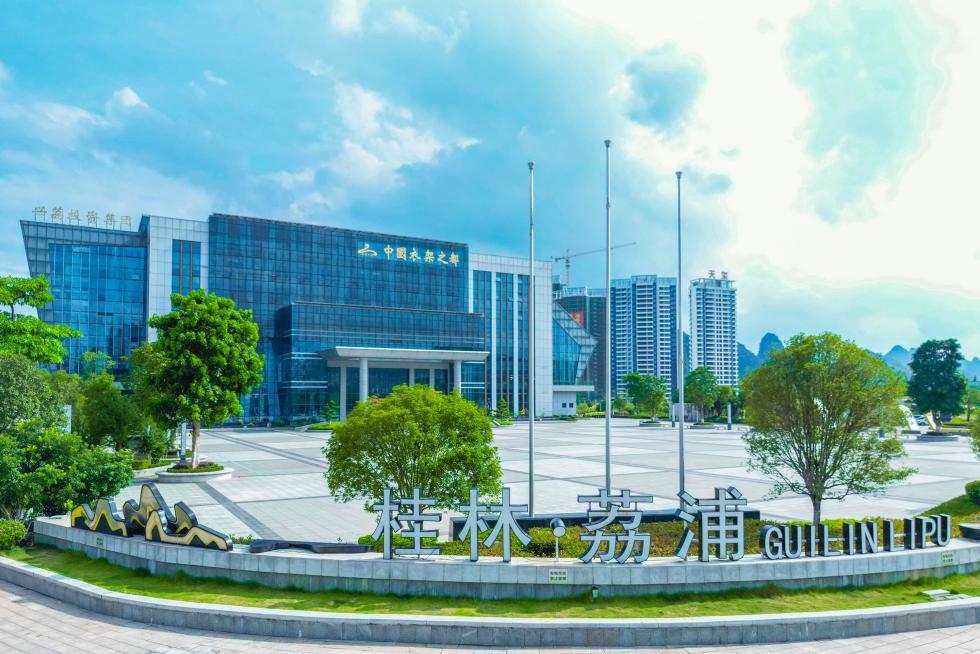
Photo shows the square of "Hanger Capital of China" in Lipu, Guilin, south China's Guangxi Zhuang autonomous region.
Lipu, in south China's Guangxi Zhuang autonomous region, operates at the heart of a global hanger manufacturing hub. Automated production lines hum in local factories, where environmentally coated hangers undergo precision polishing before shipping worldwide.
As China's designated "Hanger Capital," Lipu has established this sector as its core industry. The city has built a complete industrial chain that includes eight supporting industries and more than 3,000 product varieties. Today, Lipu is home to over 300 companies producing more than 4 billion hangers annually, with more than 80 percent of its wooden hangers exported to over 100 countries and regions.
Polishing parts, assembling components, labeling and packaging -- at a production workshop of Guangxi Guilin Huahai Home Furnishing Co., Ltd. (Huahai), a batch of birchwood hangers moved smoothly down a fully automated production line. Soon they were packed and ready for shipment to Europe.
"To ensure we can deliver orders on time, smart manufacturing is the key," said Cai Gaoxu, general manager of Huahai.
In 2022, the company purchased its first intelligent production line. Over the next three years, it added five more. Today, 95 percent of Huahai's production is automated, and the company has been recognized as a smart factory by regional authorities.
"In the earliest days, hangers were made entirely by hand, and the hooks were bent from bicycle spokes," recalled Qin Yuangao, chairman of Yuxiang Home Furnishing Products Co., Ltd., Lipu's first hanger enterprise. He has witnessed firsthand the evolution of production technology in the local industry.
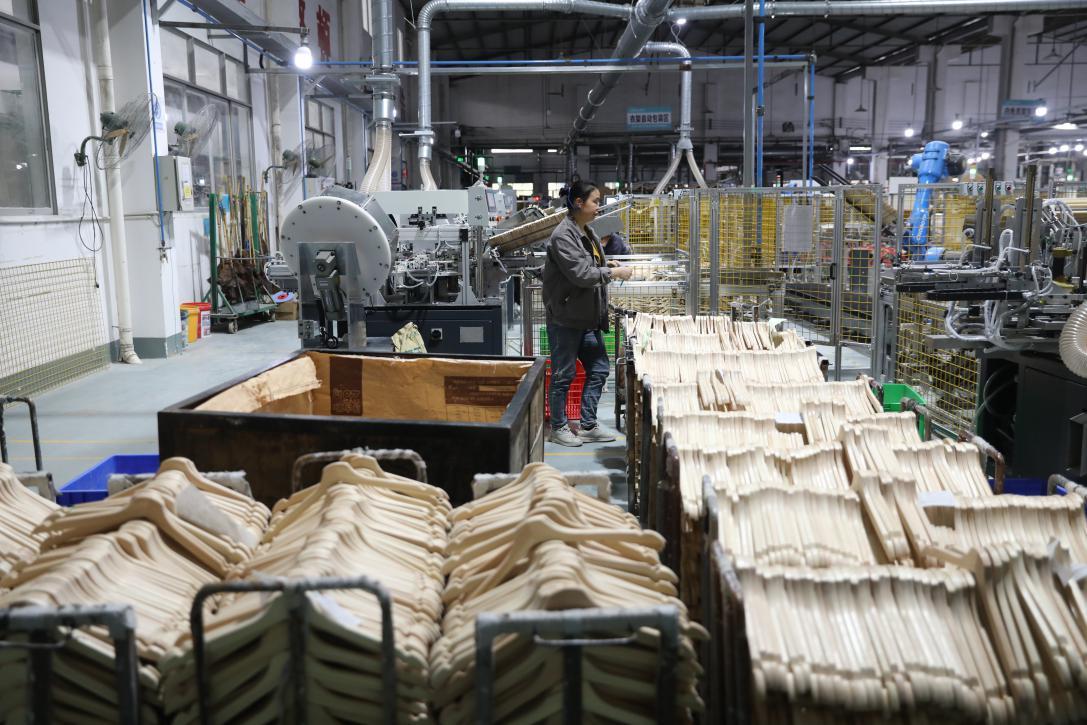
Photo shows a workshop of Yuxiang Home Furnishing Products Co., Ltd. in Guilin, south China's Guangxi Zhuang autonomous region.
Today, more than 90 percent of Lipu's export orders come from large-volume buyers, and many local companies maintain stable overseas client bases.
Automation has not only expanded production capacity but also improved product quality. At Butler Courtesy (Guilin) Inc., four large box-shaped machines roared as they operated. On the machine screens, processing parameters were set with precision down to 0.5 millimeters. Workers fed wood pieces into the machines, and in less than three minutes, 12 hanger halves were polished into shape. After assembly, they became six finished premium hangers.
"This is our 'one-touch molding' production line," said Jiang Muxun, general manager of the company. "It achieves higher precision than traditional manual polishing, ensures more reliable quality and significantly reduces rework. We hold patents for the technology."
Smart technology is also applied beyond the factory floor.
"We use digital software for market analysis, product application scenario design, material simulation and visual recognition," Qin said. "These technologies reduce the cost of trial and error in the early stages. This year, we will launch a digital transformation program to connect data across all processes and use artificial intelligence to enhance design, production and management."
Just how many forms can a hanger take? At an exhibition hall in Lipu, nine major categories of hangers are showcased, including wooden, bamboo, fabric-covered, plastic-coated, aluminum alloy, flocked, rubber-plastic, wood-plastic and metal-wood designs. There are also personalized styles such as rhinestone-studded hangers and specially shaped models. Local companies each have their own specialties. Behind this variety lies constant innovation.
Environmental responsibility shapes material science. "We transitioned from oil-based to water-based coatings over a decade ago to meet global standards," Cai emphasizes. Collaborating with Guilin University of Technology, Maos Hangers developed renewable injection-molded hangers, complementing their 2025 iron-wood design launch.
Some companies focus on high-end, customized products, while others concentrate on mass-market items.
"European and American customers prefer wooden hangers, but they take up more space and are relatively costly," Qin explained. "So we made wooden hangers thinner, allowing more people to use high-quality wooden hangers."
So far, hanger companies in Lipu hold 30 valid invention patents and 57 utility model and design patents.
"The hanger industry is about much more than hangers," said Li Qingsong, vice mayor of Lipu. "In recent years, global trade conditions have been complex and constantly changing, yet our export figures have remained stable. The key is that the entire industry, from upstream to downstream, has worked together, strengthening companies' international competitiveness."
Pooling resources has enabled the industry to maximize limited inputs and unlock internal vitality. Today, Lipu's hanger sector has horizontally driven the development of related industries such as hardware, electroplating, coatings, and packaging. Vertically, it has stimulated upstream and downstream sectors including forestry cultivation, trade, logistics, and scientific research. This complete industrial cluster has laid a solid foundation for the growth of the hanger industry.
(Photos provided by Guangxi Rural Commercial United Bank)

Tel:86-10-65363107, 86-10-65368220, 86-10-65363106
 Scan the QR Code
 Follow Us