





- BRNN
- BRI News
- BRNN News
- Database
Official Documents Polices and Regulations
Inter-government Documents International Cooperation BRI Countries
Business Guide Economic Data BRI Data
Trade
Investment Projects Latest projects
Cases - Content Pool
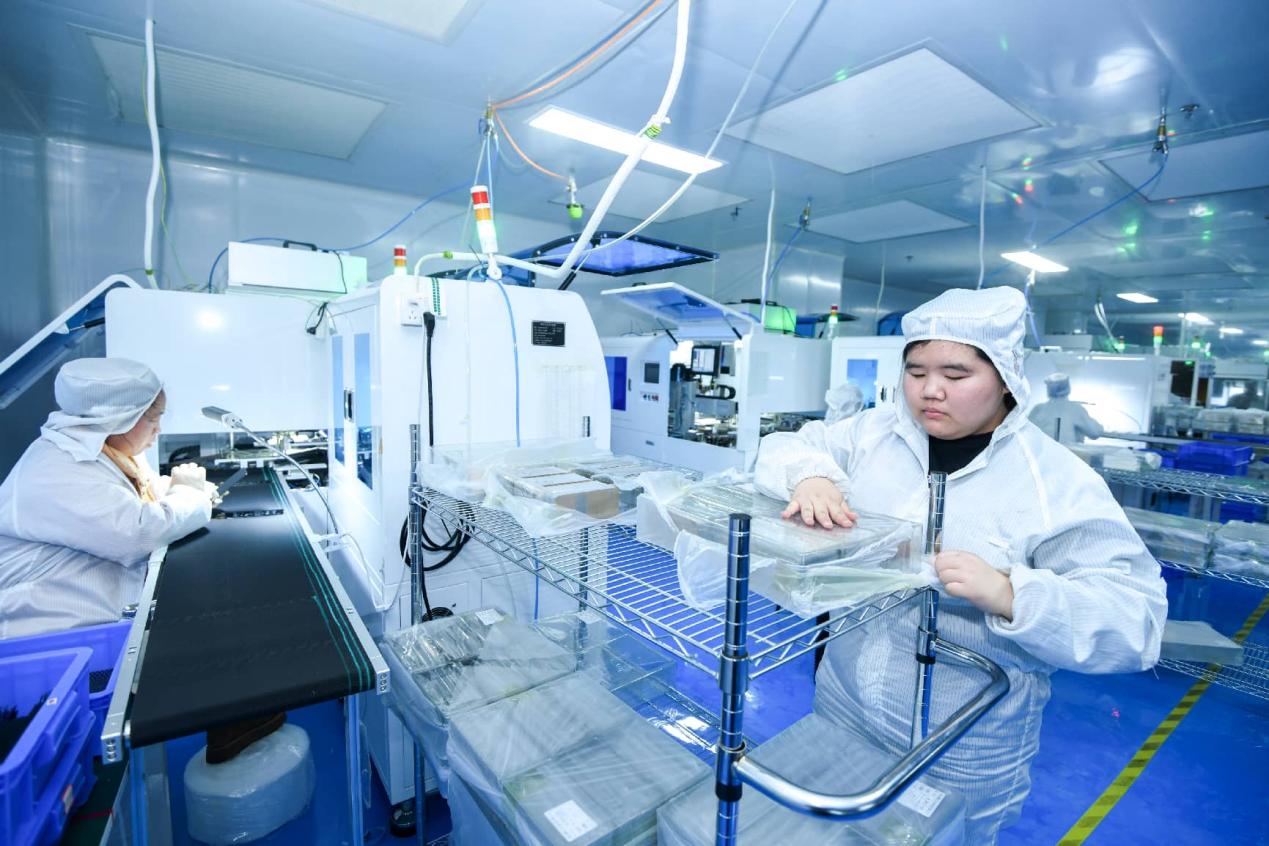
Smart LCD products are manufactured in a workshop of a tech firm in Loudi, central China's Hunan province. (Photo/Wu Yonghua)
Smartphones, televisions, computers, and e-readers -- display screens have become an unavoidable part of modern life. As technology advances, next-generation innovations are expanding into new areas including in-vehicle displays, virtual reality, and wearable devices, offering users richer and more immersive visual experiences.
What vision of the future can we see through these increasingly sophisticated screens? To explore this question: People's Daily recently spoke with industry experts and innovators.
"A 98-inch LCD TV costs only five or six thousand yuan ($724-$869). My first 40-inch LCD TV back in 2006 cost 13,000 yuan," recalled a resident surnamed Sun in Chaoyang district, Beijing. Today, a similar-sized 40-inch LCD TV sells for roughly 1,000 yuan, a drop of over 90 percent in just two decades.
Behind this dramatic decline in prices lies a key factor: China's technological innovation.
At the heart of LCD panels is the TFT-LCD glass substrate. An 8.5-generation TFT-LCD glass substrate -- measuring 2.5 meters by 2.2 meters, roughly the size of six 50-inch TV sets -- has long been regarded as the "jewel on the crown of the information display glass industry." For years, the core technology behind this advanced material was controlled by a small number of foreign companies.
That changed in September 2019, when China successfully produced its first domestically developed 8.5-generation TFT-LCD float glass substrate with full independent intellectual property rights.
"This ended foreign monopolies, reduced production costs, and brought substantial economic and social benefits," said Yang Jianqiang, deputy chief engineer at China National Building Materials (CNBM) Bengbu Design and Research Institute for Glass Industry.
An industry expert noted that China now operates nearly 20 LCD production lines, accounting for about 70 percent of global capacity.
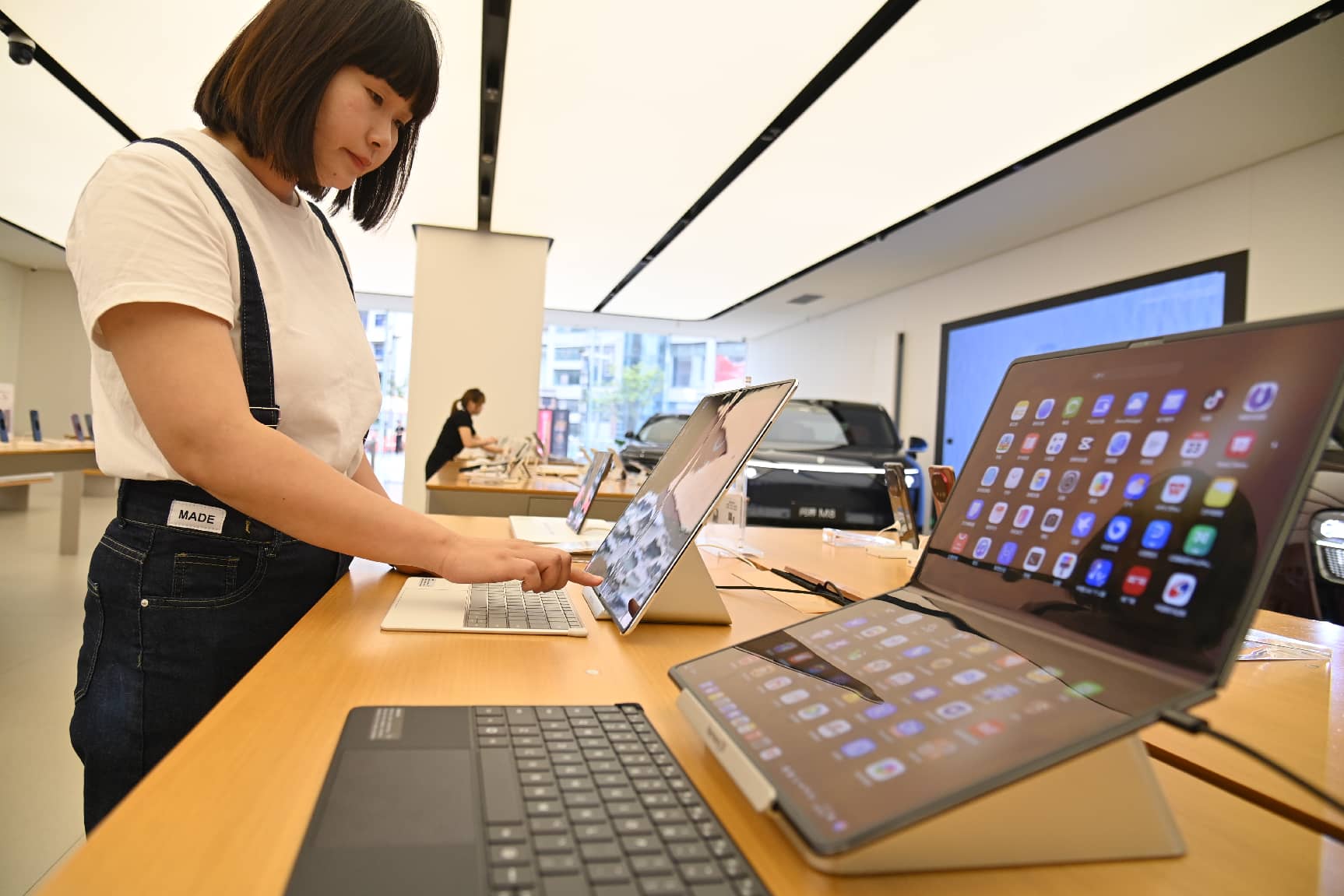
A woman experiences a foldable tablet manufactured by Chinese tech giant Huawei in a mall in Shapingba district, southwest China's Chongqing municipality. (Photo/Sun Kaifang)
But achieving "something from nothing" was only the beginning. China is continuing pushing for further technological breakthroughs.
At a state key laboratory of advanced glass materials under the institute, an ultra-thin flexible glass has been developed, which is just 30 micrometers thick, only a quarter the thickness of a sheet of printing paper.
According to Shan Fayong, deputy general manager of the institute, this glass can be bent more than 1 million times without breaking, placing its flexibility and foldability among the world's best.
Previously, ultra-thin glass thinner than 0.1 millimeters -- produced by foreign companies -- was both expensive and monopolized. In 2020, the institute, working with partner companies, successfully developed the 30-micrometer flexible foldable glass, reshaping the global landscape of ultra-thin glass technology and reducing downstream industry costs by nearly 100 billion yuan.
Today, foldable smartphones and laptops are in mass production, while rollable televisions, flexible displays, and bendable medical devices are rapidly moving from concept to reality.
"I saw a digital clock on the window and tapped it out of curiosity -- and it felt like stepping into a whole new world," said a passenger surnamed Meng on an intercity train traveling from Zhengzhou to Kaifeng in Henan province.
On the train, the window doubles as a smart screen: passengers can check arrival information, watch videos, and "scroll" through content just as they would on a smartphone. With a simple tap, the screen reverts to a transparent window, allowing passengers to enjoy the view outside or dim lighting for rest.
This "smart window" uses OLED self-emissive technology, functioning as a touch-enabled "magic screen" that delivers an immersive audiovisual experience.
Today, glass itself is becoming smarter, more energy-efficient, and more versatile.
In automobiles, glass can act as "sun-protective clothing." Coated heat-insulating windshields can block over 60 percent of solar radiation. It can also serve as a "mobile power source": by embedding solar cells within laminated glass, sunlight can be converted into electricity to power onboard systems.
"In the past, consumers mainly cared about impact strength and durability. Now, automotive glass has evolved into an intelligent terminal integrating multiple technologies," said Shen Junlong, head of automotive glass engineering at Chinese glass manufacturing company Fuyao Group.
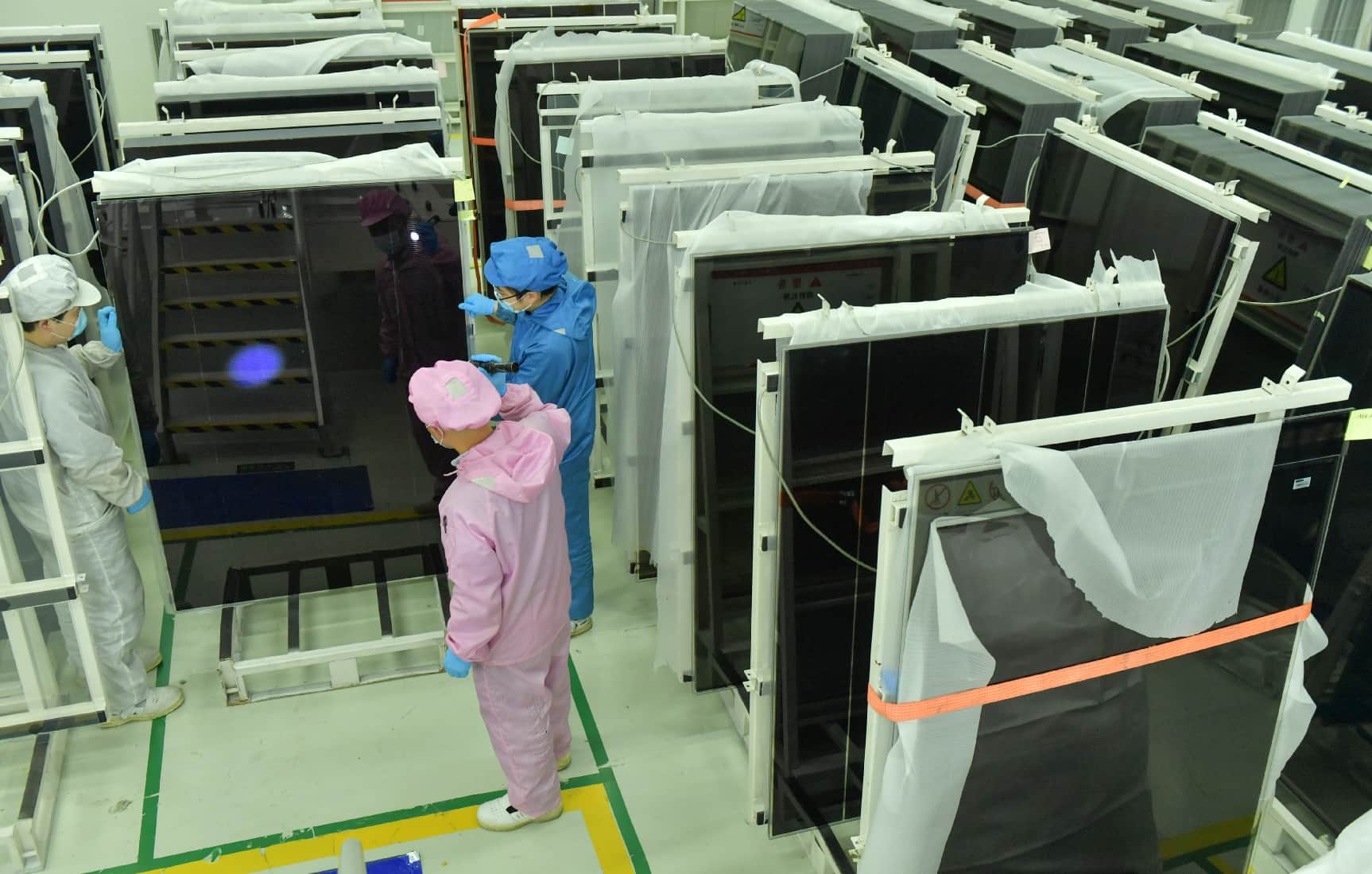
Power-generating glass is manufactured in a workshop of a material company in Chengdu, southwest China's Sichuan province. (Photo/Li Xiangyu)
In architecture, glass serves as both "armor" and "power station." Microcrystalline glass offers rich colors along with resistance to wear, acids, alkalis, extreme temperatures, and freezing. Meanwhile, by coating glass substrates with copper indium gallium selenide thin films, ordinary insulating glass can be transformed into power-generating glass.
"This type of glass can generate electricity even under low-light conditions," said Shan. "At the Bengbu Olympic Sports Center in Anhui province, over 5,000 square meters of our power-generating glass produce about 680,000 kilowatt-hours of electricity annually, saving 255 tons of coal and reducing carbon dioxide emissions by 475 tons."
Chinese researchers are currently accelerating the development and industrialization of next-generation materials, including 11- and 10.5-generation LCD glass substrates, OLED glass substrates, semiconductor glass, and even glass designed for space stations -- ensuring that this versatile material continues to enhance everyday life.

Tel:86-10-65363107, 86-10-65368220, 86-10-65363106
 Scan the QR Code
 Follow Us