





- BRNN
- BRI News
- BRNN News
- Database
Official Documents Polices and Regulations
Inter-government Documents International Cooperation BRI Countries
Business Guide Economic Data BRI Data
Trade
Investment Projects Latest projects
Cases - Content Pool
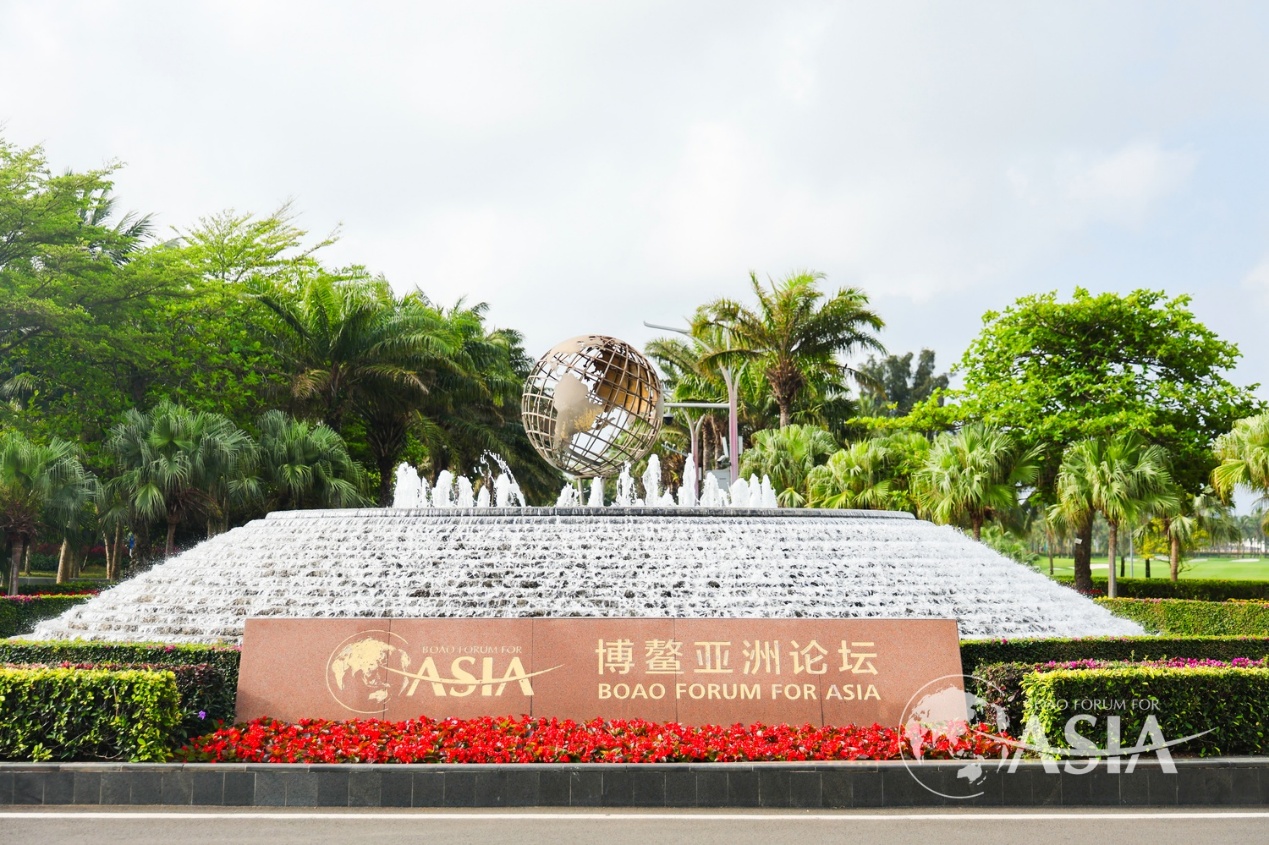
Scene from the Boao Forum for Asia 2026 Annual Conference in Boao, south China's Hainan Province. (Photo provided by the Boao Forum for Asia)
The Boao Forum for Asia (BFA) 2026 Annual Conference ended on March 27. A few days later, back from the warm air of south China's Hainan Province, I find myself sitting with one thought that keeps returning: it was beautiful.
Not in a superficial way. Boao is, of course, physically stunning. Dongyu Island sits where the Wanquan River meets the South China Sea, and the conference center looks out over water that shifts between green and blue depending on the hour. The breeze off the coast is the kind that makes you feel like you are somewhere the world has agreed to slow down for a moment. But that is not what I mean.
What I mean is something harder to put into words. It is the feeling of being in a room, or on a lawn, or in a corridor between sessions, surrounded by people who, despite everything going on in the world outside, still believe that sitting down together is worth something. That is not a small thing right now. And for four days in Boao, I got to live inside that belief.
The world that arrived at BFA 2026 was not a comfortable one. Trade wars, geopolitical fractures, the slow erosion of the multilateral institutions that held the global order together for decades. BFA Secretary-General Zhang Jun acknowledged it plainly at the opening press conference: there is far more uncertainty than certainty in the world today, he said. He is not wrong. And yet what struck me, sitting across from him and across from many others over four days, was that this acknowledgment never curdled into resignation. The uncertainty was named, and then the conversation moved to what to do about it.
This year marked the forum's 25th anniversary, a silver jubilee for an institution that began as a small gathering on a quiet island and has grown into what Zhao Leji, chairman of the National People's Congress Standing Committee, described as a prestigious platform for promoting exchanges and mutual learning, solidarity and coordination, and common development among countries in Asia and the wider world. 25 years is long enough to have seen the world change dramatically, and Boao has changed with it. But the instinct that founded it, that Asia's future is best shaped through dialogue rather than confrontation, felt as alive in 2026 as it must have in 2001.
Zhang's confidence was not merely ceremonial either. Asia's share of global GDP on a purchasing power parity basis is projected to reach nearly 50 percent in 2026. The region remains the world's leading destination for foreign direct investment. The Asian Century, as more than one speaker observed across the week, is not a prediction anymore. It is a present tense.
What I kept hearing, from economists and former heads of government and business leaders alike, was a version of the same argument: the rules-based order is fraying, but the answer is to repair it, not replace it with something cruder. Former Italian Prime Minister Paolo Gentiloni said it in terms I found hard to argue with: abandon the WTO, the multilateral frameworks, the agreed principles of trade, and you are not left with something better. You are left with the rule of force. Former World Bank Chief Economist and dean of the Institute of New Structural Economics at Peking University Justin Yifu Lin made a similar point from an economic angle, arguing that China's growth model, oriented around its five development concepts, offers a path that other countries can learn from rather than simply compete against. Zheng Yongnian, dean of the School of Public of Policy of the Chinese University of Hong Kong, Shenzhen, put it most ambitiously, describing China's approach to development as one that seeks to extend the ladder of progress to others rather than pull it up behind itself.
That framing, of China as a contributor to a shared future rather than simply a rival for a finite one, came up repeatedly and from voices that had no particular obligation to say it. It is the kind of thing that lands differently when it comes from a former New Zealand Prime Minister or a Canadian business council chief than when it appears in a policy document.
On Hainan itself, there was a particular kind of energy. The province held a dedicated press conference marking 100 days since the Hainan Free Trade Port (FTP) launched island-wide special customs operations on Dec. 18, 2025, and the setting alone said something: outside on the grass, sea breeze and all, 46 media organizations in attendance. Open air, open island, open for business. The numbers told their own story, with foreign trade surging and thousands of new enterprises registering in those first months alone, but what struck me standing there on the lawn with the cameras rolling was something harder to quantify. Hainan, more than anywhere else I have spent time in China, feels like a place that is mid-transformation, where the policy and the physical reality are catching up to each other in real time. 100 days in, the FTP is no longer just a framework on paper. You can feel it.
With China hosting APEC this year and the leaders' summit set for Shenzhen in November, there was a sense throughout the week that 2026 is a year that will matter. Not because of any single event, but because of accumulation. The 15th Five-Year Plan (2026-2030) setting a new domestic direction. APEC providing a stage for regional confidence. Boao itself, as it does every spring, offering a space to take the temperature of a world in motion and find, perhaps surprisingly, that the fever has not broken into despair.
I left Boao thinking about something George Yeo, the former Singaporean foreign minister, said: when leaders stand together and engage constructively, the world watches, and that image carries its own message. There is something in that observation that goes beyond diplomatic optics. It is a reminder that the act of showing up, of sitting across the table, of taking the conversation seriously even when the problems feel intractable, is itself a form of argument. An argument that cooperation is still possible. That the future is still open.
The forum is over. The hard work continues. But four days in Boao left me with something I did not entirely expect: a quiet, stubborn hope. Right now, that feels like enough.
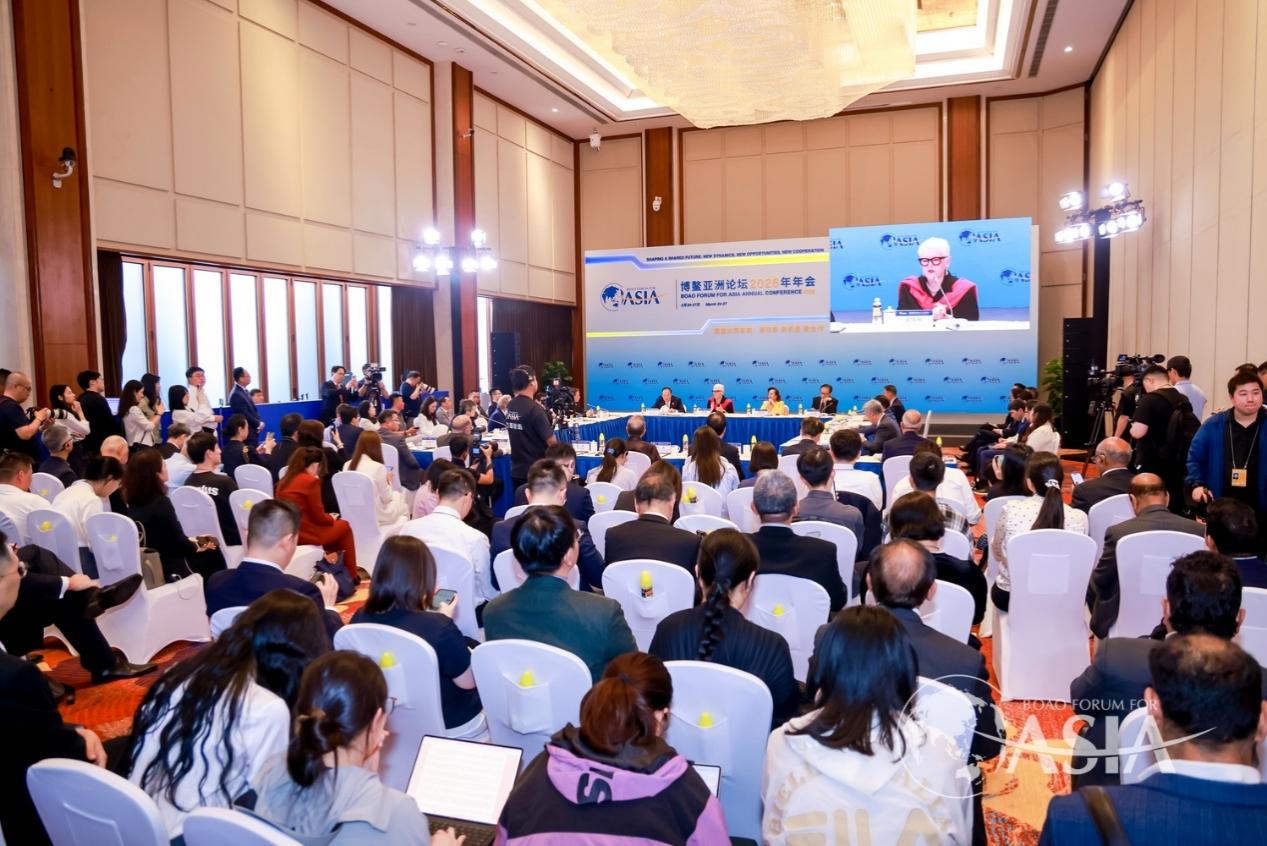
Scene from the "Boao Forum for Asia 25th Anniversary – Review and Prospect" session at the Boao Forum for Asia 2026 Annual Conference in Boao, south China's Hainan Province. (Photo provided by the Boao Forum for Asia)

Tel:86-10-65363107, 86-10-65368220, 86-10-65363106
 Scan the QR Code
 Follow Us