





- BRNN
- BRI News
- BRNN News
- Database
Official Documents Polices and Regulations
Inter-government Documents International Cooperation BRI Countries
Business Guide Economic Data BRI Data
Trade
Investment Projects Latest projects
Cases - Content Pool
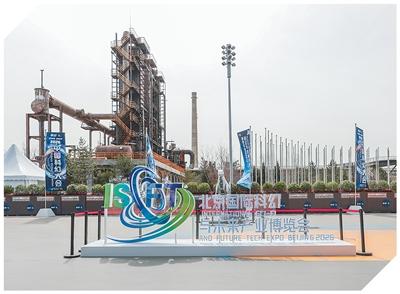
Photo shows a view of the venue of the International Sci-Fi and Future Tech Expo Beijing 2026. (People's Daily/Zhang Wujun)
The 2026 China Science Fiction Convention, held from March 27 to 29 in Shougang Park in Beijing's Shijingshan district, showcased the latest achievements of China's science fiction industry, from robots performing a lion dance to holographic light shows and multi-dimensional haptic robotic hands.
Co-hosted by the China Association for Science and Technology (CAST) and the Beijing Municipal Government, the convention was held alongside the International Sci-Fi and Future Tech Expo Beijing 2026 and the 2026 Beijing Science Fiction Carnival.
Now in its 10th edition, the convention has grown into a platform where the sci-fi industry meets the broader economy, and where science and technology intersect with the humanities, reflecting China's efforts to develop its science, technology and cultural sectors.
As technology advances, sci-fi is finding increasingly diverse real-world applications, from digital exhibitions in museums and virtual reality experiences at trade shows to immersive performances in theaters.
"Science fiction is rapidly moving beyond books and screens, weaving itself into consumers' everyday lives in diverse forms and evolving into a tangible, experience-driven industry," said Pang Xiaodong, Party secretary of the China Research Institute for Science Popularization.
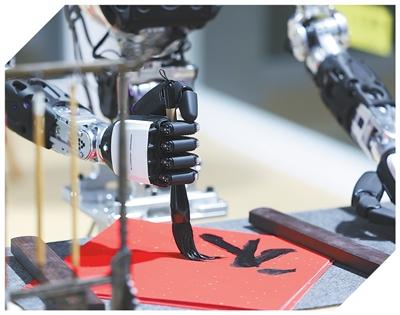
A humanoid robot demonstrates Chinese calligraphy with a brush. (People's Daily/Zhang Wujun)
Shijingshan district, home to a sci-fi industry cluster, is helping turn sci-fi concepts into reality, said Zhao Churan, an official with the Management Committee of Shijingshan Park of Zhongguancun Science Park.
Leveraging its status as a pilot zone, the district is building an AI-powered cultural block where cutting-edge technology is no longer confined to the laboratory but embedded in real-world settings, from smart interactive street installations to immersive consumer experiences.
Over the past decade, China's sci-fi sector has grown from a niche market into a mainstream trend, and the industry is steadily entering a new stage of high-quality development, Pang said.
The total revenue of China's sci-fi industry reached 126.1 billion yuan ($18.31 billion) in 2025, up 15.7 percent year on year, according to the 2026 China Science Fiction Industry Report. The sector now spans a broad portfolio, including literature, films and TV shows, games, derivative products and themed tourism.
Ren Haihong, deputy director of CAST's science popularization department, noted that the total revenue of China's sci-fi industry has exceeded 100 billion yuan for three consecutive years, with growth potential still being tapped.

A visitor experiences virtual reality racing while wearing a VR headset. (Photo/Li Wenming)
Shijingshan district has expanded its role from hosting the China Science Fiction Convention to serving as a hub for the sci-fi industry. "We were the first to explore a full-chain development model," Zhao said. To date, the district has attracted more than 300 sci-fi and related technology companies.
At the convention's opening ceremony, Yu Junqing, a member of CAST's leading Party members group, noted that since its inaugural edition in 2016, the convention has seen the creation of more than 10,000 sci-fi works spanning literature, films, TV shows and games, as well as the emergence of over 100,000 professionals in the field, including technologists, writers and entrepreneurs. Cumulative participation in the convention and its affiliated activities has surpassed 100 million.
China's sci-fi industry is also gaining global momentum. In 2025, search volumes for Chinese science fiction surged 203.3 percent year on year, and overseas audiences for major Chinese sci-fi properties continued to grow.

Tel:86-10-65363107, 86-10-65368220, 86-10-65363106
 Scan the QR Code
 Follow Us