Medical robots facilitate Beijing Anzhen Hospital's smart transformation
In China, medical robots are shifting from isolated applications to comprehensive integration across surgical procedures, drug dispensing, instrument packaging, logistics and more, accelerating hospitals' smart transformation.
More than 20 types of robots are already in operation at the Tongzhou branch of Beijing Anzhen Hospital, affiliated with Capital Medical University and designated as Beijing's first demonstration unit for "robots plus medical" applications.
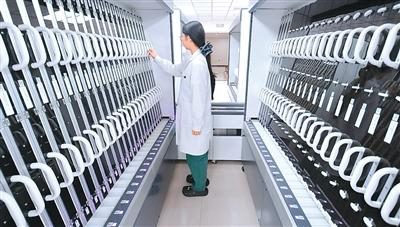
A medical worker inspects an injection solution dispensing robot at the Tongzhou branch of Beijing Anzhen Hospital in Beijing. (Xinhua/Li Xin)
Inside the outpatient building at the Tongzhou branch sits a smart pharmacy with rows of metal shelving fitted with QR codes. More than 1,350 standardized bins — each bearing a traceable barcode — can hold close to 100,000 boxes of medication, far exceeding the space efficiency of a conventional pharmacy. Four dispensing robots, two large warehouse robots and four smaller transport robots glide smoothly between the racks.
"These 10 domestically made robots work in concert around the clock, performing the full pharmacy workflow — from drug intake and storage to restocking and dispensing," said Lin Yang, director of the hospital's pharmacy department. "Labor costs in the pharmacy have fallen by one-third compared with the traditional model."
Thanks to these robots, 95 percent of patients who check in via a self-service kiosk or smartphone app can collect their prescriptions within five minutes, dramatically reducing wait times.
The Tongzhou branch's inpatient pharmacy has undergone an equally impressive overhaul. The country's first integrated intelligent dispensing machine of its kind can prepare a discharged patient's take-home medications in as little as four to 10 seconds. Staff then scan traceability codes to verify and record each order. An injection solution dispensing robot can handle complex orders that mix full vials with partial doses, automatically processing each as needed.
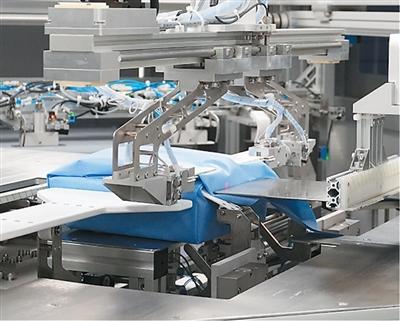
An automated packaging robot packages surgical instruments at the sterilization and supply center of the Tongzhou branch of Beijing Anzhen Hospital in Beijing. (People's Daily Overseas Edition/Chen Jingwen)
An intelligent intravenous drug compounding robot uses three coordinated arms to carry out labeling, drug retrieval, needle selection, sterilization and mixing. At peak output, the system can stably compound 180 doses per hour — more than twice the manual rate, according to Lin.
Surgical robots, meanwhile, are extending the reach of medical services and opening up new possibilities for telemedicine.
A domestically developed surgical robot for percutaneous coronary intervention is positioned alongside the operating table, assisting in procedures for patients. Surgical assistants and nurses remain on hand to supply consumables and monitor patients, while the lead surgeon — working from an adjacent control room — directs the robot's mechanical arm using joysticks and push rods.
Zeng Yong, executive director of Beijing Anzhen Hospital's coronary heart disease center, said the robot's core components include a high-precision mechanical arm, a force-feedback sensor system and a master-slave control chip. Dozens of completed clinical cases have shown the robot-assisted procedure to be safe and effective, with patients recovering normally.
Zeng envisions a future in which specialists in Beijing, Shanghai, Guangzhou and Shenzhen can perform surgeries remotely on patients in county hospitals, remote mountain areas or on islands. The key requirement, he said, is that the local facility has the necessary hardware, communications infrastructure and on-site medical staff. This, he said, could significantly help address the uneven distribution of medical resources across the country.
At the Tongzhou branch's sterilization and supply center, robots have taken over the packaging and transfer of surgical instruments — scissors, hemostatic forceps, tweezers and more. The robots take over after the items have been cleaned, automatically sorted and manually inspected.
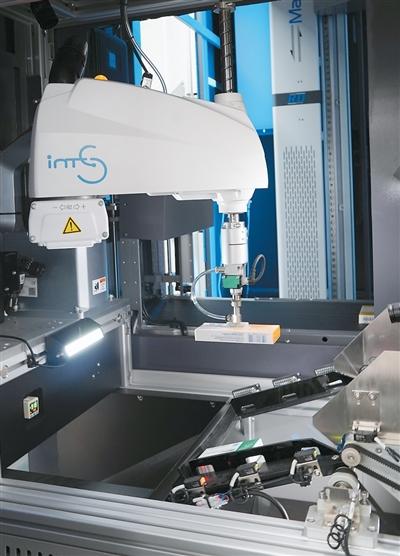
A medication-sorting robot operates in the pharmacy of the Tongzhou branch of Beijing Anzhen Hospital in Beijing. (People's Daily Overseas Edition/Chen Jingwen)
Wang Jin, head nurse of the center, said an automated packaging robot runs continuously around the clock, packaging 200 to 300 instrument sets each day. The robot does the work of four to six staff members, she said.
In both the contaminated and clean zones, two automated guided vehicles apiece shuttle back and forth, delivering instruments to designated locations on command.
"They replace traditional manual carts and minimize direct human contact, which helps reduce the risk of cross-contamination," Wang said.
Guo Yanhong, deputy head of the National Health Commission, noted that during the 14th Five-Year Plan period (2021–2025), China's homegrown innovations in surgical robots and other medical devices enhanced diagnostic and treatment precision while reducing patient trauma. These advances, she said, have supported the high-quality development of the country's health sector.

 Follow Us
 Scan the QR Code
