





- BRNN
- BRI News
- BRNN News
- Database
Official Documents Polices and Regulations
Inter-government Documents International Cooperation BRI Countries
Business Guide Economic Data BRI Data
Trade
Investment Projects Latest projects
Cases - Content Pool
China's "guzi" economy, centered on merchandise inspired by anime, gaming and other pop culture elements, is rapidly moving from a niche circle into the mainstream, becoming a new trend in cultural consumption.
From collectibles tied to intellectual properties to trendy items like badges and figure display stands, the booming guzi economy not only reflects the evolving consumer preferences of younger generations but also highlights a new trend of diversified cultural consumption in China.
The country's guzi economy reached 168.9 billion yuan ($24.5 billion) in 2024, up 40.63 percent year on year, and is projected to exceed 300 billion yuan by 2029.
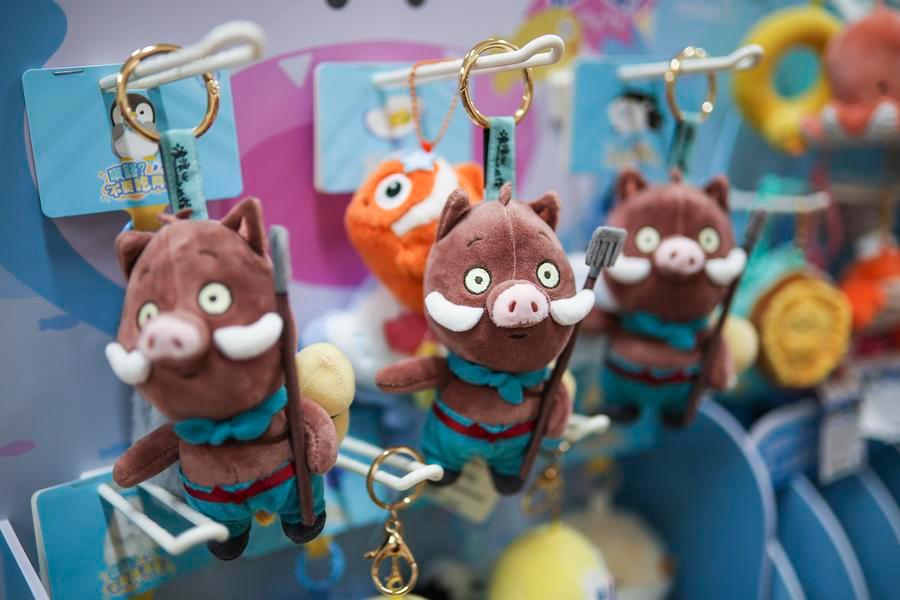
Bag charms as part of the merchandise of Chinese animation movie "Nobody" are pictured at a toy factory in Dongguan, south China's Guangdong Province, Aug. 11, 2025. (Photo by Zheng Jiaxiong/Xinhua)
"Products like guzi should not be seen merely as imported goods, and the guzi economy can't be reduced to just emotion-driven consumption by young people," said Lin Wei, a professor at Zhejiang University. "The practice of purchasing cultural products based on cultural elements and community engagement is a long-established habit in China."
The rise of homegrown IPs is transforming the guzi market. In recent years, merchandise linked to Chinese anime and games has seen consistent growth in sales, with more domestic guzi products now taking center stage in stores.
"A growing sense of cultural confidence is the key driver behind the popularity of guzi products," said Liu Yaqiong, an associate professor at the Central University of Finance and Economics. She noted that turning cultural affinity into actual spending requires continued efforts in strengthening IP content and improving supply chains.
In the past two years, several places, including Beijing, Shenzhen, Shanghai and Sichuan Province, have introduced policies to support the sector.
Beijing's Dongcheng district, for example, has proposed boosting the guzi economy by supporting derivatives from anime and film IPs and immersive consumer experiences, with subsidies covering up to 30 percent of project investment, capped at 3 million yuan.
Shenzhen has made the development of the guzi economy a priority in its government work report, while Sichuan has, for the first time, included it in a provincial policy document, encouraging well-known IPs to expand into trendy merchandise such as designer toys and digital collectibles.
The policy signals indicate that the guzi economy is now recognized as a major driver of emerging consumption trends, a key platform for promoting Chinese culture, and an important growth area for cultural trade. With policy support, domestically developed guzi products are set to shift from one-off viral successes to sustainable, long-term growth.
Leading companies are already offering useful examples. In 2025, Yuewen Group's IP merchandise business recorded over 1.1 billion yuan in gross merchandise value, more than double its 2024 figure. Yuewen Group is a pioneer in China's online literature market.
According to Hou Ding, general manager of Yuewen Group's IP derivatives business, the company has built a comprehensive ecosystem covering diversified IP development, a full range of product categories, and integrated online and offline operations, and will continue exploring new product lines.
Liu called for more targeted support in areas such as overseas IP promotion, international exhibitions, and cross-border e-commerce to help domestically developed guzi products reach global markets and share Chinese culture with the world.

Tel:86-10-65363107, 86-10-65368220, 86-10-65363106
 Scan the QR Code
 Follow Us