





- BRNN
- BRI News
- BRNN News
- Database
Official Documents Polices and Regulations
Inter-government Documents International Cooperation BRI Countries
Business Guide Economic Data BRI Data
Trade
Investment Projects Latest projects
Cases - Content Pool
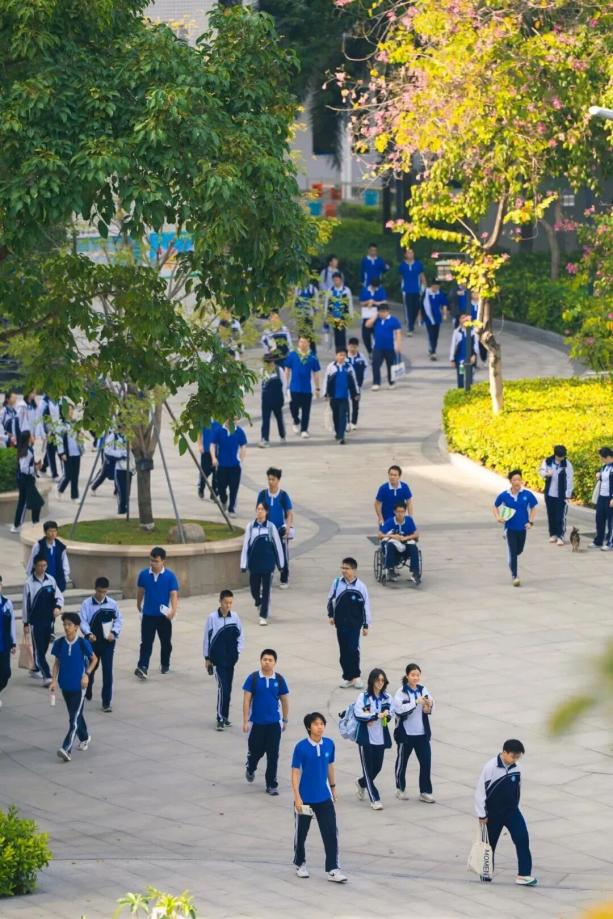
Photo shows students of Shenzhen Bao'an Middle School. (Photo/Liu He)
A persistent bird call at a middle school in Shenzhen, Guangdong province, recently sparked a widely discussed life lesson, transforming a student's frustration into an opportunity to learn about nature and coexistence.
The situation began when students at Shenzhen Bao'an Middle School preparing for exams were disturbed by the loud, frequent calls of an Asian koel, a native bird perched outside their classroom window. One student, Le Zongyan, anonymously left a handwritten letter on principal Yuan Weixing's desk. The letter candidly explained the disruption to their studies and suggested removing the bird's nest.
Yuan, whose open-door policy encourages students to share their thoughts directly or leave notes, was impressed by the letter's sincerity and rational tone. Recognizing the students' understandable desire for a quiet study environment, he chose not to give a simple answer. Instead, he penned a thoughtful public response shared via his social media channel.
In his letter, Yuan acknowledged the pressures students face. He gently explained that the birds sing at dusk instinctively -- for mating, marking territory, and communication -- and cannot adjust their natural rhythms for human schedules. He encouraged students to reframe the sound: perhaps as natural "white noise" or even a "twilight serenade" offered by the birds.
"The world does not exist for any one individual alone," Yuan wrote. "Learning to coexist with all living things is a required lesson in growing up. The ultimate goal of education is not to make the world adapt to us, but to help us learn how to live with the world."
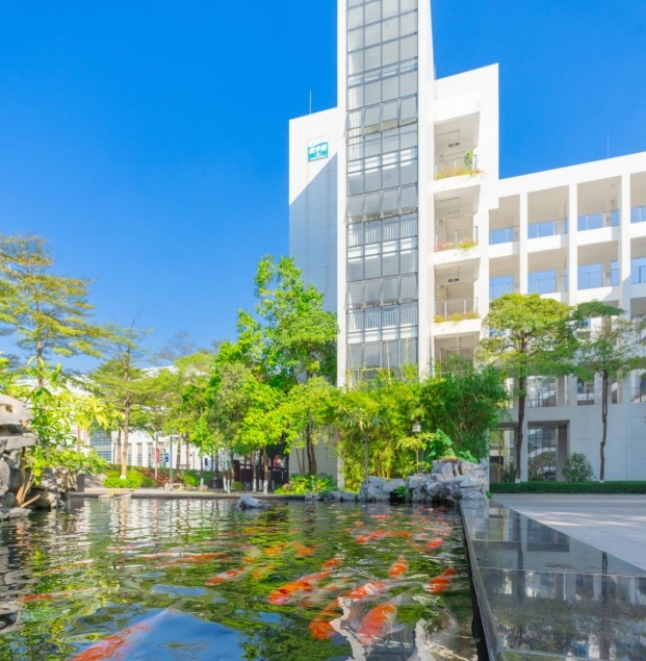
Photo shows Shenzhen Bao'an Middle School. (Photo provided by Shenzhen Bao'an Middle School)
The principal's warm and insightful reply quickly gained widespread online praise, hailed by many as "exemplary education." Le Zongyan later responded, stating that the principal's words had become "a life education lesson," emphasizing the importance of harmony with others and nature.
Recognizing this as a broader educational opportunity, Yuan noted, "Simply driving the bird away wouldn't be appropriate, but doing nothing wasn't an option either." The school subsequently invited ecological experts to conduct science sessions on campus and organized student representatives to collaboratively discuss practical solutions, turning an isolated complaint into an ongoing journey of learning about respect and coexistence.
Experts clarified that the bird, colloquially termed the "noisy cuckoo" by students but scientifically known as the Asian koel, becomes especially vocal during its March and April breeding season. Male birds call persistently to attract mates. While their calls can reach 60 to 80 decibels at close proximity, the birds' activity is sporadic, and their locations shift.
To reduce disruption, the school provided earplugs to students in dormitories near wooded areas. At the same time, artificial nests were installed to guide the birds toward a designated "life garden" recreational zone, away from classrooms and dorm buildings.
In fact, such life education has long been part of the school's routine practice. When ducks in the campus pond began eating lotus plants, students formed a "campus duck management committee" to address the issue. During typhoons, the principal writes letters encouraging students to respect nature and appreciate resilience. A student-run "campus cat club" also cares for stray cats on school grounds.
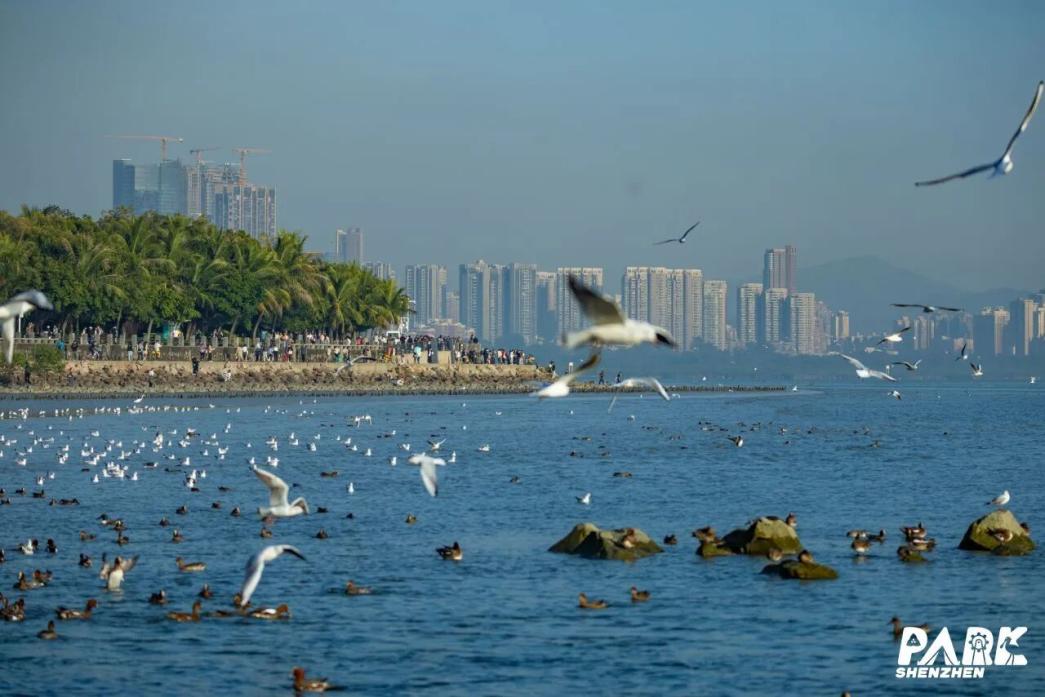
Birds fly at Shenzhen Bay Park. (Photo from the official account of the center for public education and development research under the Shenzhen urban management bureau on WeChat)
According to Liu Yang, a professor at the School of Ecology of Sun Yat-sen University, true civilization is not about conquering nature, but about balancing development with ecological protection. This lesson at the Bao'an middle school planted seeds of ecological awareness in students' minds, making harmony between humans and nature a living reality on campus, Liu said.
The story also reflects Shenzhen's broader efforts to promote ecological conservation.
To protect more than 100,000 migratory birds wintering in the city from November to March, Shenzhen Bay Park has chosen not to install high-intensity lighting, preserving natural darkness. Futian Mangrove Ecological Park has introduced specially designed "bird-friendly streetlights" to provide safe nesting spaces. Some high-rise buildings have added dotted patterns to glass facades to prevent bird collisions.
Survey data show that Shenzhen is home to over 450 species of wild birds, accounting for about 1/3 of China's total. From 2021 to 2025, monthly counts of migratory birds on the Shenzhen side have remained at around 40,000, reflecting the city's ongoing commitment to ecological protection.

Tel:86-10-65363107, 86-10-65368220, 86-10-65363106
 Scan the QR Code
 Follow Us