





- BRNN
- BRI News
- BRNN News
- Database
Official Documents Polices and Regulations
Inter-government Documents International Cooperation BRI Countries
Business Guide Economic Data BRI Data
Trade
Investment Projects Latest projects
Cases - Content Pool
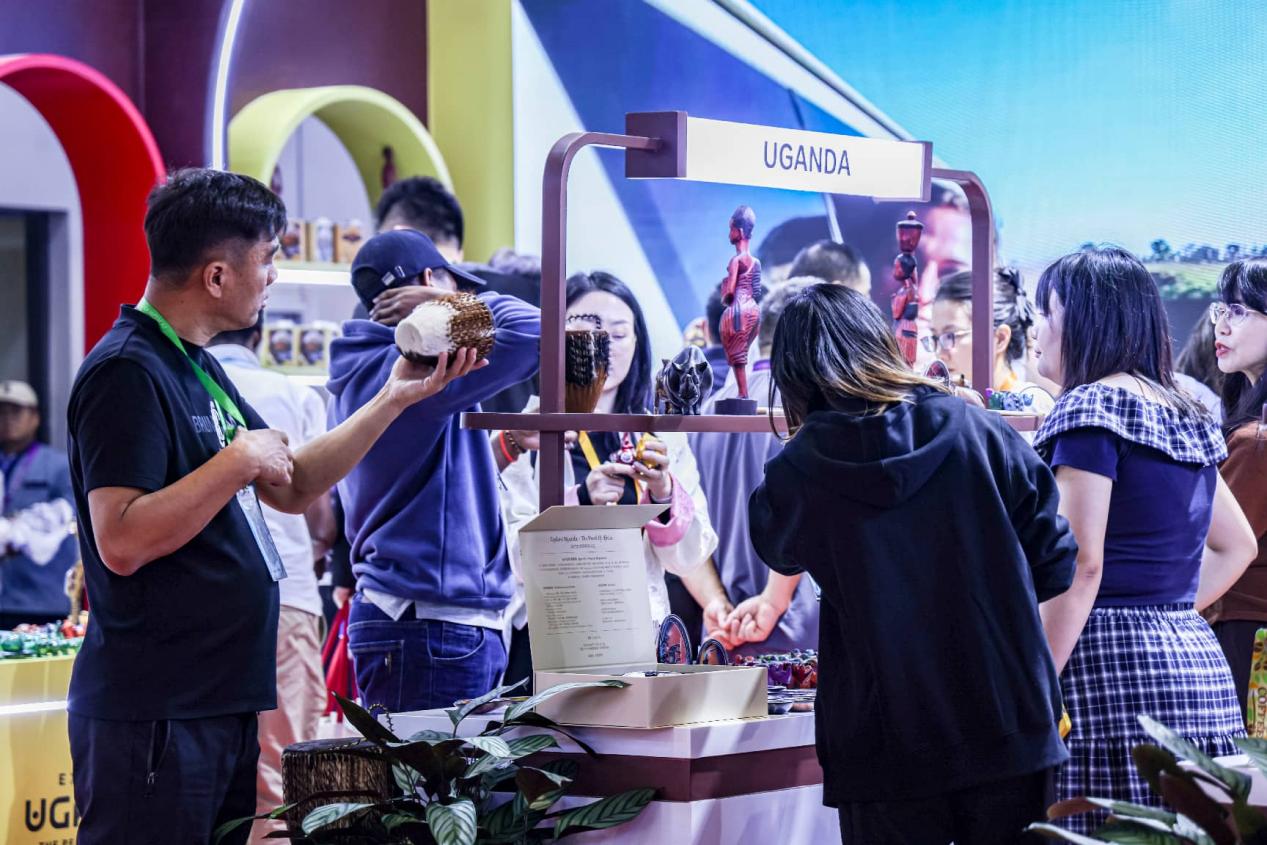
Photo taken on Nov. 6, 2025 shows the Ugandan Pavilion in the National Exhibition Hall of the 8th China International Import Expo. (Photo/Wang Chu)
At the 14th WTO Ministerial Conference recently held in Cameroon, tariffs and market access once again became focal issues. During the meeting, trade ministers from African countries widely praised China's zero-tariff policy for Africa, noting that it will help advance the continent's industrialization.
In February this year, China announced that it will fully implement zero-tariff treatment on 100 percent of tariff lines for products from 53 African countries with which it has diplomatic relations. While African nations widely welcomed the move, some in the West reacted with alarm, falsely labeling it as "economic penetration" and claiming it would "disrupt global trade balance."
Why does this tariff-eliminating policy generate such concern?
First, this initiative lays bare the hypocrisy of some Western countries that engage in "fake aid, genuine exploitation".
Whether zero tariffs are beneficial is best judged by Africa itself. As one African scholar aptly observed, this is not merely a change in tariff rates, but a more stable and predictable destination for African exports. Historically, Africa has faced the paradox of possessing quality products while struggling to access global markets. Challenges including volatile export channels, steep market-entry barriers, and infrastructure limitations have prevented many distinctive African goods from sustainable participation in global trade.
China's zero-tariff policy aims precisely to unblock these channels and lower these barriers, enabling Africa's competitive products to gain a foothold in international markets. For Africa, access to China's 1.4 billion consumers -- with their growing purchasing power -- promises not only stable revenue but also industrial upgrading opportunities, increased foreign investment, and modernization pathways.
In short, it represents using the subtraction of tariffs to drive the addition of trade and achieve the multiplication of livelihoods.
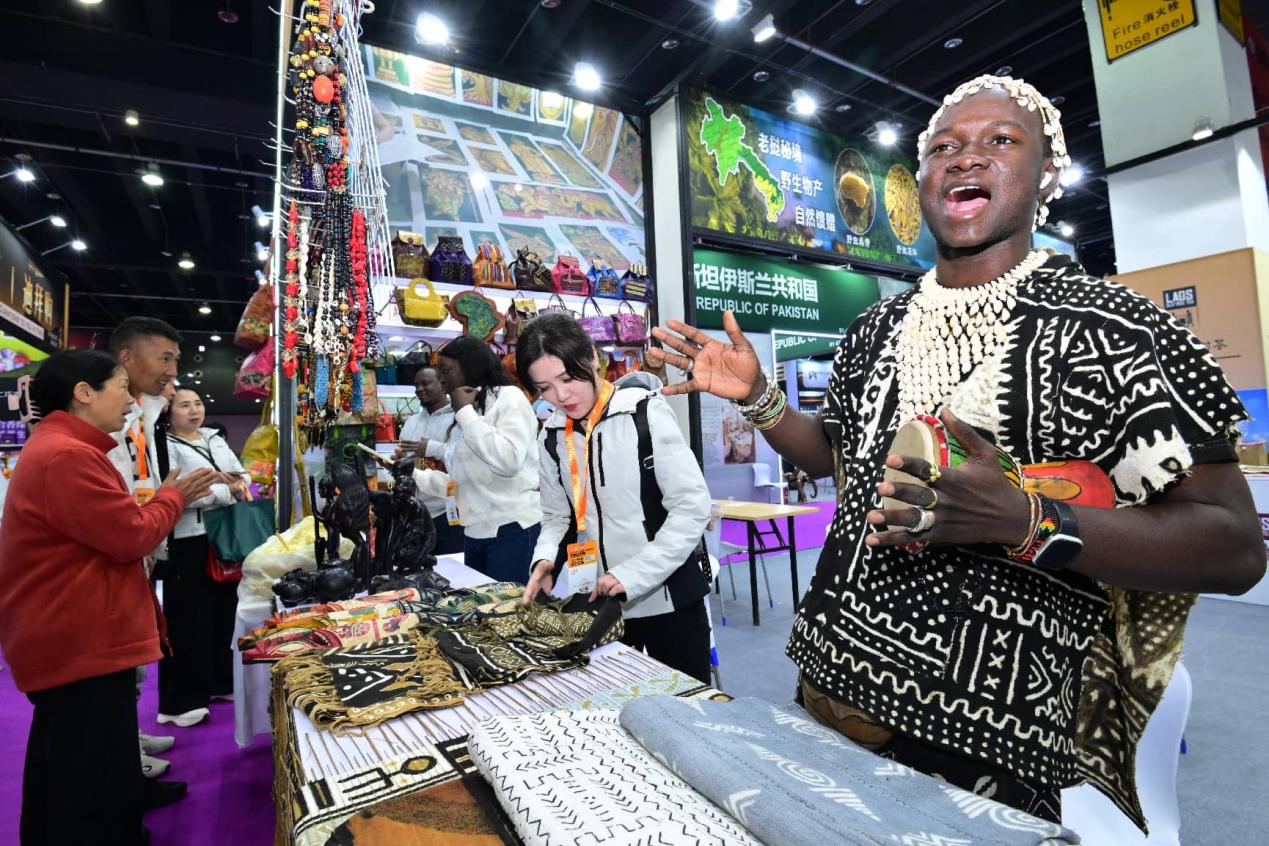
A Ghanaian exhibitor promotes handicrafts from Ghana at the China Yiwu International Commodities Fair -- Import Goods Exhibition held in Yiwu, east China's Zhejiang province, Nov. 13, 2025. (Photo/Lyu Bin)
Some African scholars describe the zero-tariff policy as a "structural opportunity," not a short-term dividend, but a long-term pathway.
One can envision a virtuous cycle: as more African coffee, nuts, and fruits enter the Chinese market, foreign exchange earnings will grow, which can then be transformed into agricultural machinery, photovoltaic power stations, and processing lines, precisely the kind of endogenous development capacity Africa needs for industrialization.
Second, the policy reveals fundamentally different trade philosophies. China operates with an "incremental mindset": expanded channels create new opportunities; cooperation grows markets. Conversely, some Western perspectives reflect a "zero-sum mindset": finite opportunities mean one party's gain implies another's loss. Yet trade isn't inherently zero-sum -- collaboration can enlarge the global economic pie rather than redistribute fixed portions.
Recent global trade conditions have proven challenging. Unilateral tariffs imposed by certain developed nations have increased uncertainty for developing economies, with some African exports facing duties exceeding 30%. In this context, African nations naturally seek reliable partners.
Certain Western narratives mistakenly frame "cooperation" as "alignment" and "market access" as "influence expansion," overlooking a crucial reality: African nations are active decision-makers, not passive recipients.
At a time when some countries are raising tariffs and building barriers, China is genuinely lowering them. This, in itself, is a powerful response to the tide of protectionism.
Who is paving the way for Africa's development, and who is obstructing global trade? African people know the answer, and the world can see it clearly.

Tel:86-10-65363107, 86-10-65368220, 86-10-65363106
 Scan the QR Code
 Follow Us